Does Nvidia Have Another 10x Run In It? Trefis Team Tue, November 17, 2026 at 12:21 PM EST 8 min read NVDA -1.29% MSFT -3.17% AMZN -0.51% GOOG -0.80% META -0.91% Explore stocks on Coinbase Trading disclosure Trading disclosure The above button links to Coinbase. Yahoo Finance is not a broker-dealer or investment adviser and does not offer securities or cryptocurrencies for sale or facilitate trading. Coinbase pays us for certain activity generated through this link. Prices displayed are informational.
Today's big story: Could Nvidia Stock Fall 50%? Follow The Cash
Picture a Friday night a few years from now. On your way to dinner, you ask Claude, ChatGPT or Gemini for a movie: part James Bond, part Shawshank Redemption, starring you and your partner, ready when you get home. Or you ask for a 15-minute video that fixes your squash backhand. If people start asking for things like that, every request will run on a lot of chips. Today many of those chips are Nvidia's.
That is the case for another 10x. Below is the record of Nvidia's last four 10x runs, what a fifth would take, who would pay for it, and how to own it without being wrecked by the falls on the way. The stock closed Monday at $156.14, down 4.1% on the day and 35% below its October high. Nvidia reports third-quarter results after the close today.
Yes, four times since 2004, and never without pain. Each run starts at the lowest close after the previous run ended. It ends on the first day the stock was worth 10 times as much.
Source: Trefis, prices through Nov 16, adjusted for splits and dividends.
Over 10 years, a 10x has been normal for Nvidia. It rose 10x or more in 63% of all 10-year stretches since 2003, and 69x over the latest 10 years. Over 5 years it was less common: only 37% of 5-year stretches made it. Three of the four runs also had to get through a fall as deep as today's 35%.
If runs like these made Nvidia a big part of your wealth, its 35% fall has cost you real money. Our partner advisory firm offers a free 30-minute strategy review, with an exit plan, a floor under losses and a lower-tax way out. Book a free review.
Analysts expect Nvidia's sales to reach $1.2 trillion in the year to January 2031. That is four times the $303 billion of the last four quarters. It needs about 36% growth a year for four and a half years. That is ambitious, but slower than the record. Sales grew 83% in the last year, and 11-fold in the three and a half years since the four quarters to January 2023.
Who would pay? Microsoft, Amazon, Alphabet and Meta put $615 billion into capital spending over their last four quarters. That is already 91% of their operating cash. Nvidia's yearly sales equal 49% of that spending. Suppose their operating cash keeps growing 26% a year, as it did last year, and they keep spending 91% of it. If Nvidia's sales stay at the same 49% of that spending, they would reach about $825 billion in the year to January 2031. To reach $1.2 trillion, the other $385 billion would have to come from buyers growing faster than those four: other clouds, governments, companies building their own AI, and AI labs spending what they raise.
What would it earn? Over the last four quarters, Nvidia kept 64% of its sales as profit, up from 55% two years earlier. But it turned only 42% of its sales into free cash, and just 22% in the quarter to July. Analysts' 2031 numbers assume a 67% profit margin, about $806 billion at today's share count. That is four times today's $193 billion. At last year's cash rate, $1.2 trillion of sales would bring about $508 billion of free cash, against $127 billion now.
Here is what Nvidia could be worth in January 2031 in four cases, from cash lagging to another 10x.
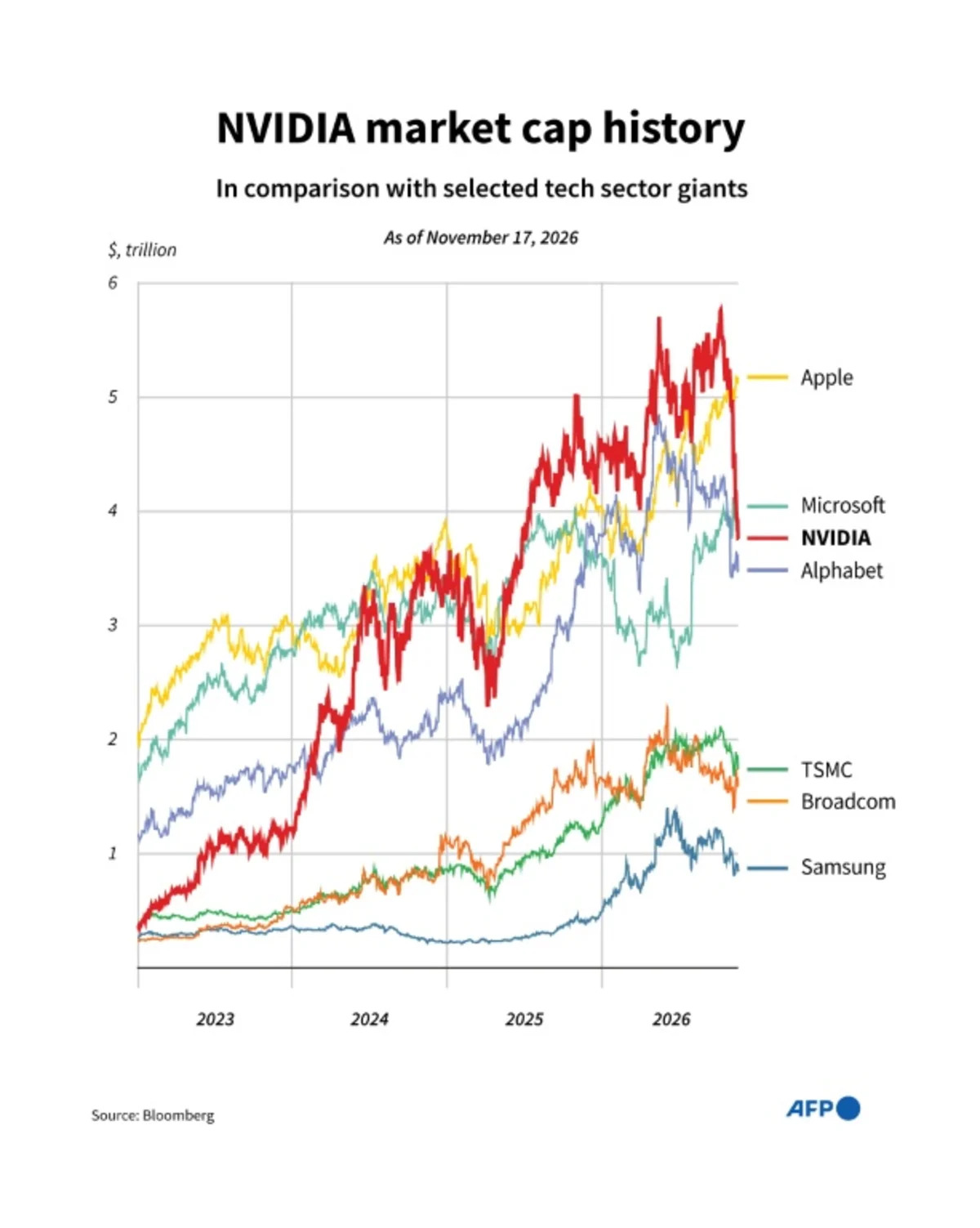
Source: Trefis. At Monday's close, Nvidia was worth $3.79 trillion, about 20 times its profit. Since 2014 it has traded between 18 and 243 times profit at month ends, 48 at the median.
So the analysts' profit path, at 20 to 30 times profit, would give about a 4x to 6x by 2031. A 10x needs one of two things. Investors could pay 47 times profit for a $1.2 trillion business. That is about Nvidia's own median since 2014, but untested for a company that size. Or sales could reach about $2.9 trillion at 20 times profit. If AI stays mostly text and chat, the forecasts may be about right. If AI moves into films, tutors and agents made on request, today's forecasts may prove too low.
Training isn't done. Today's video models mostly make short clips. A two-hour film starring you, consistent from scene to scene, needs models that haven't been trained yet. So does a squash lesson built from your own swing. In our view, training is Nvidia's stronghold, with flexible chips and the software developers already use. More training would be upside.
Making each movie is a different job. Once a model exists, every request is inference: the same work, repeated millions of times. Here the cost per request decides the winner, and Nvidia has real rivals. Google runs much of its AI on its own chips, designed with partners including Broadcom. Broadcom's sales grew 49% to $89 billion over the last four quarters, and AMD's grew 42% to $45 billion. How Nvidia plans to keep this work is in Nvidia's Inference Power Play. The risk case is in How Broadcom Ends Nvidia's GPU Monopoly.
On your phone, Nvidia isn't the leader. Apple designs its own chips, and MediaTek and Qualcomm make most of the rest. Nvidia's personal AI computers, such as DGX Spark, are desktop machines for developers. A feature film will probably be too heavy for a phone for years, so the movie case likely runs in the cloud. But simpler AI that moves onto phones is sales Nvidia may not get.
Follow the money to you. Microsoft, Amazon, Alphabet and Meta took in $1.86 trillion of revenue over their last four quarters, up 19%. They earned $504 billion of operating profit. They already put more than that, $615 billion, into capital spending. Say $1.2 trillion of Nvidia chips a year wears out over five years. Then the buyers need roughly $1.2 trillion a year of new AI revenue just to cover the chips, before power, buildings and people. That is $100 a month from each of a billion people. It is about 24 times what Netflix took in over the last year, $50 billion.
What else needs to be true for $1.2 trillion of sales:
Businesses pay for AI that does work, not just consumers for fun. Agents that replace hours of paid labor are likely the bigger pool.
The cost of each video falls far enough for a $10 movie night to make money.
Nvidia keeps most of the inference work as custom chips get cheaper.
The buyers' cash keeps up. Today Nvidia's own cash lags its profit, the case in today's big story.
Our read: new kinds of AI, like films and tutors, are upside for Nvidia's training business. The move to cheap, high-volume inference is where its share is most at risk. The 10x case needs Nvidia to win both.
In every 10x run but the fastest, holders were down 44% or more at some point. The gains went to whoever was still holding.
Size it so a 56% fall would hurt but not ruin you. Two of the four runs had a fall that deep. The falls of 2008 and 2022, between runs, went deeper still.
Count the Nvidia you already own through index and tech funds. It may be more than you think.
Decide now what you would add after a 30% fall, not in the middle of one.
Holding on is easier when your portfolio falls less than the market. For every dollar its benchmark lost, the Trefis High Quality (HQ) Portfolio lost about 81 cents on average, holding 30 quality stocks in equal weight.
For education, not a recommendation to buy or sell.
For questions about this article or underlying research, email help@trefis.com.