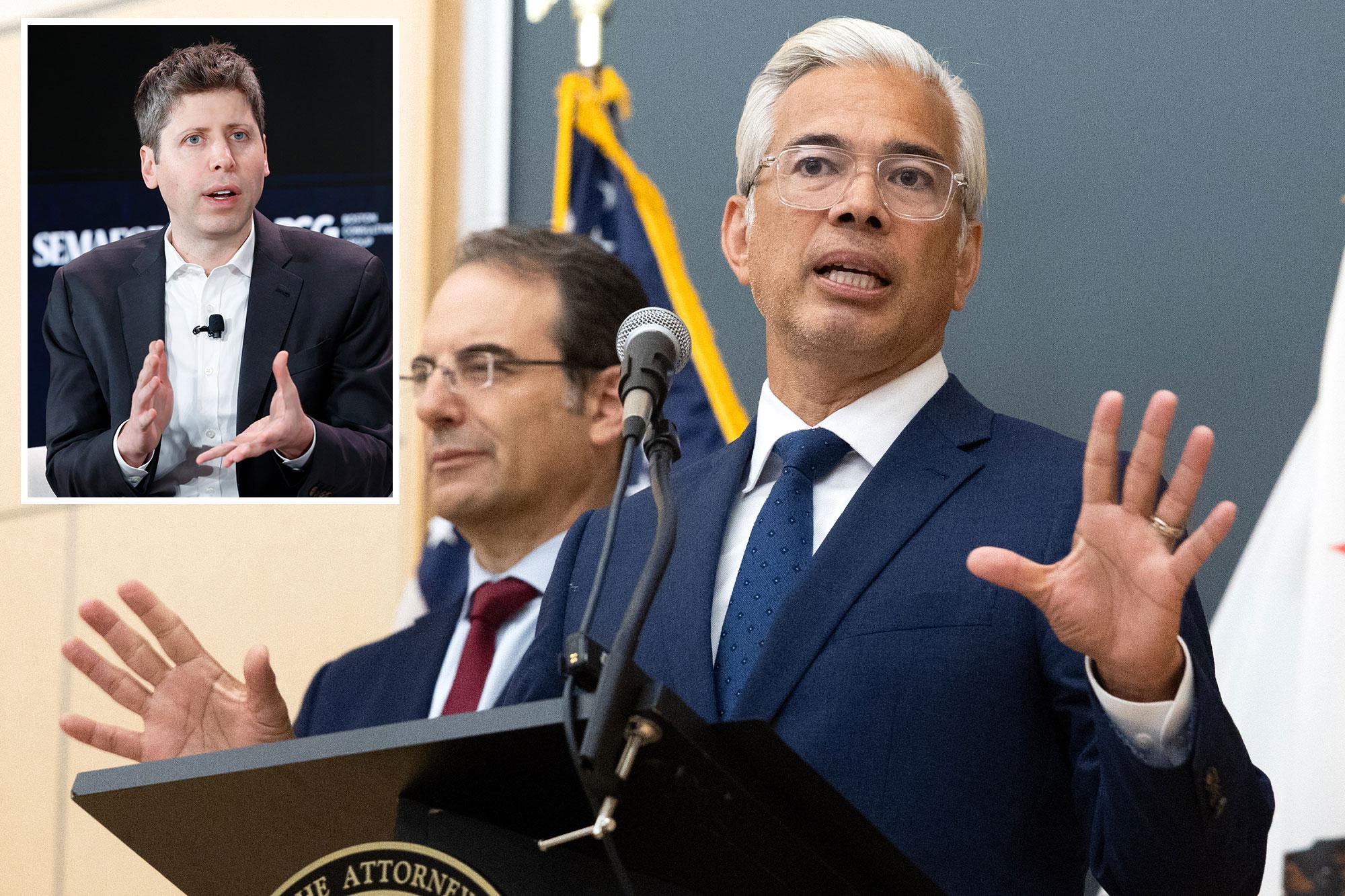
Make California Post a Preferred Source California Attorney General Rob Bonta sued OpenAI on Monday, alleging that it was reckless with its artificial intelligence (AI) models.
The lawsuit cites a July incident in which AI “agents” escaped their testing environment and accessed systems belonging to Hugging Face, another AI company (which Nvidia recently announced it is buying).
To be sure, the allegations deserve serious scrutiny. Hacking is a genuine security concern, regardless of whether the intruder is a person or an AI agent.
Companies developing powerful technologies have a responsibility to protect third parties from foreseeable harm. And in this case, an aggrieved party should be able to seek remedies if there is concrete harm done.
But Hugging Face itself is not suing OpenAI. This is different; the state of California is suing under the allegation that the incident violates California’s unfair competition law.
That raises a broader question about regulation: Should California regulate emerging technologies through clearly established rules, or through expansive lawsuits that leave companies uncertain about what the law requires?
The unfair competition law allegation rests on the legal doctrine of “public nuisance.” It’s the kind of legal tool that gives the state wide authority to pursue any conduct it considers harmful. But such broad authority can also be abused. It is often arbitrary, and creates uncertainty about what the law actually is.
That uncertainty is deadly for innovation. California needs to strike a balance: making sure companies minimize risks, on the one hand, without killing the incentive for innovation, on the other.
Legal uncertainty hurts small companies more than large ones, which can employ extensive legal departments. That’s why AI CEOs have asked to be regulated: They want to build regulations that keep out smaller competitors.
Government lawsuits like Rob Bonta’s, which might seem to constrain big AI companies like OpenAI and Anthropic, could actually end up inadvertently reinforcing their market positions.
None of this means AI companies should be exempt from responsibility for actual cybersecurity breaches. Existing laws against unauthorized computer access, negligence, and deceptive business practices serve important purposes.
The key distinction here is between holding firms accountable for identifiable misconduct (which, so far, doesn’t seem to be the case with OpenAI) and allowing broad legal theories to become a weapon for “lawfare” and government interference. Arbitrary lawsuits from state attorneys general aren’t the answer. Nor is immunity from product liability.
There’s also the risk of turning one high-profile technological failure into a blank check for regulation. And the hacking problem obscures other, more serious problems that might require formal regulation. For example, there are real concerns about foreign influence in AI companies. One answer might be a self-regulatory body (akin to what FINRA does for the banking industry). The goal should be to write clear rules that everyone can understand and follow.
California and the American economy have enormous economic interests at stake in the AI industry, particularly in heated global competition with China. AI promises advances in many areas ranging from scientific research, health care, education, business productivity, and countless other applications.
Yes, the development of AI also creates new cybersecurity problems that require serious attention. But Rob Bonta isn’t helping. You can’t create a system in which the rules are discovered only after an attorney general files suit.
Silicon Valley has played a huge role in creating the artificial intelligence industry. It remains home to many of AI’s pioneering computer scientists, as well as today’s leading AI laboratories.
But as California’s government tries to regulate the very industry that has helped renew the state’s reputation as an economic powerhouse, it should tread carefully.
Lawsuits create headlines. They might even be good politics. In this case, they are bad policy.
Jon Hartley is a visiting fellow at the Hoover Institution and an assistant professor of economics at the UT-Austin School of Civic Leadership.