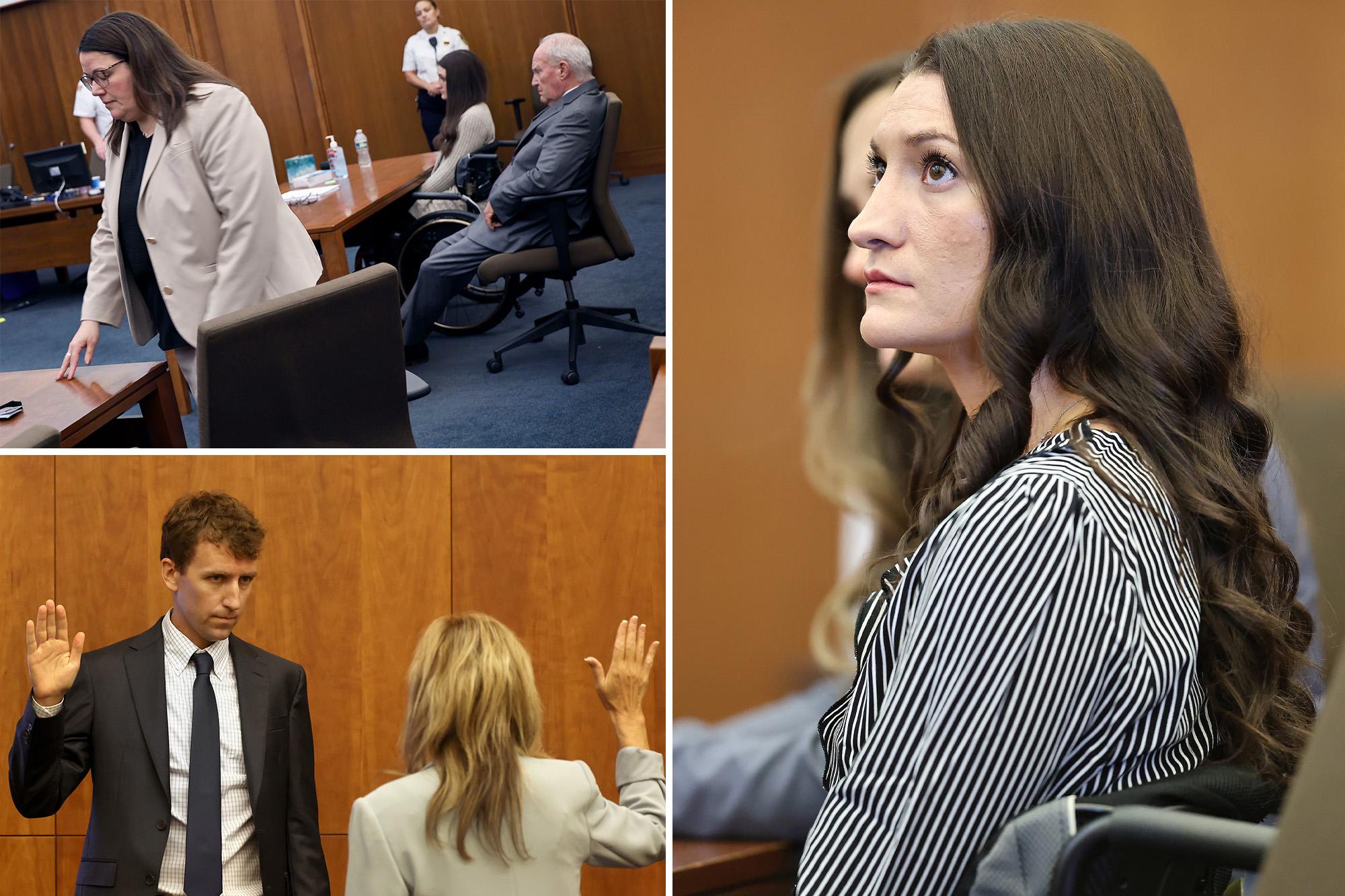
Make New York Post a Preferred Source Lindsay Clancy prosecutors face an uphill battle taking the killer mom’s case in front of a jury again — but legal experts said there is one tactic they should change as they head to a retrial.
Prosecutors should embrace the 36-year-old Duxbury, Massachusetts mom’s mental health arguments to gain credibility with a jury — while maintaining that it’s still not enough to find her not criminally responsible for murdering her three kids, Boston veteran lawyer Brad Bailey told The Post.
“It could have been that some of [the jurors] didn’t like the fact that there wasn’t any initial concession or acknowledgment of what Lindsay Clancy was going through,” Bailey said.
“If at least there is some sort of concession right out of the box, that she was struggling — but it doesn’t, in their opinion, rise to the level of negating criminal responsibility — maybe [prosecutors] feel that they can gain more trust with the jurors.”
Clancy’s lawyer, Kevin Reddington, argued at the first trial that his alleged killer mom client should be found not guilty by reason of insanity because she was in the throes of severe postpartum psychosis and hallucinated a voice commanding her to kill Cora, 5, Dawson, 3, and Callan, 8 months.
Prosecutors claimed at trial that Clancy carefully planned and carried out the Jan. 24, 2023, killings.
After the Sept. 4 mistrial, jurors revealed that 11 of them sided with Clancy’s defense while one holdout wanted to convict her.
At a hearing Monday, prosecutors said they wanted a jury trial, indicating they intended to try Clancy on the same first-degree murder charges from the first go-round.
Judge William Sullivan set the new trial for March 29.
But there isn’t much prosecutors can change at the next trial, Bailey and another seasoned Boston lawyer, Peter Elikann, said.
“It is unlikely that the defense would ever want to change their strategy, which proved so extremely effective,” Elikann said. “To use the old cliche, if it’s not broken, don’t fix it.”
On the other hand, while Plymouth County District Attorney’s office would probably really like to use a different strategy, “it’s not clear how much the prosecution can change because they’ve still got the same set of facts and the same group of witnesses,” Elikann said.
“They might possibly want to streamline the presentation of the prosecution, which got kind of redundant at times,” Elikann said.
Elikann said prosecutors should focus on driving home any evidence showing that Clancy “did premeditate this and that it was a calculated, intentional act.”
Bailey said prosecutors might “refine their approach, refine their strategies and pivot a little bit.”
One way would be trying to get new expert witnesses to discuss Clancy’s mental health in the months leading up to the murders, though they likely wouldn’t have enough time to evaluate her.
“I wasn’t particularly impressed with the experts on which the Commonwealth was relying, but I think at this stage it’s going to be very difficult for them to switch them,” Bailey said.
“They might be able to do that. But on the other hand, there could be negatives if they present people that hadn’t had an opportunity to evaluate Lindsay herself.”