Make New York Post a Preferred Source A passing “minimoon” discovered earlier this year is expected to stay in Earth’s orbit until January 2027, astronomers confirmed.
The space rock, dubbed 2026 QQ8, was first spotted in August by Hungarian researcher Krisztián Sárneczky. An official report from astronomers later confirmed the object is, in fact, a minimoon and is temporarily bound to Earth’s gravitational pull until early next year.
The object was formally logged as a minimoon on Oct. 29 by the International Astronomical Union’s Minor Planet Center, the official organization responsible for tracking and confirming solar system objects.
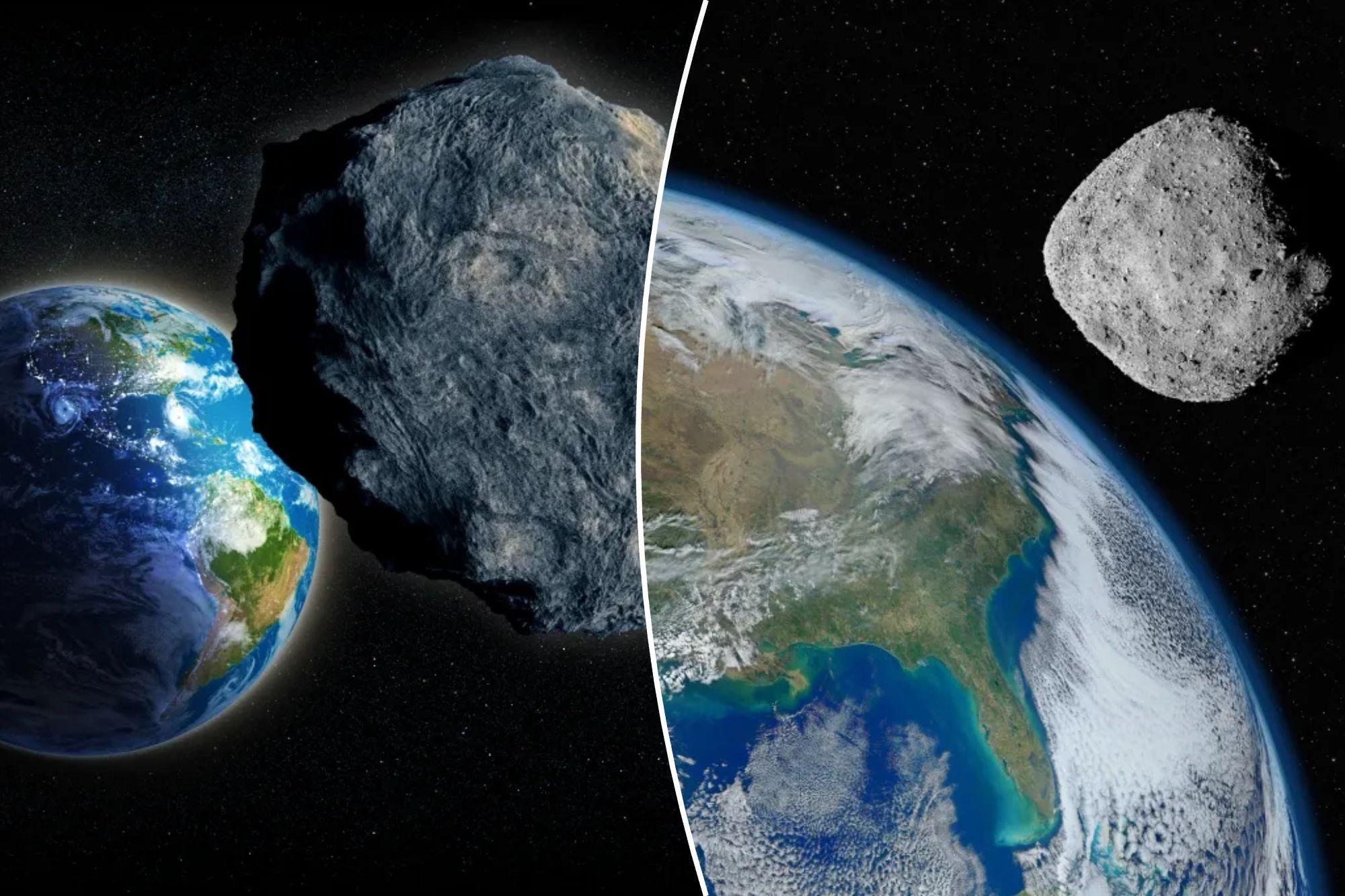
A large asteroid closes in on Earth. Mopic – stock.adobe.com When Sárneczky initially submitted his findings, experts were divided over the object’s true identity.
In a statement, the Minor Planet Center noted that the object’s trajectory suggested it could be either a minimoon or man-made space debris, sparking debate. Harvard astrophysicist Professor Avi Loeb speculated that the object might be a panel left behind from the Apollo 13 moon mission.
However, follow-up observations by Arizona’s Lowell Discovery Telescope and the University of Hawaii’s 2.2-meter telescope confirmed the minimoon is a natural space rock.
Measuring roughly 6 feet in diameter, 2026 QQ8 was first captured by Earth’s gravity in April.
Although a rock that size would burn up if it entered Earth’s atmosphere, scientists say there is no threat of an impact. At its closest approach, 2026 QQ8 will remain roughly 353,000 miles (568,000 km) away — about 1.5 times the distance to the Moon.
The object takes 359 days to complete an orbit around the Sun and approaches Earth about once per decade. It is classified as an Aten asteroid — a type of space rock whose orbit crosses Earth’s path while remaining mostly close to the Sun.
An illustration shows a dangerous asteroid approaching planet Earth. lukszczepanski – stock.adobe.com While larger Aten asteroids can pose serious hazards because they can be hidden by the Sun’s glare, astronomers emphasize that 2026 QQ8 is far too small to cause any harm.
The first confirmed minimoon, 1991 VG, was discovered in November 1991 and measured about 30 feet across. Scientists estimate that Earth usually hosts at least one temporary minimoon at any given time, though most drift away within a year.
Though 2026 QQ8 is too dim for amateur telescopes to spot, researchers worldwide are closely monitoring its orbit to better understand how Earth captures temporary moons.
Advanced observatories like the Vera C. Rubin Observatory in Chile are expected to help discover many more of these objects. By scanning the entire southern sky every few days, the observatory has already detected a potential new dwarf planet and a satellite galaxy of the Milky Way.
Over its 10-year mission, the observatory is projected to discover millions of previously unknown moving objects throughout space.
Under normal circumstances, the asteroid would not enter Earth’s “Hill Sphere” — the boundary zone where Earth’s gravitational force overcomes the gravitational pull of the Sun. However, 2026 QQ8 crossed this gravitational boundary and became temporarily trapped in orbit around Earth.
Research suggests that Earth usually has at least one extra minimoon in its temporary orbit. A minimoon breaks free from Earth’s orbit when a gravitational tug-of-war occurs with the Sun. As the space rock gains enough speed and energy, the Sun’s stronger gravitational pull gradually drags it away, allowing it to return to its regular path orbiting the Sun.
While QQ8 completes its visit, scientists plan to observe it as much as possible to learn more about the process – and what it means for Earth’s safety.