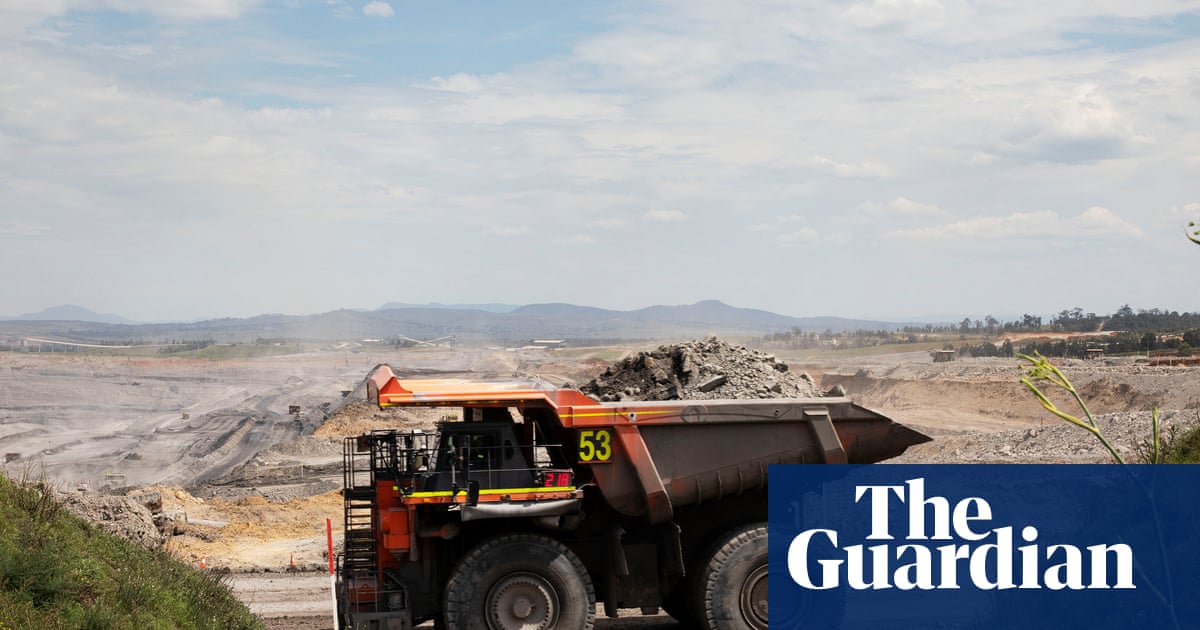
The NSW parliament will this week debate legislation to allow MACH Energy to increase coal production at its Mount Pleasant mine by 32%. Photograph: Jessica Hromas/The GuardianView image in fullscreenThe NSW parliament will this week debate legislation to allow MACH Energy to increase coal production at its Mount Pleasant mine by 32%. Photograph: Jessica Hromas/The GuardianProposed NSW laws to allow coalmine to increase production pose ‘serious corruption risk’Bill to authorise expansion at Mount Pleasant coalmine, subject to a landmark high court decision, will be debated this week
Get our daily political email, free app or daily news podcast
A New South Wales government bill to increase coal production at a Hunter Valley coalmine creates a “serious corruption risk” for the state due to a clause that would give the resources minister “king-like” powers, the barrister and anti-corruption campaigner Geoffrey Watson says.
The state parliament will this week debate legislation to allow MACH Energy to increase coal production at the Mount Pleasant mine in Muswellbrook by 32% to 16.5m tonnes per year.
The Minns government announced the bill last month after the high court ruled that an expansion of the mine was invalidly approved. The government has said the legislation is necessary to prevent 400 job losses at the site before Christmas.
Read moreWatson, the Greens and some members of the crossbench have raised concerns that a clause in the bill would give the resources minister of the day “unusually broad” powers to override other state laws.
Known as a Henry VIII clause, it would allow the minister to make regulations that could modify laws of the state as they apply to the Mount Pleasant development.
Henry VIII provisions are sometimes used by parliaments and draw their name from King Henry VIII and his style of governing by royal proclamation.
Watson is a director of the Centre for Public Integrity and Grata Fund and a former counsel assisting the NSW Independent Commission Against Corruption (Icac).
In a legal analysis of the bill, he raised concerns that Clause 17 “explicitly places” wide powers to “make new laws (or to repeal or modify existing laws) in the hands of one person – the mining minister – and for a single coal mine owner”.
“There are real problems with this as it is known that the concentration of this kind of power in the hands of one person creates a serious corruption risk,” he wrote.
View image in fullscreenGeoffrey Watson says that corruption can include ‘undue influence’ and ‘decisions made in [circumstances] other than the public interest’. Photograph: Dan Peled/AAPHe said the risk was “heightened” because the Mount Pleasant bill had been created for a single private company. He wrote that while he imputed “no bad faith at all to the current mining minister”, past experience in the state “has shown that not all ministers have acted in a manner free from improper motives”.
“Historically, we’ve seen this concentration of power into the hands of a single decision maker as posing a serious risk of corruption,” Watson told Guardian Australia.
“Now, corruption in that sense may not mean money passing hands. It also includes undue influence, decisions made in [circumstances] other than the public interest.”
Elaine Johnson is the director of Johnson Legal, which represented the Denman Aberdeen Muswellbrook Scone Healthy Environment Group (Dams Heg) in the high court proceedings. In a separate legal opinion, she raised similar concerns there was “a very obvious corruption risk arising from Clause 17”.
She wrote that the clause gave the resources minister of the day “unfettered power to make regulations to change the application of any law of the state” to the mine, and said it could potentially affect many laws that applied to the mine, such as those that regulate noise and dust or worker safety.
Sign up for Guardian Australia’s Politics, really newsletter here
The lower house is expected to debate the legislation on Tuesday, followed by the upper house later this week. The Minns government is hoping to pass the bill in what is likely to be the final sitting week before the March 2027 election.
Both Labor and Coalition lower house seats are under pressure from One Nation in the Hunter, where the mine is located.
One Nation’s NSW leader and candidate for Cessnock, Mike Newman, has described the Minns government’s bill to increase production limits at Mount Pleasant as a “Band-Aid on a bullet-wound”.
The Coalition resources spokesperson and Nationals MP for Upper Hunter, Dave Layzell, said the opposition would not oppose Labor’s legislation “in any way”. Asked about the Henry VIII clause, he said the Coalition would follow advice on the bill from the parliament’s legislation review committee which is expected on Tuesday.
“We recognise [Labor’s] argument about the need to protect the number of jobs they are quoting.
“We agree that it is important that we fix the situation with the Mount Pleasant Mine extension.
“We cannot allow green environmental lawfare to continue to delay projects that have the support of the majority of the community, and are approved on a technical basis by the planning system.”
View image in fullscreenA protest in Sydney this month opposing the expansion of the Mount Pleasant coalmine. Photograph: Blake Sharp-Wiggins/The GuardianThe Greens climate spokesperson Sue Higginson said it was “the broadest” Henry VIII clause she had seen during the current parliament and the party would seek to remove it from the bill or limit its scope.
“Placing that much power in the hands of a single minister is a corruption risk the Labor government should know well,” she said.
“A tightly limited Henry VIII provision can be necessary to give effect to parliament’s decision over time, as with the recent Great Koala National Park bill, where it allowed more land to be permanently protected in the public interest as it becomes available.”
A spokesperson for the resources minister, Courtney Houssos, said the government had been clear that the purpose of its bill was to protect all permanent workers at Mount Pleasant. They said the bill had been presented transparently to parliament.
“We welcome constructive engagement on the Bill from crossbenchers and will engage with good-faith amendments as we always do,” they said.
Read more“Any proposed regulation would be submitted to the Executive Council for approval and published transparently in the usual manner, and also subject to disallowance in the usual manner.”
They added that Henry VIII provisions had been “routinely” used in legislation for decades, including in bills the Greens had supported in this term of parliament.
The independent MP Alex Greenwich, who intends to oppose the bill as a whole, said the provision was “dangerously broad and quite unprecedented”.
“It’s especially concerning, given parliament won’t sit for six months, meaning regulations issued during that time won’t be able to be disallowed,” he said.