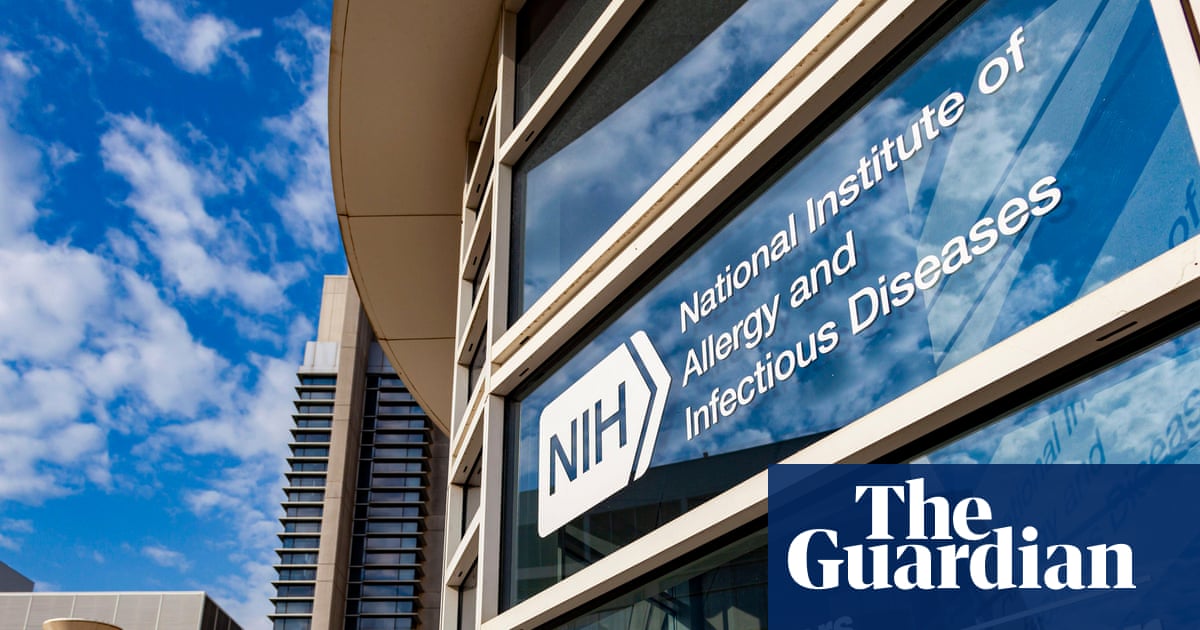
The process has injected uncertainty and confusion into scientific grant-making at the NIH over the past two years Photograph: Grandbrothers/AlamyView image in fullscreenThe process has injected uncertainty and confusion into scientific grant-making at the NIH over the past two years Photograph: Grandbrothers/Alamy‘Orwellian’: HIV scientist’s ordeal lays bare Trump officials’ interference in grant-makingResearchers forced to scrap original studies as NIH rethinks grants not in ‘alignment’ with administration’s priorities
Dr Jade Pagkas-Bather received her first grant from the National Institutes of Health (NIH) in June 2025 – a milestone in any researcher’s career.
She planned to study basic income as a medical intervention: her randomized control trial would test whether monthly grants of $500-cash helped poor, HIV-positive young people in Chicago stick with treatment. Her hypothesis was as straightforward as it was cutting.
“Maybe taking care of your HIV isn’t your priority when you’re unhoused or hungry,” said Pagkas-Bather. That summer, she was through peer-review and about to be funded when NIH program officers started asking for changes, verbally and usually on a video call. “We had something that said we would include people of all gender identities in the grant. Program officers asked us to remove the term ‘gender identities.’ We had a clause that said Black and Latinx people experience more poverty than other people. They asked us to remove that.” There was also “concern” with the acronym for basic income grants (Big).
Pagkas-Bather removed it all, received funding and enrolled dozens of study participants. Then, in 2026, a bigger ask came: could she remove the entire idea of giving out cash?
She recounted being told: “You can’t use unconditional cash transfer and you need to remove any reference to this having an impact on policy.”
Pagkas-Bather’s experience is a glimpse into the Trump administration’s NIH renegotiation process, an opaque and “Orwellian” political review that uses a “text analysis tool” to flag grants not in “alignment” with the Trump administration’s priorities.
The process has injected uncertainty, confusion and woe into scientific grant-making at the NIH over the past two years. Renegotiations force program officers, who typically take pride in shepherding critical research, to flag grants on topics the Trump administration disfavors. Even as they do so, they must guess what the “no-no” words are: NIH director Jay Bhattacharya has repeatedly denied a list of banned words exists.
“Her story is not unique,” said Shalini Agarwal, special counsel at Project Democracy, who is representing Pagkas-Bather in a suit seeking class-action status, and alleging the government is violating the first amendment. “There are many other researchers in a similar situation who are being asked to subvert their own grant projects that have been peer-reviewed and approved for funding a year or more into the project.”
The number of scientists who have been through this process is unknown.
Data shared exclusively with the Guardian shows re-negotiations surged in the first two years of the Trump administration. In 2023, only 154 of more than 40,000 grants up for renewal changed their titles, abstracts or public health statements: 0.4% of all grants, according to an analysis by Grant Witness, an independent group that tracks canceled government grants.
Those changes increased 21-fold during the Trump administration. In 2025, 8.6% of all grants changed year-to-year, or more than 3,401 of the more than 39,000 grant continuations awarded by NIH. In 2026, 8.5% of all continuing grants changed, or 3,006 of the agency’s nearly 35,500 grants, according to an analysis by Grant Witness.
In the 2027 fiscal year, which just started, 64 grants have been renewed. Three have already seen changes. In one a study initially titled “The Black Zones”, which was to focus on African American neighborhoods, all mentions of “African Americans” was removed, and a new version referenced “Black Americans”. In another, an HIV grant that would study a specific viral subtype had text changed from including “men and women” to “a wide range of people”.
HIV grants are almost twice as likely to have been changed, data shows, and were especially hard-hit in early cancelations. In part, many likely undertook renegotiations because the Trump administration placed severe restrictions on scientific work in South Africa. In 2025, of the 1,795 HIV-related continuing grants, 305 were changed, or 17%. In 2026, 335 of 1,609 grant continuations were changed, or 20.8%.
“The censorship that’s happening now is, I think, pretty much unprecedented,” said Jeremy Berg, a former director of the National Institute of General Medical Sciences, who has closely tracked changes in grant-making at the NIH. “It’s very Orwellian in the sense that it’s purely double-speak,” he said. “It’s a way of exerting political control and control of the terms of the debate,” said Berg.
The Guardian asked the NIH how many grants have been changed, and about the “text analysis” tool employed by NIH.
The agency said “more than 5,000 new and continuation grants” have been re-negotiated, “to ensure the agency funds the most meritorious science, addresses urgent health needs, and sustains a robust biomedical research workforce”.
“During these grant renegotiations, grant scopes were substantively altered wherever possible to replace poorly defined, non-scientific or subjective concepts and variables with well-defined, scientific concepts that have objective and measurable variables,” an NIH spokesperson told the Guardian. “Renegotiation is a normal process that NIH has used for years on grants for various reasons. All renegotiated grants are assessed by human experts.”
The NIH’s renegotiation process was set into motion in 2025, after court battles slowed down Trump administration grant cancellations. As the administration sought to change scientific studies, it developed a process of bringing grants into “alignment” with administration priorities – to name a couple, the belief that gender is binary and research into health equity is “unscientific”. Program officers who take pride in helping foster critical research are now tasked with renegotiating grants, often intuiting what might get flagged, said National Cancer Institute branch chief Sarah Kobrin.
“They are told to contact the investigators in case the investigators want to make changes,” Kobrin said. “We are compelled. We are not calling and saying, ‘Hey, could you change these words.’”
Instead, program officers must ask: “‘Hey, you know, if you want, you could change these words and it might work out well for you.’”
“It is certainly, certainly, certainly continuing,” she said.
Now, as a historic number of Democratic doctors and scientists prepare to take office, current and former leaders of NIH said Congress has years of work ahead to restore the agency.
Pagkas-Bather is one of 14 named plaintiffs in a first amendment lawsuit that argues such renegotiations and cancellations amount to censorship or, in legalese, “viewpoint-based discrimination”.
The Guardian has also covered other researchers involved in the lawsuit. In Pittsburgh, a group of researchers had funding cut for a study of Alzheimer’s disease risk in a low-income, majority Black neighborhood. The study was cancelled by the administration, leaving hundreds of aging residents without potential dementia diagnoses.
Ultimately, Pagkas-Bather was told that if she did not remove the cash payments from her $1.3m grant, she would need to find $1m in funding elsewhere. Seeing no path forward, she eliminated cash grants from her study and plans to use food and transportation vouchers as her intervention. She will need to ask each participant for consent again, since the study they signed up for bears little resemblance to the one she is now conducting.
“Not only would [Pagkas-Bather’s study] demonstrate that money empowers people to preserve their right to exist, but also thrive,” said Leslie McGorman, senior director of policy and strategy with AIDS United. “That is so threatening to this administration.”
A federal court hearing will determine whether the lawsuit filed by Pagkas-Bather and others will receive class-action status in November.