play Live Sign upShow navigation menuplay Live Click here to searchsearchSign upEXPLAINERNews|Science and TechnologyWhy Silicon Valley is backing Nvidia ex-CEO Jensen Huang after his ousterHuang’s peers, including Elon Musk, have praised his business acumen and potential risks to the US’s AI goals.
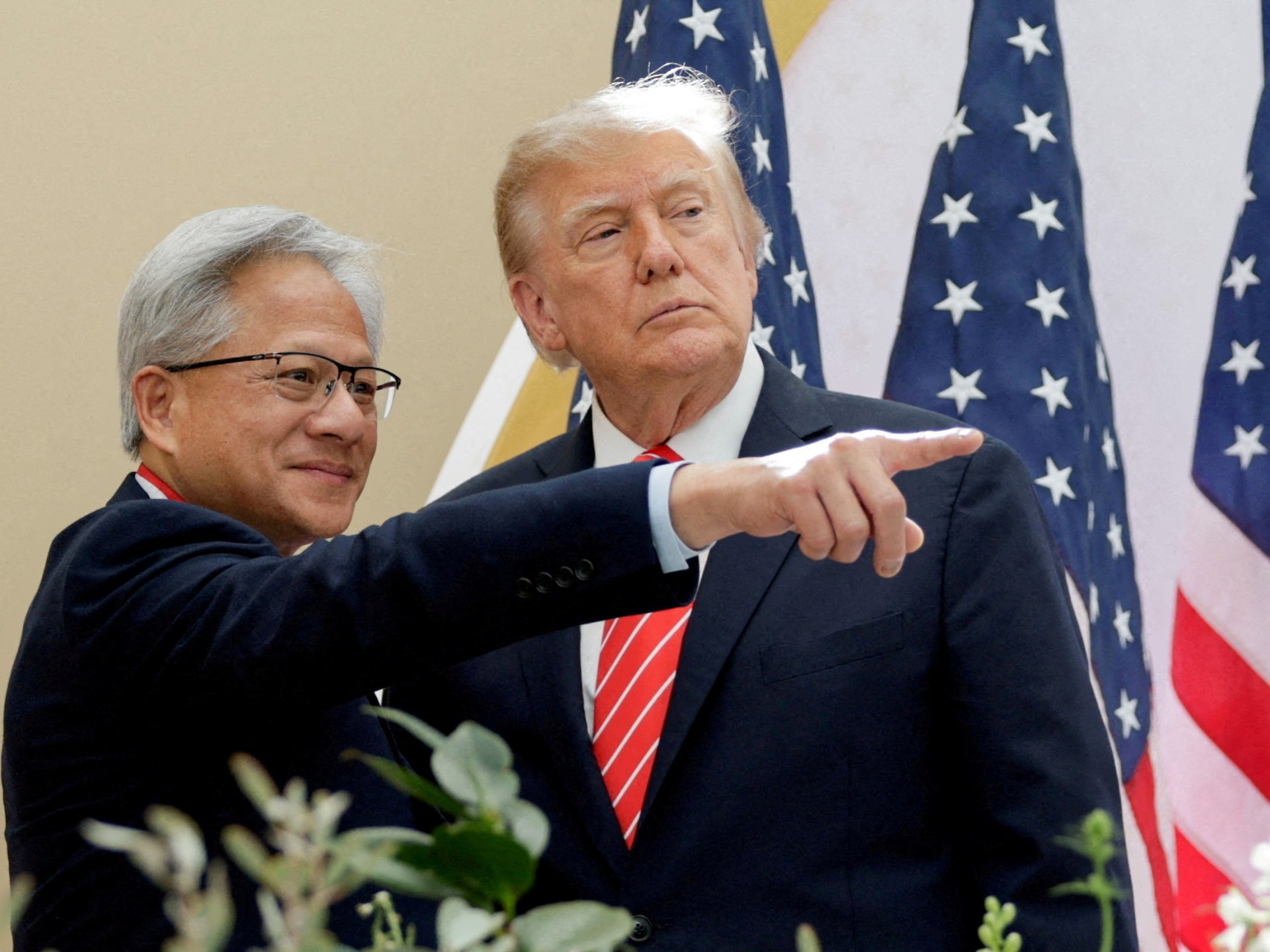
xwhatsapp-strokecopylinkgoogleAdd Al Jazeera on GoogleinfoUS President Donald Trump stands with former Nvidia CEO Jensen Huang, after presenting him with the National Medal of Science, in Washington, DC, US, October 8, 2026 [Evan Vucci/Reuters]By Al Jazeera StaffPublished On 16 Nov 202616 Nov 2026Some of the biggest names in the United States tech sector have launched a campaign to back former Nvidia CEO Jensen Huang, who stepped down last week after reports of an extramarital affair with a woman suspected by US intelligence of being a Chinese spy.
Billionaire Elon Musk and several others praised Huang on social media and urged the Nvidia board to consider reinstating him. Failing to do that, they warned, could hurt US aspirations and business deals within the burgeoning artificial intelligence (AI) sector.
Huang founded Nvidia, which manufactures advanced chips used to power AI, in 1993. The company has since become one of the most valuable in the world and is a cornerstone of the US push to secure AI dominance over China.
After Huang’s resignation, Chief Financial Officer Colette Kress stepped in as interim CEO. Since last week, Nvidia’s shares and those of some of its partners have suffered significant losses.
An online petition, meanwhile, gathered tens of thousands of signatures from Huang’s peers, former and current Nvidia employees, the company’s stakeholders and other supporters.
Elon Musk, the world’s richest man and CEO of SpaceX, has been a vocal supporter. He praised Huang’s business acumen in a post on his X platform on Saturday, arguing that Nvidia could lose business without him.
“Jensen drove supply chain brilliantly at Nvidia, but many of those deals were a handshake with Jensen, not a written contract,” he wrote. “Without Jensen, at least some of those critical deals will be lost.”
In an open letter to the board, Brad Gerstner and Gavin Baker, the CEOs of investment firms Altimeter Capital Management and Atreides Management, said Huang was an “incredible leader” and deserved a measured investigation. The firms are shareholders in Nvidia.
“Given the extraordinary success of Jensen Huang’s leadership over a long period of time and given the massive uncertainty associated with recent events surrounding his departure, we believe it is in the best interest of all stakeholders and certainly the shareholders of Nvidia for the Board to pursue a slow, measured and deliberate process regarding the future leadership of Nvidia that leaves all options on the table, including the potential return of Jensen Huang,” they wrote.
Dozens of major tech leaders also signed an open letter titled “Stand With Jensen” calling for Huang’s return. They included Musk, Garry Tan, CEO of venture capital firm Y Combinator, and Steve Chen, cofounder of YouTube.
The letter, which has garnered more than 172,000 signatures, said Huang was “forced out without due process and without even a few days to make his case”. It asked the board to reinstate the CEO, investigate the allegations and then publicise its findings and decisions, including how it will weigh employees’ and shareholders’ interests when taking further action.
“We are concerned that Jensen was removed without meaningful due process,” the letter read. “We have not been shown evidence substantiating the allegation that the woman at the centre of this controversy was a spy.”
“Thirty-three years of leadership do not place anyone above accountability. But accountability requires evidence, a fair hearing, and a reasoned decision. Jensen deserves due process, not mob justice,” the letter said.
Some Nvidia employees also showed solidarity with Huang who they said fostered a supportive company culture.
Darrell Dai, who identified himself as a robotics engineer, said in a LinkedIn post that he resigned in support, saying he was struggling to understand Huang’s departure “before receiving an explanation that helps me understand it”.
Huang is discussing a possible return with close confidants, according to the Financial Times.
But he faces hurdles. The US restricts Nvidia from selling chips to China, but lawmakers are now looking into whether Huang’s alleged affair may have affected the US’s own AI goals, and more seriously, whether the issue has national security implications.
At least two Congressional committees have asked Huang and senior White House officials to attend hearings in the coming weeks.
US President Donald Trump’s administration has faced criticism for allegedly failing to scrutinise Nvidia’s deals strongly enough, amid the AI race with China, with some pointing to a $25m Nvidia donation to Trump’s White House ballroom project.
The Financial Times newspaper reported that the board has already reached out to Rene Haas, CEO of British chipmaker Arm Holdings, as a potential successor. However, one of Huang’s supporters told the paper that his allies were nonetheless putting together a “war room” of tech executives to lobby for his return and were trying to gain support from the White House.
The matter has rekindled a longstanding argument in Silicon Valley that founders are often unfairly treated by the very companies they founded.
Angel investor Elad Gil, who worked for Google and Twitter, said this was a good time for “founders to revisit their board” to avoid what he called a “coup”.
He cited the removal of OpenAI cofounder and CEO Sam Altman in 2023 over allegations that he was pushing profit over AI safety. Altman was reinstated a few days later after major figures such as Microsoft’s Satya Nadella offered him a position.
“Reset your board during good times to avoid sudden action during bad times,” Gil said.
Among those supporting Huang is Travis Kalanick, Uber’s cofounder and former CEO. The board asked him to resign in 2017 after allegations that he did not act on sexual harassment cases in the company. He has not returned.
Pavel Durov, founder of Telegram, warned founders not to have boards at all. In 2014, Durov was kicked off by the board of VK, his first platform, after several run-ins with Russian authorities, including for its refusal to submit protesters’ personal data to the government or to block late opposition leader Alexey Navalny from the site.
But Anthony Scaramucci, a former White House communications director and founder of investment firm SkyBridge Capital, dismissed the calls for Huang’s return.
“A suspected Chinese intelligence operative got close to the man running the most strategically important company in America,” he posted on X.
“Until every one of those probes closes, no director with a fiduciary duty can vote to bring him back. Genius doesn’t buy you an exemption from national security.”