The trial of opposition politician Venancio Mondlane begins in Mozambique on Tuesday. The former presidential candidate is facing five charges, including incitement to terrorism.
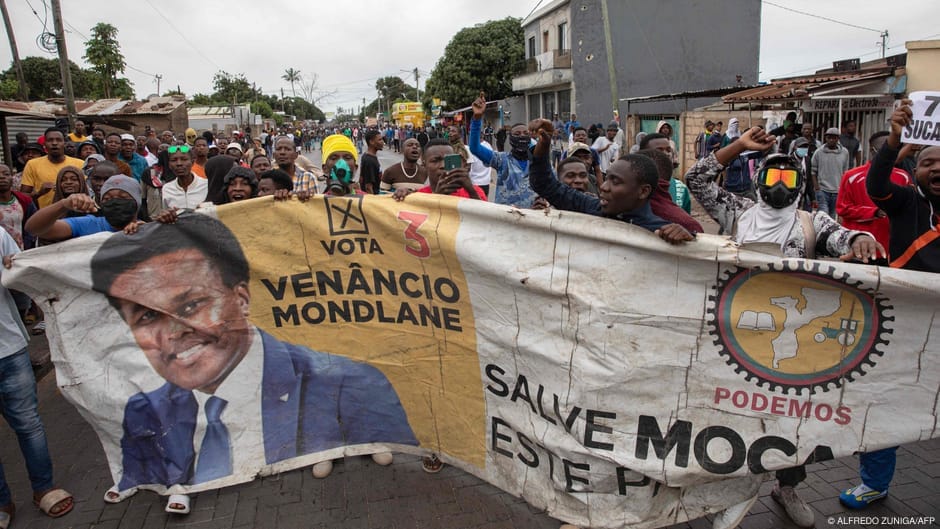
https://p.dw.com/p/5PSapPrefer DW on GoogleAfter parliamentary and presidential elections in November 2024, supporters of opposition politician Venancio Mondlane took to the streetsImage: ALFREDO ZUNIGA/AFPAdvertisementThe trial of Venancio Mondlane will shape the political future of Mozambique, and influence how much trust citizens place in state institutions.
From November 17, the country will be watching the opposition politician and former presidential candidate as he faces five counts, including publicly advocating crimes and inciting collective disobedience and terrorism after the October 2024 elections.
If convicted, he could be sentenced to more than 20 years in jail.
Mondlane has denied all the charges, and said he never called for violence. In fact, he said, his public statements were meant to prevent violence.
"I have more than enough evidence that numerous statements I made went in exactly the opposite direction," he told DW during a Septembervisit to the European Parliament in Strasbourg. "I have more than sufficient evidence that numerous statements I made were in exactly the opposite direction."
'Nothing can prove that I am the one who promoted violence'To view this video please enable JavaScript, and consider upgrading to a web browser that supports HTML5 video
The post-election protests had two main goals: To pressure authorities to investigate extrajudicial killings of members of Mondlane's political movement, and to find out the truth about election results.
"These were the fundamental issues of our entire protest," he said. "This has absolutely nothing to do with violence."
In the October 2024 presidential and parliamentary elections, Mondlane ran as a presidential candidate with the support of the left-wing opposition party Podemos. Afterwards, he did not recognize the official election results.
The election saw Daniel Chapo of the Frelimo party declared winner. Frelimo has governed Mozambique since independence in 1975.
After the elections were called, Mondlane and his supporters protested. For months, there were demonstrations, strikes and road blockades as well as violent clashes with security forces nationwide. According to reports from civil society groups, more than 400 people died. Shops and public facilities were looted or destroyed.
The public prosecutor's office has alleged a connection between Mondlane's public calls to action and the violence. The indictment is based on his live broadcasts on social media, in which he called for protests, strikes and civil disobedience.
Albino Forquilha, who heads Podemos and is Mondlane's former political ally, is expected to testify at the trial. However, he told DW that he would not appear as a witness for the prosecution.
Forquilha said he would report his own observations of the protests and would only testify to what he personally experienced. He cannot predict whether his statements will benefit Mondlane or the state.
Baltazar Fael, a prominent Mozambican lawyer, argues that the prosecution's case is problematic.
Speaking with DW, he warned against equating indictment with conviction. "What we currently have is an indictment by the public prosecutor," he argued. "And this does not mean that the accused has already been convicted."
The court will hear arguments from both sides and must decide whether what happened constitutes a criminal offense. Predicting the outcome is difficult.
Fael is particularly critical about the charge of incitement to terrorism. For this charge to be valid, a plausible connection between Mondlane's statements and specific acts must be proven. Acts of violence that occurred following his calls to action will not be enough to convict him on this charge, Fael said.
The question is whether Mondlane actually intended to incite terrorist acts. "What power did Venancio Mondlane actually have to incite people to commit all these crimes?" Fael asked, adding that, after reading the indictment, he believes the prosecution is overstating some aspects of its case.
There are also questions as to whether the trial might be politically motivated in some way. For years, Mozambique's justice system has been criticized because of potential political interference.
Fael said several factors have raised doubts. "The timing of the trial and the circumstances that led to it — namely, a challenge to the election results — are clearly political in nature," he said.
Additionally, the speed at which the trial was prepared might also give the impression that there's some political pressure at work here, he added.
What an opposition leader's trial means for MozambiqueTo view this video please enable JavaScript, and consider upgrading to a web browser that supports HTML5 video
Adelino Muchanga, chief justice of Mozambique, has emphasized that his court will decide the case based on facts. But observers are still asking how independent the judiciary can be when the defendant is one of the most prominent critics of Mozambique's political leadership.
The Supreme Court's decision not to allow a live broadcast of the trial has drawn further criticism. Mondlane's defense requested a live broadcast but was denied by the court, which reasoned that such a broadcast could endanger the safety of those involved, influence or intimidate witnesses and disrupt proper conduct of the trial.
Critics see this refusal as a setback for transparency, especially since another recent, prominent trial, the so-called "hidden debt scandal" where state-owned companies secretly borrowed billions from international banks, got extensive media coverage.
Additionally, the causes of the protests that sparked this trial have not disappeared. DW's interviews with citizens in the northern Mozambican city of Nampula make this clear.
"The people still want the same thing," one resident told DW. "They wanted Venancio to become president."
Another Nampula resident pointed out that "the population protested against hunger and the lack of jobs for young people. And that's legitimate."
Still, some in Nampula just want to see closure, preferring to have peace and an end to the demonstrations. Even if the economic situation could be better, the country has to return to normality at some stage, they argued.
Additional reporting by Amos Fernando and Conceicao Matende in Maputo.
This article was originally written in German.