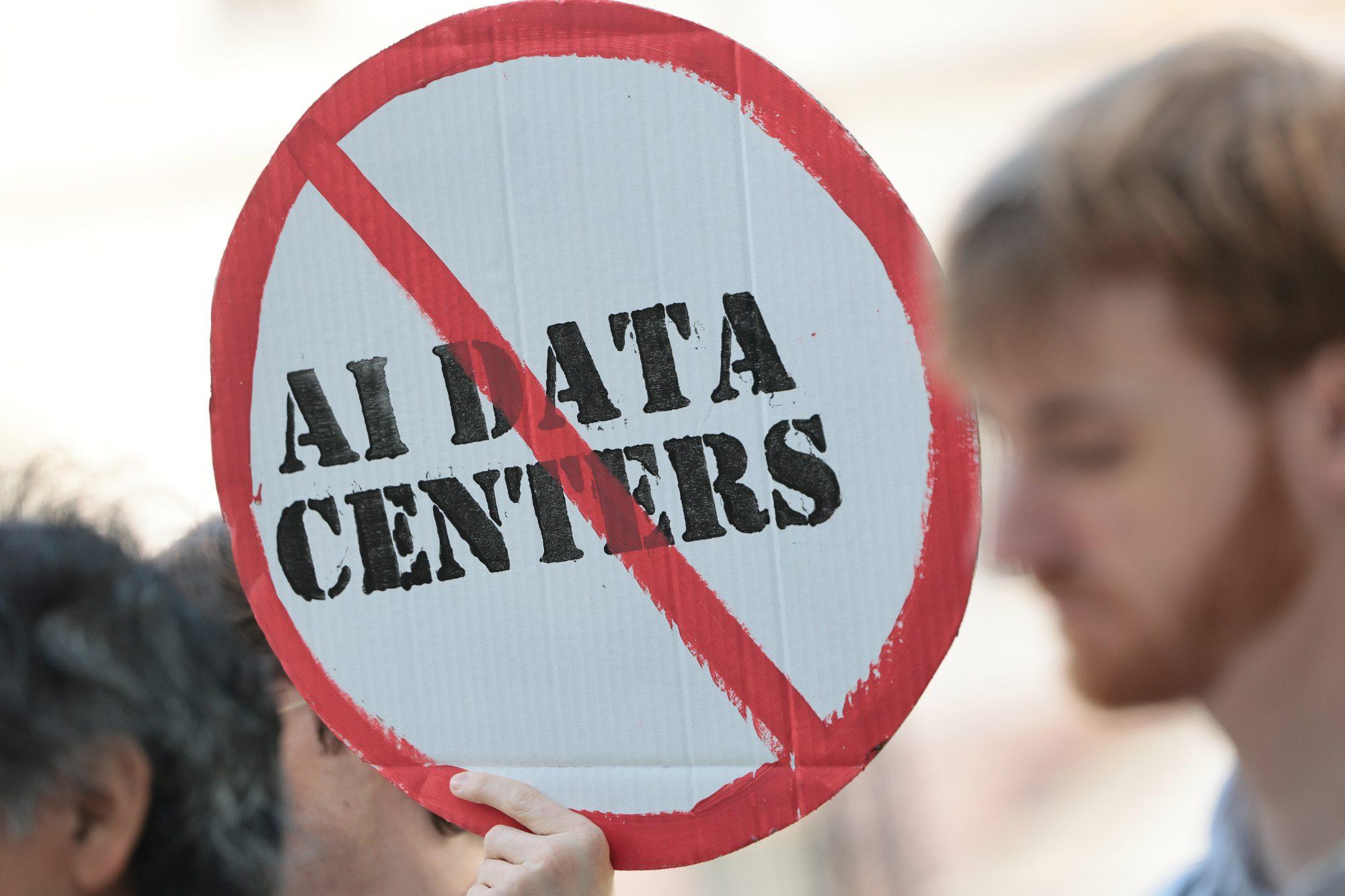
Make New York Post a Preferred Source People protest artificial intelligence and data centers ahead of a New York City Council Committee hearing on the risks and regulation of artificial intelligence, at City Hall Park on October 05, 2026. Getty Images A neo-Luddite movement is on the rise, and it’s now chic to denigrate modern technology and long for the “good old days” of the preindustrial past. But we tend to forget that the typical American is living a healthier, more comfortable life than even royalty once did.
Most of our ancestors lived in total darkness after sundown. Roughly half of people didn’t make it to age 20 in early modern Europe. Cannibalism could occur during famine not so long ago. Even the palace at Versailles lacked bathrooms.
A new book argues that technological progress — and the much-maligned Industrial Revolution — is the only thing that separates us from such unthinkable living standards.
“I don’t think people appreciate our modern abundance enough,” Chelsea Follett, author of “The Grim Old Days,” told The Post. “We all take the world that we are born into as the default. We think this is the normal condition of humanity to have running water and electricity and grocery stores with more food than any one person could ever eat.”
As we face down the prospect of AI transforming the economy and changing our lives, it’s important to take a lesson from history and remember that technology has consistently brought us prosperity — and not the doom that naysayers have consistently claimed it would.
Follett, a research fellow at the Cato Institute’s Center for Global Liberty and Prosperity, argues that virtually every facet of life — from birth to death, and for rich and poor alike — has been improved by technology. To prove her point, she takes readers through the lives of our ancestors in order to “deromanticize the past.”
“Before industrialization, snail-like progress verging on stagnation was the general rule,” Follett writes. “Rose-colored views of the past bear no resemblance to reality. The world our ancestors faced was in fact more gruesome than modern minds can fathom.”
Historical cities that we tend to idealize, like Renaissance Florence and imperial Rome, had no street lights and turned into dangerous nightmares at night. George Washington, per his own calculations, was spending the equivalent of $15,000 a year to burn a single candle for five hours per night.
Even royals had it worse than the average American does today. Heating was so scarce that kings could see their wine freeze at their dinner tables in the winter. And, at Henry VIII’s Hampton Court, the communal toilet could serve 14 people at once — but, of course, didn’t flush.
“If you could transport someone from the pre-industrial world into the modern one and show them a grocery store, it would blow their minds,” Follett explained. “I mean, it truly is a level of abundance that would be beyond their imagination.”
The Industrial Revolution, Follett argued, lifted our ancestors out of constant misery and suffering for the first time in human history.
There’s been more economic output in the last two centuries than in every previous century combined, per Cato’s Human Progress project.
All this technological progress, Follett argues, freed the typical person of subsistence labor and gave them space to think and be creative. The crucial labor that once occupied our ancestors’ minds at all times — like producing enough food and clothes to keep your kin fed and warm — can now be accomplished by vastly fewer members of society.
She points out that just 2% of people in developed countries today are farmers, compared with as many as 90% in many preindustrial economies.
“A transformation occurred [during the Industrial Revolution:] freedom spread, trade and commerce flourished as they never had before, technology advanced, and global wealth grew . . . exponentially,” Follett writes. “For the first time in history, pursuing dreams came within reach of the average person.”
The book is timely, as more and more people sour on AI and warn that it’s going to bring doom upon society. A July poll found that just 30% of respondents thought AI was a good thing for society — even though it has been responsible for massive GDP and stock market growth.
“People continuously compare the AI revolution to the Industrial Revolution, but if we don’t learn the right lessons from the Industrial Revolution, then we could squander this moment with the AI revolution,” she said.
It’s understandable that such powerful technological transformation is causing anxiety. AI threatens to upend the way we live, work, and even the way we think. But, as it turns out, history is a helpful guide for what can often feel like unprecedented times.
By all indications, it’s less likely that our worst fears come to fruition than further progress and more prosperity — and perhaps even new creative potential if AI can free us from the remaining drudgery of modern life.
We’re standing on the precipice of change, like our predecessors were during the Industrial Revolution. And history looks better upon those who embraced change than the Luddites who tried to hold everybody back.