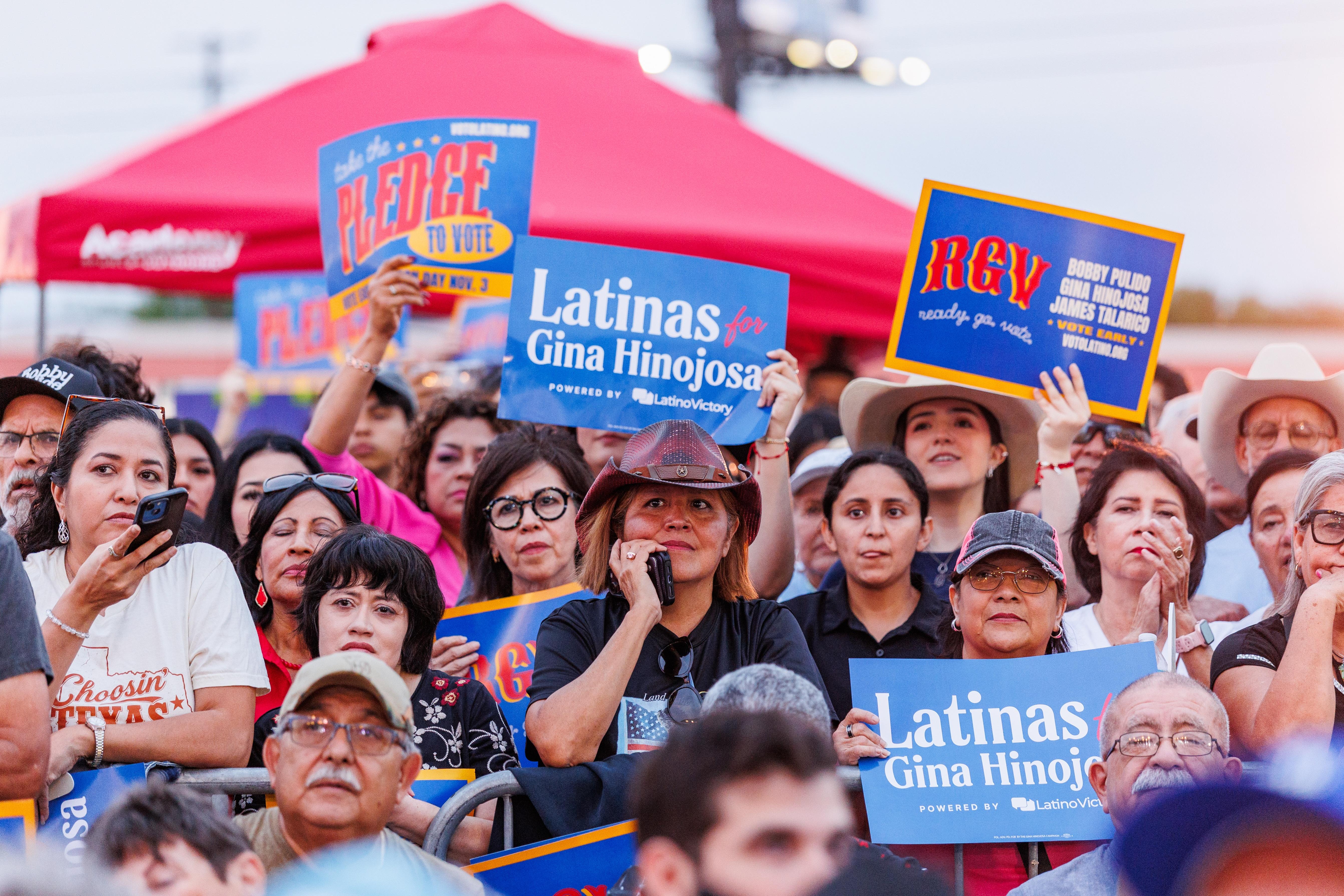
Make New York Post a Preferred Source Texans attending a rally for Democratic candidates ahead of the midterm elections in Weslaco on Oct. 25, 2026. AP Photo/Michael Gonzalez In 2024, Republicans made a historic breakthrough with Hispanic voters as Donald Trump captured 43% of the Latino vote — up from 35% in 2020.
But in this year’s midterms, those gains and more evaporated: Only about a third of Hispanic voters backed GOP House candidates, reverting to their pre-2024 patterns.
Republicans must ask themselves how to win back the hearts and minds of the Hispanic voters who propelled Trump into the White House.
The truth is, the GOP got arrogant about its Hispanic surge.
Republicans read the 2024 vote to mean lasting, undying loyalty — while misunderstanding the thin line that separates legal and illegal immigration within Latino communities.
They interpreted genuine Hispanic support for strong border enforcement as support for heavy-handed policies that impacted legal and illegal immigrants alike.
Take Texas, where Democrats captured the governor’s office and a US Senate seat in a state Trump carried comfortably just two years ago.
In heavily Hispanic border counties, where ICE presence has sharply increased over the past two years, the shift was especially stark: Cameron County, for example, gave Trump 52.5% of its vote in 2024, but Democrat James Talarico took 68.4% there in his Senate victory.
Florida provides another example: Miami-Dade County, with its strong Latino population, gave Trump 55.2% of its vote in 2024 — but this year, Democratic Senate candidate Angie Nixon carried it with 53%, leaving Republican Ashley Moody with only 46%.
A nationwide 13% shift doesn’t happen overnight.
Indeed, the warning signs began to appear well before Election Day.
Among Hispanics who voted for Trump in 2024, his approval fell from 93% at the start of his second term to 57% just before the midterms.
Why? Because even though they overwhelmingly back a secure border, and agree that at least some illegal immigrants should be deported, their views on immigration overall are nuanced.
An April poll of 1,200 Hispanic voters found that 85% favored creating more pathways for people seeking to immigrate legally.
Eight in 10 said that Trump should focus on deporting those who have committed serious crimes.
Many Hispanic voters, in other words, favor enforcement, but not haphazard enforcement — and they want it alongside an expansion of legal immigration.
To them, Trump’s immigration vision has been far too narrow and punitive.
And House and Senate Republicans had a hard time telling their Hispanic constituencies that immigrants should get in line and wait their turn while the White House was essentially proposing to stop the line from moving at all.
Latinos now make up a fifth of America’s population, making them a critical bloc in elections to come.
If the GOP wants to win these voters back, the party needs to dissect this failure without delay.
And a swing back is certainly possible — because culturally, Hispanics align with conservative values.
About 38% say parenthood is the most important part of their identity, compared to 25% of white parents.
Hispanics place more importance on their children getting married: 26% call it extremely or very important, versus 17% of white parents.
Religion matters, too. At least 39% of Hispanics believe that it is very important for their children to share their religious beliefs, compared with 32% of white parents.
And 47% of Hispanic adults pray daily, against 40% of white adults.
This translates to conservative policy as well: 73% of Hispanic voters support school choice.
The midterm election wasn’t proof that Latinos aren’t conservative anymore — but even voters who share a party’s priorities can still decide its politicians have failed to deliver for them.
Another potential GOP edge: Democrats have historically failed to differentiate the Hispanic population, treating these voters as a monolithic demographic.
In 2024, however, Republicans understood that the Latino vote is multifaceted.
They smartly targeted their messaging and policy proposals to appeal to their various background nationalities.
But the administration lost sight of that principle over the past two years, imposing harsh immigration enforcement measures that even heavily Republican groups, like Cubans and Venezuelans, perceived as indiscriminate.
Hispanic voters aren’t ready to embrace the Democrats’ entire progressive agenda.
But they know very well that Trump’s immigration policy has been worse for them.
And now Trump has learned that these voters can and will walk away.
The GOP has two years to make it right — and to win back the Hispanic support it’s rightfully enjoyed.
Santiago Vidal Calvo is a Cities policy analyst at the Manhattan Institute.