play Live Sign upShow navigation menuplay Live Click here to searchsearchSign upEXPLAINERNews|ASEANASEAN summit: Who’s attending and what’s at stake?Energy disruptions as a result of the US-Israel war on Iran is a key issue for the import-dependent bloc.
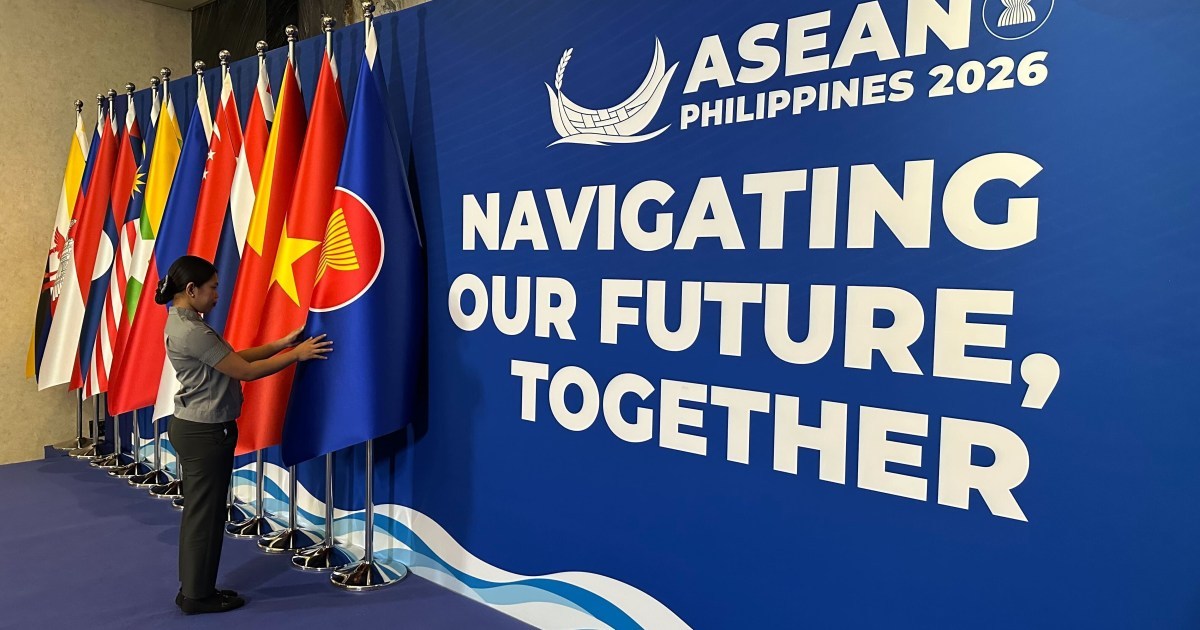
xwhatsapp-strokecopylinkgoogleAdd Al Jazeera on GoogleinfoA woman adjusts the flag of the Association of Southeast Asian Nations (ASEAN) in Cebu, Philippines, Wednesday, January 28, 2026 [Joeal Calupitan/AP]By Shola LawalPublished On 15 Nov 202615 Nov 2026Southeast Asian countries that comprise the ASEAN economic bloc will meet in the Philippines this week as the region continues to bear the brunt of oil shortages caused by the US-Israel war on Iran, as well as by US-China rivalry, which has hit economies hard.
The Manila summit will be held from November 15 to 17 and will include US President Donald Trump and several other world leaders.
The 11-member Association of Southeast Asian Nations (ASEAN) aims to establish a single market, although it cannot impose decisions on members. It comprises Indonesia, Malaysia, the Philippines, Singapore, Thailand, Brunei, Vietnam, Laos, Myanmar, Cambodia and East Timor, with a combined population of nearly 694 million, or 8.4 percent of the world’s population.
Several ASEAN meetings are held annually. This week’s summit is expected to be the final one for this year.
Beyond the energy crisis, other pressing issues include disputes over the South China Sea and trade.
In addition to leaders and representatives from the 11 member countries, other guests include:
The summit is being held at a time when Southeast Asian countries have been hit hard by shortages in oil and gas supplies from Middle Eastern suppliers amid the US-Israel war on Iran.
The Philippines, Vietnam and Malaysia are among the most vulnerable to the energy disruptions in the Gulf, with Manila declaring a state of national energy emergency in March.
Millions of ASEAN citizens also live and work in the Middle East, where the war threatens their safety and earnings.
Meanwhile, Asian countries are worried the conflict could spill into the Strait of Malacca, a narrow waterway between Indonesia, Malaysia and Singapore.
The US’s tariff war has seen ASEAN countries slapped with 10-12.5 percent tariff hikes since the beginning of US President Donald Trump’s second term in the White House, prompting the bloc to strengthen trade relationships elsewhere.
China and four ASEAN members – Brunei, Malaysia, the Philippines and Vietnam – as well as Taiwan, have been locked in decades of territorial standoffs in the busy waterway.
The area is important as it is believed to host undersea deposits of oil and gas.
In 2005, the bloc began negotiating a “code of conduct” with China to discourage aggression and prevent major clashes. The negotiations have often stalled, however, partly due to flared tensions, especially between Manila and Beijing in recent years.
In 2023, the two sides agreed to speed things up and release a finished draft this year. At least 10 rounds of talks have been held this year, led by Malaysia, with a final round taking place in October.
However, analysts doubt a definite conclusion will be reached at the summit this week, meaning talks could continue into next year.
Armed clashes broke out between the two ASEAN member states late last year along an 800km (500-mile) contested border area, as well as over competing claims to sacred religious sites, such as the Preah Vihear Shiva temple.
At least 150 people were reported to have been killed, and nearly one million displaced.
ASEAN members, as well as China and the US, intervened, leading to talks. Although a ceasefire has been in place since December, the wider border dispute remains unresolved, and the bloc is calling for more dialogue and the participation of third-party observers.
The ongoing civil war in Myanmar, which has compounded the Rohingya refugee crisis, has been at the top of the agenda as the bloc pushes for the restoration of democracy in the country.
Multiple rebel forces, some of them ethnic-based armed groups, have been fighting the military government since the country’s February 2021 coup.
ASEAN has already restricted Myanmar’s participation at important summits to non-political representatives as concerns about violence and a humanitarian crisis grow.
The bloc’s five-point Myanmar peace plan, launched in April 2021 and calling for dialogue and improved humanitarian aid access, has meanwhile failed to alleviate the situation.
Months of widespread wildfires in drought-hit Indonesia have scorched an estimated 2.88 million hectares (7.12 million acres) and resulted in at least 3,500 deaths.
The resulting haze has severely impacted not just the country’s residents, but also those in neighbouring Malaysia, the Philippines, Singapore and East Timor.
Jakarta has faced criticism for failing to effectively respond to the fires, but the government has defended its approach, saying thousands of responders have been deployed.