AMD Just Beat Nvidia by the Widest Margin Since 1999 Omor Ibne Ehsan Sat, November 14, 2026 at 10:07 AM EST 5 min read AMD -10.95% NVDA -3.12% CRWV -8.57% GOOG -1.54% GS -0.23% Explore stocks on Coinbase Trading disclosure Trading disclosure The above button links to Coinbase. Yahoo Finance is not a broker-dealer or investment adviser and does not offer securities or cryptocurrencies for sale or facilitate trading. Coinbase pays us for certain activity generated through this link. Prices displayed are informational.
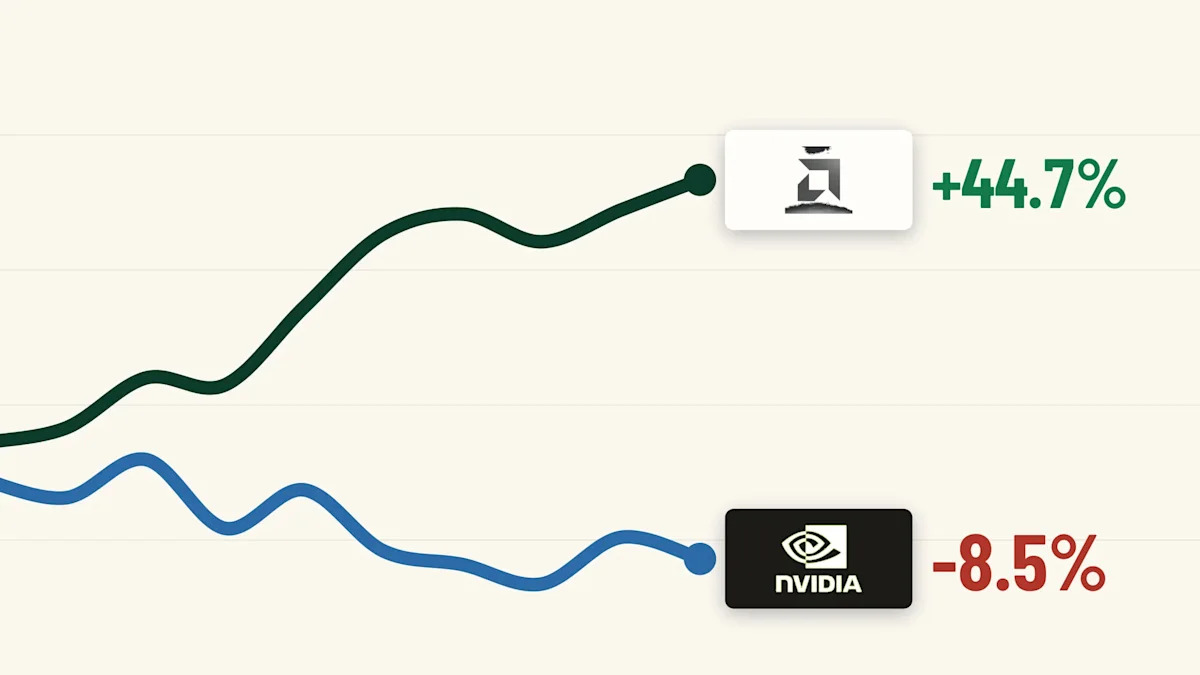
AMD surged 45% in five days while Nvidia sank 8.5%, the widest weekly gap in AMD's favor since Nvidia's 1999 IPO.
CoreWeave results, a Goldman Sachs preferred chip listing and a Google cloud deal for EPYC chips lifted AMD on November 11.
Jensen Huang's resignation as Nvidia CEO left the stock with a sixth straight weekly loss and leadership uncertainty that lingers until a permanent successor arrives.
Building a portfolio and living off one are two completely different skills, and almost nobody teaches the second. This problem is what The Definitive Guide to Retirement Income helps, and it is free today. Read more here. (Sponsor)
In the five trading days through Thursday, AMD (NASDAQ:AMD) rose 44.7%, from $404.40 to $585.30. Over the same period, Nvidia (NASDAQ:NVDA) fell 8.5%, from $181.60 to $166.19.
By our calculation, that 53.2-percentage-point gap is the widest five-day spread in AMD's favor across 6,997 trading days, which covers all 27 years since Nvidia's January 1999 IPO. AMD had record results and new customer orders, while Nvidia lost its chief executive.
The old high was 50.1 points in the five days to April 22, 2016, when AMD rose 47.8%, and Nvidia fell 2.3%. Nvidia's fall this time was much steeper than in 2016, so it accounts for more of the gap.
From Friday to Friday, AMD gained 18.93% from $449.04, and Nvidia lost 12.75% from $186.64. By our calculation, that 31.7-point gap is still the widest since the five days to October 10, 2025.
AMD jumped 11.04% on November 6 after third-quarter revenue reached a record $13.4 billion, up 45%. Data center revenue rose about 97%, so the business that competes head-on with Nvidia powered the quarter.
Many successful investors eventually reach the same moment. The saving is done, the portfolio is built, and the question quietly changes from how much can I grow this to how much can I take out? Get that second question wrong and decades of good investing can come apart in a handful of years.
That is exactly what The Definitive Guide to Retirement Income helps answer. It covers what your retirement could actually cost, which income sources are worth using, and the withdrawal math that decides whether the money lasts. It is free today from Fisher Investments. Read More Here ›
On November 11, AMD added 7.32% to $552.90. That move followed results from CoreWeave (NASDAQ:CRWV), a spot on a preferred chip list from Goldman Sachs (NYSE:GS), and a cloud deal with Alphabet (NASDAQ:GOOG, NASDAQ:GOOGL) unit Google for fifth-generation EPYC chips. CEO Lisa Su said "demand is higher than supply" and guided fourth-quarter revenue to about $17 billion as Helios racks and Venice processors ramp.
On November 12, Nvidia said Jensen Huang had resigned as president, CEO, and director and named CFO Colette Kress interim CEO. The stock then posted its sixth straight weekly loss.
The market usually absorbs reported results within days, but uncertainty over who leads a company lasts until the board names a permanent replacement. Size also helps explain the gap, because AMD's $875.9 billion market value takes far less new money to move sharply than Nvidia's $3.93 trillion. Nvidia still controls its CUDA software platform and reported $96.22 billion in revenue last quarter, so a credible CEO pick could steady the stock.
On Friday, AMD fell 8.75% to $534.06, while Nvidia slipped 2.01% to $162.85. In after-hours trading, AMD changed hands at $521.24 and Nvidia at $161.04.
A one-day drop that steep after a 44.7% run suggests that many late buyers were chasing momentum. AMD is also still about 19% below its 52-week high of $658.52.
AMD has the stronger near-term growth case. Management expects 2027 revenue to grow more than 80%, with data center making up more than 80% of sales.
The stock swings hard in both directions, and a trailing P/E of 202 leaves little room for a guidance miss. Nvidia's lower price could draw renewed interest once it names a permanent CEO. Until then, AMD has the clearer growth story, and its reported numbers support it.
(Sponsor) Most people spend their entire working lives focusing on one thing: growing a pile of money. Then they retire and discover the skill they actually need is close to the opposite. Turning that pile into steady income, year after year, through good markets and bad, without ever running out.
It may be the least discussed and most consequential transition in personal finance, and plenty of otherwise careful investors walk into it with no real plan. That is exactly what The Definitive Guide to Retirement Income helps answer. It is a free guide from Fisher Investments covering what your retirement will really cost, where the cash flow should come from, and how much you can safely withdraw each year. Learn more here. Learn More Here ›
Contact editorial@247wallst.com for any questions or corrections.