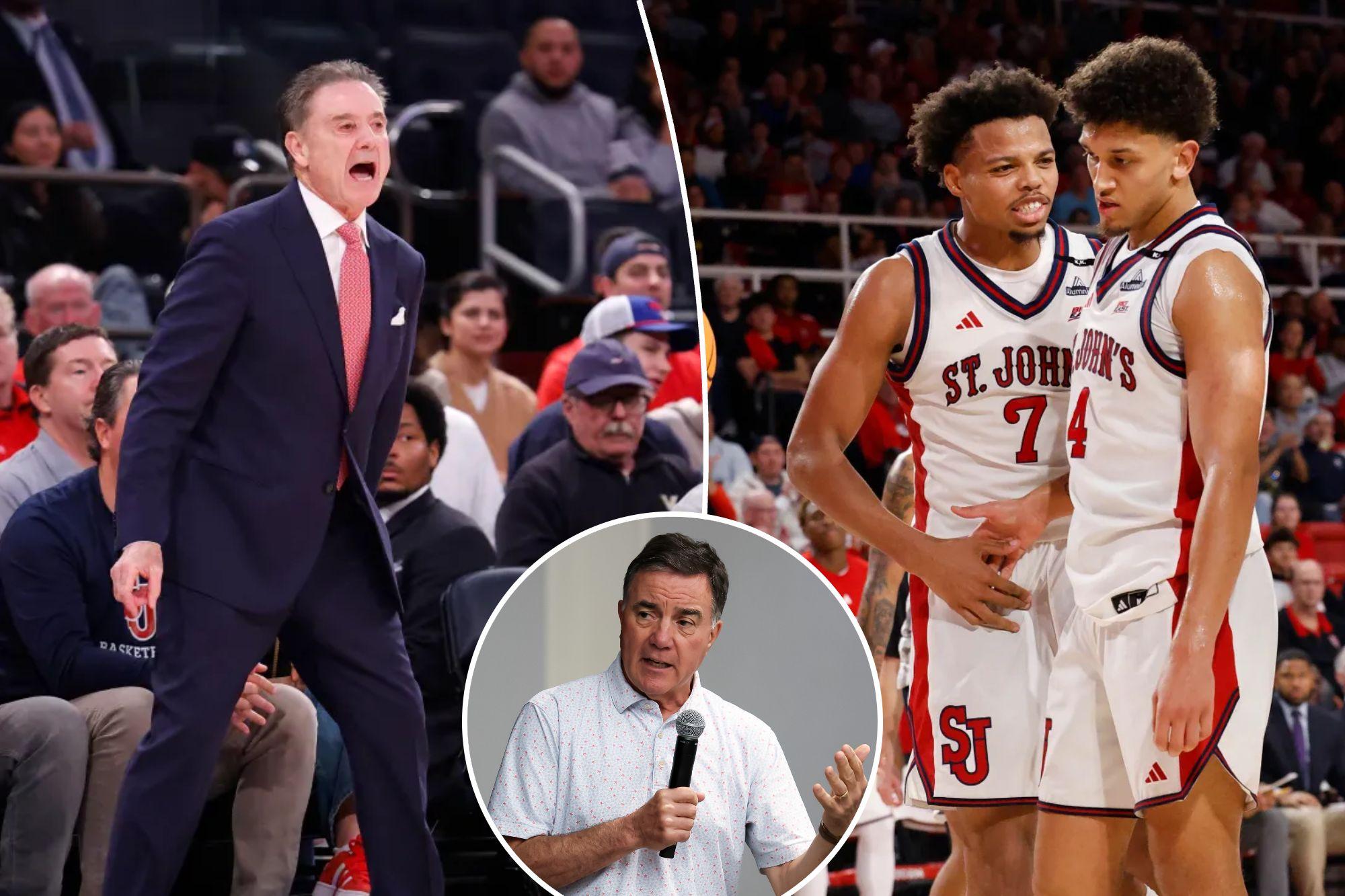
Make New York Post a Preferred Source ESPN college basketball analyst and former St. John’s and Manhattan coach Fran Fraschilla takes a timeout for some Q&A with Post columnist Steve Serby. Fraschilla’s autobiography, “Don’t Mess With Happy,” was released last month.
Q: What makes Rick Pitino a great coach?
A: I saw Rick Pitino coach at 25 at Boston University when a good friend of mine was his first point guard [Glenn Consor]. He has an ability to inspire players to take their game to the highest level possible because he is relentless at demanding intensity and effort.
Q: What are your thoughts on his current St. John’s team?
A: Here’s what I would say about Rick Pitino: If you put him in Alaska-Anchorage, he would have them in a Sweet 16 in two years. He has an ability to take players beyond anything they could ever imagine they could be. As long as he keeps the energy that he has, St. John’s is gonna be as good or even better this year.
Q: A possible Final Four team?
A: I think they’re an Elite Eight-level team if everything comes together. But whatever it is, he’s gonna maximize the amount of the talent that they have.
Q: What about the kid from Baylor, Tounde Yessoufou?
A: He’s a linebacker disguised as a basketball player, yet Rick will likely turn him into a first-round pick. He’s what I would call a power wing, Tounde Yessoufou, who Rick has to turn into an NBA-level shooting guard before the young man leaves St. John’s.
A: Super athletic. The skill level is a work in progress.
A: Love him. You wake him up at 3 in the morning he gets 25. He’s a bucket. He scores like he breathes. He has an ability not only to score, but he’s so powerful he’s gonna shoot 10 free throws a game.
A: Because of his experience in the second-best basketball league in the world — the EuroLeague — he will dominate Big East opponents with his playmaking. He’s played in venues where they throw smoke bombs on the court, so he’s not gonna be intimidated very easily.
Q: Can you rehash the story about one of your players eating Wendy’s during a team meeting when you were the new St. John’s coach?
A: It happened to be Tarik Turner, who’s now an excellent broadcaster for Fox. My first team meeting, we had two guys show up late, two guys didn’t show up, and my starting point guard (chuckle) showed up with a bag of Wendy’s. He was gonna eat lunch in my meeting. And I simply said, “Hey fellas, listen, that’s not how we do it. We’ll see everybody tomorrow morning at 6 a.m., we’ll start our meeting then.” And I was just trying to infuse my idea of what a winning culture was in the program. They were magnificent to coach once we got all on the same page.
Q: What makes UConn’s Dan Hurley a great coach?
A: Incredibly intense and extremely bright. Even smarter than people realize as a basketball coach. He is a great coach in part because of the people that have affected his career.
Access the St. John's beat like never before Join Post Sports+ for exciting subscriber-only features, including real-time texting with Zach Braziller about the inside buzz on St. John’s.
Q: Were you close to his intensity as a coach?
A: He’s a 10-plus. He’s literally off the charts. I was probably in the 9 range. He’s a unique individual because he coaches every game like he’s going to the electric chair if he loses.
Q: You were a counselor at the Dean Smith Camp at 19.
A: I knew at 14 I wanted to be a college basketball coach. I wrote letters to every coach in the country. I tried to work at as many basketball camps as I could. I show up at Chapel Hill [N.C.], first time I’ve ever been on a plane, I check into my dorm room, it’s a suite, there’s four guys sharing two bedrooms and one bathroom. There’s a guy in the other dorm room, he’s a little loud, brash. I go in there to introduce myself and he introduces himself and he says, “My name’s John Calipari,” 19-year-old kid from Pittsburgh. We’ve been friends for 48 years. He was a head coach three years before I was, so when I got the job at Manhattan College with no head coaching experience coming from Providence as an assistant, John was able to take me through the things that he learned when he became the head at UMass three years before.
A: Dean Smith to me is the best college basketball coach of all time. Others had more wins, but to me Coach Smith was a visionary, he revolutionized the game, he was doing analytics before anybody knew what it was. He treated players fairly. He had a way of holding players accountable without raking them over the coals. And I thought the coolest thing that he did when he passed away was every single player that he ever coached got a $200 check that he left in his will so they could take their families out to dinner. He innovated the game of basketball beyond maybe anybody in the history of the game. In addition to coaching some great players like Michael Jordan and others.
Q: Who were some of the other coaches who wrote you back?
A: Jerry Tarkanian at UNLV, Coach K [Mike Krzyzewski] at West Point, Dave Gavitt at Providence. … I would write them and say, “Dear Coach, I want to be a college coach. If you have any drills or offenses or defenses that you could send me so that I could learn, please send to me.” In addition, I’d ask them if I could work their summer camps. Coach [Lou] Carnesecca invited me to be a manager while I was in college. I wasn’t able to make the commute every day.
A: Growing up in New York, I idolized Bob Knight and Woody Hayes. They were both students of military history, and at Brooklyn College, I majored in history with a minor in military history. When I go out to Ohio as a coach at Ohio University, Coach Knight was a guy I probably studied more than anybody, watched the tapes, went to the clinics. I actually did the last three games that he broadcast at ESPN in the NIT in New York City with John Saunders, and we had a blast because probably for the first time in his career at ESPN, I engaged him. One of the players on one of the teams took a bad shot and I said, “Coach, that’s not a shot you’da let [Quinn] Buckner take.” I knew Quinn Buckner was his favorite player of all time.
Q: Describe the young Chris Mullin.
A: Marine Park in Flatbush. A playground, metal backboards, no nets. Would dribble my ball from 17th Street to Marine Park. When we chose up sides, there was a kid that was four years younger than me, 6-foot-3, left-hander, great bank shot off the metal backboards. Just a neighborhood kid who turned out to be one of the 50 greatest players of all time.
A: When you coach New York kids, you gotta be crazier than your craziest player. Ron had a volatile temper, but I loved him because he jump-started the St.John’s program, which was needed. But his energy and effort really, I thought, lit a fire under the St. John’s program in the time that he was there. I had my moments with him, but I would coach him every day of the week for the next 50 years. I’m really proud of the fact that we recruited New York kids as well as anybody’s who’s done it in the last 30 or 40 years. I already knew every high school coach and every AAU coach in New York. Instead of recruiting the fourth-best player on a great AAU team when I was at Manhattan, I could recruit Ron Artest and Erick Barkley and Anthony Glover. … The one great regret I have of the way things ended for me at St. John’s is they had no idea what we were building behind the scenes. I had eighth graders and ninth graders already in our sights — Ben Gordon, who went to UConn; Taliek Brown, who went to UConn, won a national title; Levance Fields, who starred at Pitt. We were involved with all these city kids, and they went by the wayside when they fired me.
Your weekly dispatch from the No. 1 source on the Johnnies Sign up for Inside St. John's by Zach Braziller, exclusively on Sports+.
A: Billy Hahn played for Lefty Driesell at Maryland on the great Maryland teams of the ’70s. … He was a young college coach who I befriended when I worked at the Rhode Island camp where he was an assistant. He was an Indiana guy who knew nobody in New York City. He wanted to recruit New York City for Rhode Island. I became as a teenager his human GPS in New York and New Jersey. I didn’t have a license to drive, so Billy would come to New York, stay with my family, we were a family of nine fitting into four bedrooms in Brooklyn … and I would take him around New York City to all the high school games. … When I got out of college, he helped me get my start in college coaching. … Billy taught me how to coach and recruit. There’d be no Fran Fraschilla if I didn’t meet Billy Hahn when I was on most of those summer journeys through the college basketball camp circuit. … He was such a character that one time, Maryland was up by 20 — his mom and dad were farmers from Indiana, they show up at a game — it’s two minutes to go, Billy’s still not in the game (chuckle). He got up, took his warmup suit off and walked right by Lefty and the coaching staff, put himself in.
Q: You never dreamed of a broadcasting career.
A: No, but when you’re driving for hours and hours through the state of Ohio with no FM radio, no cell phones and no satellite radio, and I’d be driving back from Cleveland four hours after seeing a high school game, an eight-hour round trip, I would do postgame interviews with myself like I was a head coach somewhere. I pretended I was doing coaching shows and interviews — I had a great imagination. I would do these imaginary postgame shows: “Coach Fran, you guys won big tonight, what were the keys?” “Well, you gotta really give the kids credit, they played really hard.” When you grow up where I grew up in Brooklyn, we all developed a gift of gab — whether it was arguing about the Mets and the Yankees, or the Jets and the Giants. You just learned that on the sidewalks of Brooklyn. One of the things that really helped me was going back to Manhattan [College] and coaching in New York for six years. You get a chance to handle yourself in front of a microphone nightly.
Q: Describe Brent Musburger.
A: The greatest, man. The best three years I had at ESPN. He’s on the Mount Rushmore of sports announcers. We’re in Morgantown, West Virginia, for “Big Monday” on a Monday night, it’s the Harbaugh [Super] Bowl in [New Orleans on Feb. 3, 2013]. We are in an Italian restaurant. It’s obvious that his first prop bet of the night is how long the national anthem is gonna go, and he had the Over on Alicia Keys singing the national anthem. Early in the anthem it was clear she was going Over, and he turned to all of us and he said, “Boys, we’re off to a good start.” He didn’t take himself seriously.
A: Before the internet, in order to learn the game, you went to coaching clinics, and Hubie’s probably the greatest basketball clinician that there’s ever been, in my opinion.
A: Dick Vitale and Billy Packer are the Larry Bird and Earvin [“Magic”] Johnson of college basketball. It was the dawn of the ESPN era, it was the dawn of college basketball on TV, more than one weekend Saturday. The most amazing thing is nearly 50 years later, through many illnesses and setbacks physically, the guy is still going strong. What he taught me, and I believe I had it in me as a broadcaster, is to have a joy for the game.
A: Again, one of a kind. It’s an incredible legacy he’s leaving behind. In some ways, I mirror Bill Raftery and Dick Vitale because we all left coaching at an early age. Where it really hits home for me and why I wrote my book is if you think of Bill Raftery, he didn’t mess with happy. Once he got into broadcasting and realized that there was a life besides the potential ulcers of a buzzer-beating loss, that you could still be a part of this game and have a great impact. I’ve worked with Bill in three-man crews, and he is the ultimate teammate. He broadcasts with no ego.
Q: What is the meaning of “Don’t Mess With Happy”?
A: When I left coaching to go to broadcasting, we moved to Dallas, Texas, [wife] Meg’s hometown. It’s an idyllic community. We watched Matthew Stafford and Clayton Kershaw grow up from their sophomore year on. ESPN career was going along nicely four years in. But I still had the coaching bug. I was turning down two or three coaching jobs a year those first few years, mostly back east where everybody knew me — the Fordhams, the Manhattans, the Fairfields, the Marists, the Sienas. In 2007, I was offered a chance to go to Marquette and be the associate head coach under Tom Crean. I take the job. I’m 90 minutes from getting on a plane in June, the family’s moving up in September, my boss at ESPN [Dan Steir] calls me just to thank me. When I hung up the phone with him, I told Meg, “We’re not going.” I said, “I’m not messing with happy.” And I left coaching basically for the last time. The first person that I remember saying this in my research was the great Al McGuire.
Q: Assisting Rick Barnes at Providence in the Big East Conference?
A: He was a 35-year-old young head coach, we were fighting for our lives every night. We were the Little Engine That Could. It was hand-to-hand combat every night, but it was a big family. It was like brothers fighting in the backyard. We lost a 19-point lead at Villanova, and as they charged the court after the game, one of the students punched our point guard, and Rick Barnes socked that guy (laugh), and he had to have a nice little talking to the next day by his godfather, the [conference] commissioner, Dave Gavitt.
Q: What’s a story from the book?
A: Chris Jent is recruited by the country, Dean Smith and Coach K, everybody recruits him out of Sparta, New Jersey. He had an uncle, Lou McGuire in Columbus, Ohio, that nobody knew about. I’m at Ohio State, I find out about uncle Lou and the fact that Chris has relatives in Ohio. We recruit Chris, he comes out on a visit. He’s as intense as Gary Williams. On the final Sunday morning of his visit, I come up with this idea ’cause Chris loved golf, we’re gonna play nine holes with Coach Williams, uncle Lou and Chris, and they were gonna put him back on a plane to New Jersey. The second hole, Gary’s playing with Chris, I’m playing with uncle Lou, Gary hits a bad shot and he throws his clubs. I said to uncle Lou, “When we get to the third tee, we’re switching carts. Because if I let Chris play nine holes with Coach Williams, he’s not coming to Ohio State.” He has a great time, he flies home that day, late that afternoon he calls me and says, “Coach, I’m gonna be a Buckeye.”
A: The way I got the Manhattan job was we had a mole inside the Manhattan College program, a former Providence player who had been a walk-on for Rick Pitino, and had been an assistant coach at Manhattan before leaving for Niagara. His name was Ryan Ford. When Ryan left for Niagara and then Steve Lappas left for Villanova the next year, and I interviewed for the job, Ryan told me every single thing about Manhattan College that I needed to know. Because they had a very good team coming back, they basically were looking to hire a Steve Lappas 2.0 — a highly energetic Big East assistant from New York City. And rather than going into the interview and acting like I knew basketball like Dr. Naismith, I tried to just model myself after Steve.
Q: What do you think of this college basketball season?
A: I think by and large there’s four or five teams that really separate themselves, and ironically, some of those teams have the kind of continuity where they actually have a rarity in college basketball where they actually have three- and four-year guys. Who comes to mind right away are Virginia, Florida, Michigan State, Arizona and UConn. Duke is always gonna have a plethora of one-and-done high lottery picks, so the talent level is oftentimes gonna supersede the experience, but this year, the older players — the three-, four- and five-year guys — really dominate the sport. If you’re a kid who’s a second-round NBA pick, and you could stay in college and possibly make seven figures, why would you even put your name in the draft?
Q: The state of college basketball today?
A: It’s the worst it’s ever been in the offseason. The chaos that’s been created by grown men who refuse to make intelligent decisions over the last 25 years, and I’m talking about the NCAA and conference commissioners and college presidents. But once the season starts, we have great basketball because the transfer portal is basically free agency, and we have many more older players playing probably since before one-and-done was popular. So in the era of David Robinson and Ralph Sampson and Patrick Ewing staying four years, that’ll probably never be that way again, but there’s a whole bunch of great older players because of the transfer portal.
Q: If you were the commissioner, what changes would you make?
A: I would allow a one-time free transfer to a player who wants to leave without sitting out. But after that, the next transfer you sit out a year like the old-school way we did it, so that a player’s not going to five schools in five years, and trying to figure out which alumni game he goes to 20 years from now. So the transfer portal needs to be fixed. … The second thing I would do is allow players to go directly to the NBA again from high school. There was a time 20 years ago when the league took players from high school who were not ready to produce. Cam Boozer, AJ Dybantsa, Cooper Flagg, unlike those guys — and there were some successes like Kobe [Bryant], Jermaine O’Neal and Kevin Garnett — were good enough to go directly to the NBA because they’re more prepared than the players were 20 years ago. That would allow everybody else who goes to college to star in college and take advantage of NIL. Cooper Flagg coulda been the No. 1 player in the draft coming out of high school, and will be probably a potentially billion-dollar player someday. The other kids who are not ready to go right to the NBA should be allowed to go directly to college and make as much NIL money as they can. The five-and-five is good, five years to play five, there’s nothing wrong with that. We’re used to four-and-four, but five-and-five allows kids to go to college and get an education ’cause they spend a fifth year in college.
Q: What is it about basketball that you love so much?
A: I was a very good baseball player growing up as a kid. But I fell in love with the game on the playgrounds in part because those of us who grew up during that era, we learned how to play the game the right way because of these guys by the name of [Dave] DeBusschere, [Willis] Reed, [Walt “Clyde”] Frazier … hit the open man, play unselfishly. And although I knew I was not gonna be an NBA player, I knew I had the desire and the intelligence to be the kid who picked the sides on the playground, settled the arguments, got everybody the ball who needed to get the ball so we would stay on the court for two hours on a Saturday morning. In a strange way, I’ve had two incredible careers in the game of basketball because of the kid from the Flatbush section of Brooklyn. I do something with basketball every single day of my life since the time I was 14. I’ve never lost that love and joy for the game since I grew up on those playgrounds. … Hey, I got one more story for ya. When I get the Manhattan job and I replace Steve Lappas, it’s a three-page contract. In the contract, that Steve had in his contract that they just carried it over was there, was a $50,000 loan so that we could purchase a home. In the contract, the loan would be forgiven if the team made the NCAA Tournament. I never thought about the loan. We’re playing Niagara in the championship game of the MAAC, we run a last-second play, and my point guard gets fouled with one second to go in a tie game. An 80 percent free-throw shooter by the name of Chris Williams. We’re up in Albany, he misses the first free throw. It’s the first time all year I thought to myself, “Now that we might go to the NCAA Tournament, but holy crap, this is a $50,000 free throw.” Chris makes the second free throw, we win the game, we go to the NCAA Tournament — and I didn’t tell him about the contract and the free throw for 25 years later. We had a great laugh about it. Manhattan was glad to pay it because it was our first [NCAA] Tournament in 38 years.