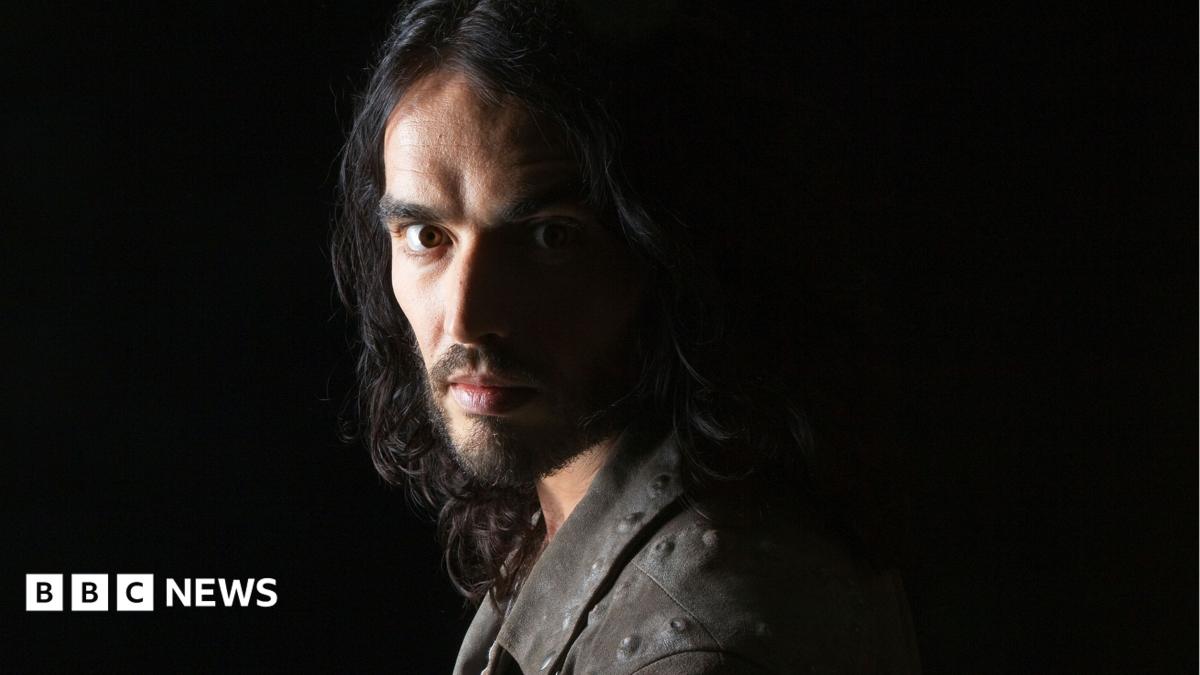
Image source, ReutersImage caption, A jury at Southwark Crown Court found Russell Brand guilty of one count of rape and three of sexual assault
This week, the dark side of television has come crashing into the open.
On Monday, disgraced entertainer Russell Brand was jailed for rape and sexual assault.
Twenty-four hours later, author and comedian David Walliams was unmasked and accused of preying on young women.
Also in the last week, Married at First Sight UK has been cancelled following allegations of rape on the hit TV show.
These are all very different stories, but each can be seen as a major reckoning with abuse of power and culture in the industry.
In reality, the glut of recent days is something of a coincidence.
All these revelations began with journalistic investigations that started years ago.
From my own experience - including in my Panorama on Married at First Sight UK - I know investigations typically take a very long time to reach a conclusion, from initial tip-off, to evidence-gathering, corroboration, getting responses, and eventually reporting.
"The truth is, these stories have a long build up. It can be incredibly difficult to get [them] in the papers," Sunday Times columnist Hadley Freeman told me.
In the case of Brand, there was then a police investigation too, before an outcome was reached in court.
Together these stories represent the consequences of changes that began years ago, rather than a sudden cultural shift in the entertainment industry.
It should also be said that Walliams denies the allegations against him. The men accused of rape and sexual misconduct on MAFS UK have also denied all the allegations.
What has changed is that women (because it almost always is women) have seen others speaking up - which, according to broadcaster Kirsty Wark, has given them "courage to do the same". She describes those who have come forward as "beyond brave".
When looking at what’s driving more women to speak up, much can be traced back to the revelations about Harvey Weinstein and the #MeToo movement.
It changed the perception of whether victims would be believed.
In the past, women alleging this sort of behaviour faced barriers - being seen as opportunistic, fearing retaliation, believing they might be the only one.
Now, there can be a snowball effect. Once one, two or three come forward, that prompts others to revisit their experiences - which they may have dismissed or subdued.
"There is more of a sense that you will now be listened to," said Freeman.
It's also clear that when women see action taken, it can encourage others to speak up as well - as it helps counter the widely-held assumption that reporting abuse results in nothing.
To play this video you need to enable JavaScript in your browser.This video can not be played
Married at First Sight UK cancelled after rape allegations
When another high-profile man, MasterChef presenter Gregg Wallace, faced accusations of a very different and much lesser order, relating mostly to inappropriate sexual language and humour, the reaction was similar.
Last summer, an independent inquiry upheld dozens of claims against him, and he was sacked. Wallace said "none of the serious allegations" against him had been upheld but that he was "deeply sorry for any distress caused".
One young woman I spoke to in my investigation into Wallace texted me at the time, to give her reaction to his sacking.
"I really believe this will encourage young girls going into the TV industry to have the courage to speak up, if they feel something is wrong," she told me.
But unions say it is still difficult for junior freelance workers, who often find their income unstable and unpredictable, to speak up.
Vulnerable workers "continue to fear raising concerns", said head of broadcast union Bectu, Philippa Childs.
She's echoed by Freeman, who said an "attitude of protecting the talent" remained.
"There will always be wealthy famous predators," she said. But, she added: "Hopefully more and more people at TV stations and movie studios are willing to hear these young people and will take them seriously”.
For more senior people in TV, raising the alarm can also be difficult.
Earlier this week, comedian Lucy Beaumont told Sky News: "The reason high-profile people are not saying anything is because they lose work, because you're seen that you might be a trouble causer. It does need to be said that there needs to be some intervention."
Social media has also played a role in encouraging people to speak up.
And policing investigations have had to keep pace - and adapt - with media scrutiny often prompting authorities to investigate.
Attitudes towards women who speak up are also starting to change – although not always.
Some of what unfolded in court during the Russell Brand case felt like a throwback to how rape cases used to be conducted.
Many have commented on Brand's lawyer's defence tactics against the accusers on the stand - behaviour Freeman said would have been "standard" in the past.
But Freeman noted it was heartening to hear the judge’s remarks in summing up the case - which have also been widely shared by women online and praised for dispelling rape myths.
When Mr Justice Bennathan sentenced Brand to ten-and-a-half years, he told him: "Whatever women wear, wherever they go, indeed whatever they drink, they retain the right to say no."
"I think attitudes have changed,” said Freeman. “It doesn't mean those assaults don't happen any more but attitudes around them have changed.”
Events of the past few weeks highlight how figures who rose to prominence in the nineties and noughties did so in an era with different standards.
Lad culture and celebrity status shielded Brand and others from scrutiny.
Now, behaviour once dismissed as eccentricity or womanising is increasingly being reassessed and called out. Times are catching up with some men of that era.
However, it would be an error to assume this sort of behaviour is confined to the past.
"This is not just about nineties/noughties culture," Wark told me. "It can't be dismissed as a hangover of the past, this is about right now and the industry changes that must happen.
"There will be more cases to come, sexual abuse, coercive control, verbal and physical abuse. It is not OK, and it never was OK."
This week, comedian Deborah Frances-White told BBC Radio 4's The World at One that young women were "definitely" still being exploited in the comedy industry.
And in the past few days, I've had tip-offs about other celebrities allegedly abusing their power. No doubt other journalists have too.
None of those is reportable, yet. As Freeman said: "There are other names out there, but you and I couldn't name them as we'd be sued".
But one "cheering thing", she said, was that the sort of jokes and innuendos from the nineties and noughties, or even the optics of seeing a much older man with a younger girl would no longer be "glossed over".
"It wouldn't be laughed at, and it wouldn't be 'nudge nudge'," Freeman said. "That kind of open, in your face, weirdness won't happen any more".
"On the downside, that may make it harder to identify predators, if it means these things are kept more in the shadows."
Image source, Getty ImagesImage caption, Channel 4's office in central London. Its bosses will be questioned by MPs next week following the cancellation of Married at First Sight UK
Then there’s the use of gagging orders and other legal routes often used by celebrities and media organisations to stop women speaking out.
Last week, a High Court judge rejected an injunction request by Walliams, clearing the way for him to be named.
"There are lots of barriers to speaking out, and those that have access to wealth or fame will often use legal measures to deter alleged victims from doing so," Harriet Wistrich, from the Centre for Women's Justice, told me.
This week, multiple government ministers have spoken against non-disclosure agreements and called for further restrictions on their use.
Next week, Culture Secretary Lisa Nandy will convene industry leaders to urge them to improve safeguarding practices - while Channel 4 bosses are due to appear in front an MPs on Tuesday.
When MAFS UK was cancelled, Channel 4 said the programme had "run its course" and apologised to the women involved in the investigation.
It said the review found that in Channel 4 and production company CPL's handling of the issues raised at the time, there was no breach of Ofcom's broadcasting code.
There is growing recognition that those at the top of media organisations have a responsibility to root out abuse. It can't just be down to the victims.
"People in positions of power have a duty to speak up too," said Wark.
"Broadcasters, production companies and those financing productions all have a responsibility to ensure protections are upheld," added Josephine Brassey, from Women in Film and TV, while Philippa Childs urged the creative industries to accept that their current internal reporting mechanisms were "inadequate".
What everyone seems to agree on is that this can't be another empty tipping point with no real, lasting change.
Maybe this time it could really be a watershed moment.
If you have more information about this story, you can reach Noor by email at noor.nanji@bbc.co.uk
Married at First Sight UK cancelled after BBC revealed rape allegations
David Walliams accused of sexual misconduct after losing injunction bid
Russell Brand sentenced to 10-and-a-half years in prison for rape and sexual assault
How Panorama exposed rape allegations on Married at First Sight UK