Alibaba’s (BABA) AI Growth Prospects Remain Masked by Short-Term Challenges TipRanks Fri, November 13, 2026 at 3:52 PM EST 6 min read BABA -0.41% AMZN -0.88% GOOG -1.41% Explore stocks on Coinbase Trading disclosure Trading disclosure The above button links to Coinbase. Yahoo Finance is not a broker-dealer or investment adviser and does not offer securities or cryptocurrencies for sale or facilitate trading. Coinbase pays us for certain activity generated through this link. Prices displayed are informational.
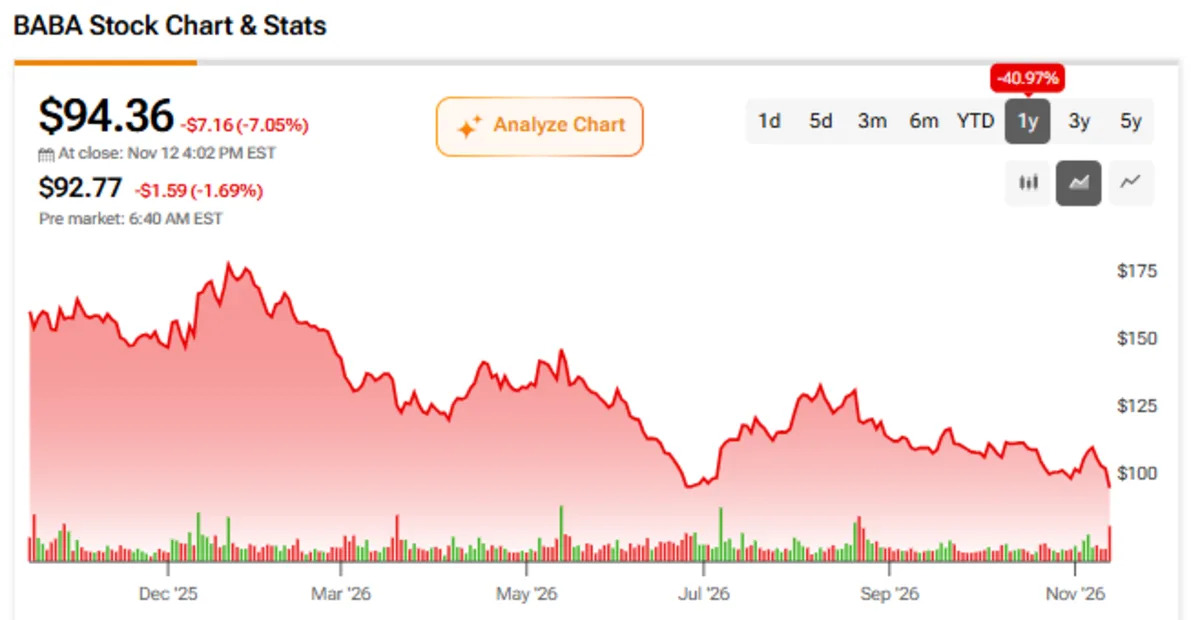
Alibaba Group Holding Limited (BABA) offers promising artificial intelligence (AI) growth prospects, but its short-term struggles continue to weigh on the stock. The Chinese tech giant has failed to gain traction following its regulatory nightmare in 2020. In the past 12 months alone, Alibaba stock has lost around 37% of its value. This lackluster market performance has compressed Alibaba's forward P/E multiple to just 14x.
Part of this multiple contraction can be explained by Alibaba's net income halving from FY2020 through the first quarter of FY2027. Today, the company is taking steps to unlock shareholder value by shedding non-core assets. Its planned spin-off of the chip unit, T-Head, is the latest example. I am bullish on Alibaba, as I believe its cash bleed will eventually lead to strong earnings growth.
One of the reasons behind my bullish stance on Alibaba is that the company is trying to strategically unlock value by divesting some of its non-core assets. As part of this strategy, Alibaba is planning to spin off its chip manufacturing business, T-Head, through an initial public offering (IPO) in Hong Kong. According to a recent company filing, Alibaba has obtained the necessary approval from the Hong Kong Stock Exchange and has already submitted a listing application on September 11.
Get 75% Off TipRanks Premium and unlock powerful investing tools to make smarter, more confident investment decisions
T-Head, founded in 2018, focuses on data center processors and high-performance AI chips. In September, T-Head unveiled the Zhenwu V900 processor, which is expected to support Alibaba's full-stack AI strategy over the long term. At a time when the U.S. maintains strict export controls on high-performance chips, Alibaba has been able to secure advanced chips through its strategic investments in T-Head since 2018.
Commenting on the massive long-term opportunity ahead of T-Head and Alibaba Cloud, CEO Eddie Wu said in September: "Today, the total volume of Machine Thinking is less than 3% of all Human Thinking. If that volume eventually scales to 1,000x human capacity, the simple math tells us: Machine Thinking still has an enormous growth runway. As machines are becoming the primary force behind Thinking, turning intelligence into a commodity supplied at scale, the truly groundbreaking products of the Machine Intelligence era have not yet arrived. With this in mind, our target is that by 2032, the global data center capacity operated by Alibaba Cloud will surpass 20GW, fueling the industry's exponentially rising demand for AI."
T-Head will continue to play an important role in Alibaba Cloud's growth story, and the spin-off will immediately help Alibaba's balance sheet. Once the spin-off is complete, Alibaba will receive a direct cash infusion without diluting shareholders. This is important as Alibaba was free cash flow (FCF) negative in FY2026.
Alibaba announced its at least RMB 380 billion three-year AI and cloud capex commitment in February 2025, meaning it is already midway through that three-year spending cycle. The spin-off will also help T-Head independently raise new capital through both equity and debt issuances. This should accelerate its growth investments.
One of the main reasons behind my bullish stance on Alibaba is the company's interesting AI growth strategy. Today, Alibaba is in the investment phase of this narrative. Its massive AI capex budget covers scaling data centers (over 20 GW of data center capacity by 2032), developing custom silicon (T-Head), improving the capabilities of the Qwen model family, building consumer AI applications using the Qwen architecture, and integrating AI into its core e-commerce products.
Alibaba's AI strategy resembles that of Alphabet Inc. (GOOG). Like Google, Alibaba is following a full-stack AI strategy. T-Head produces custom silicon, Alibaba Cloud provides cloud infrastructure solutions, and Qwen serves as the foundational model layer for building applications. This strategy can be justified by the strong demand for AI computing power in China (Alibaba raised AI computing power prices in April amid strong demand) and export restrictions on high-end foreign graphics processing units (GPUs). These macro drivers are likely to boost Alibaba Cloud's earnings in the next few years following the investment phase.
The growth of cloud revenue is likely to boost Alibaba's operating margins in the future. Although aggressive capital investments pushed Alibaba's FCF negative in FY2026, the Cloud Intelligence segment's adjusted EBITA rose 35% year-over-year to RMB 14.3 billion. This is a clear indication of how the cloud business is likely to boost Alibaba's corporate-level FCF in the long run once the initial build-out phase peaks.
As I noted earlier, Alibaba is currently valued at a forward P/E multiple of 14x. Alibaba, therefore, is valued like a business with lackluster growth prospects. As I discussed in the previous segment, this is far from the truth. The company is well-positioned to enjoy an acceleration in growth once it moves out of this heavy investment phase. In FY2026, non-GAAP net income declined 62% year-over-year, and FCF turned negative. The company's current valuation reflects these negative developments.
Beyond the current aggressive investment phase, Alibaba's earnings and FCF are likely to improve notably. This will trigger a valuation re-rating even if all other variables are held constant. A quick look at the valuation multiples of comparable Western tech giants confirms this.
Amazon.com, Inc. (AMZN), which runs both an e-commerce platform and a cloud business, is currently valued at a forward P/E multiple of 28x. Alphabet, which compares to Alibaba with its full-stack cloud business, trades at a forward P/E of 22x. For Alibaba, even a partial valuation re-rating toward its Western peers in the coming years could lead to handsome returns for investors.
Based on the ratings of 14 Wall Street analysts, the average Alibaba price target is $186.86, which implies upside of 98% from the current market price.
Alibaba stock has disappointed investors over the past six years. Although regulatory challenges that limited the company's investment appeal between 2020 and 2023 are no longer a threat, the company's aggressive AI investments have continued to spook investors.
These AI investments have negatively impacted Alibaba's earnings and FCF, but I believe the company will reap handsome rewards from these investments in the long run. Alibaba's strategy of divesting non-core assets should also improve its balance sheet. I am bullish on Alibaba as I believe the company is cheaply valued.