GM -0.12% TSLA -1.67% Explore stocks on Coinbase Trading disclosure Trading disclosure The above button links to Coinbase. Yahoo Finance is not a broker-dealer or investment adviser and does not offer securities or cryptocurrencies for sale or facilitate trading. Coinbase pays us for certain activity generated through this link. Prices displayed are informational.
Investors face a choice between a legacy giant and an electric pioneer in General Motors (NYSE:GM) and Tesla (NASDAQ:TSLA) as they compete for dominance in an evolving global market.
General Motors focuses on transitioning its massive manufacturing scale to electric models while maintaining strong internal combustion sales. Tesla continues to disrupt the market by integrating software, autonomous vehicle (AV) technology, and energy storage into its automotive ecosystem. Both companies offer distinct paths within the automotive industry for those interested in the future of transportation.
General Motors serves retail and fleet customers through well-known brands including Buick, Cadillac, Chevrolet, and GMC. The company operates over 4,500 authorized dealers in North America and secures battery raw materials through long-term offtake agreements. GM Financial supports these operations by providing automotive financing solutions to customers and dealers, while strategic joint ventures in China involve partners like SAIC.
In the trailing 12 months ended Sept. 30, 2026, revenue reached $187.0 billion, a decrease of 0.3% from the prior year. Net income during this period was $3.9 billion. This performance follows a trend of varying net margins as the company balances legacy and new vehicle investments during its ongoing transition to electric power.
As of its December 2025 balance sheet, the debt-to-equity ratio was 2.1x, meaning total liabilities are more than double the company's shareholder equity. The current ratio of 1.2x indicates the company has approximately $1.20 in current assets for every dollar of short-term debt. In the fiscal year ended Dec. 31, 2025, free cash flow was $11.1 billion, representing the cash remaining after a company pays for capital expenditures like equipment and facilities.
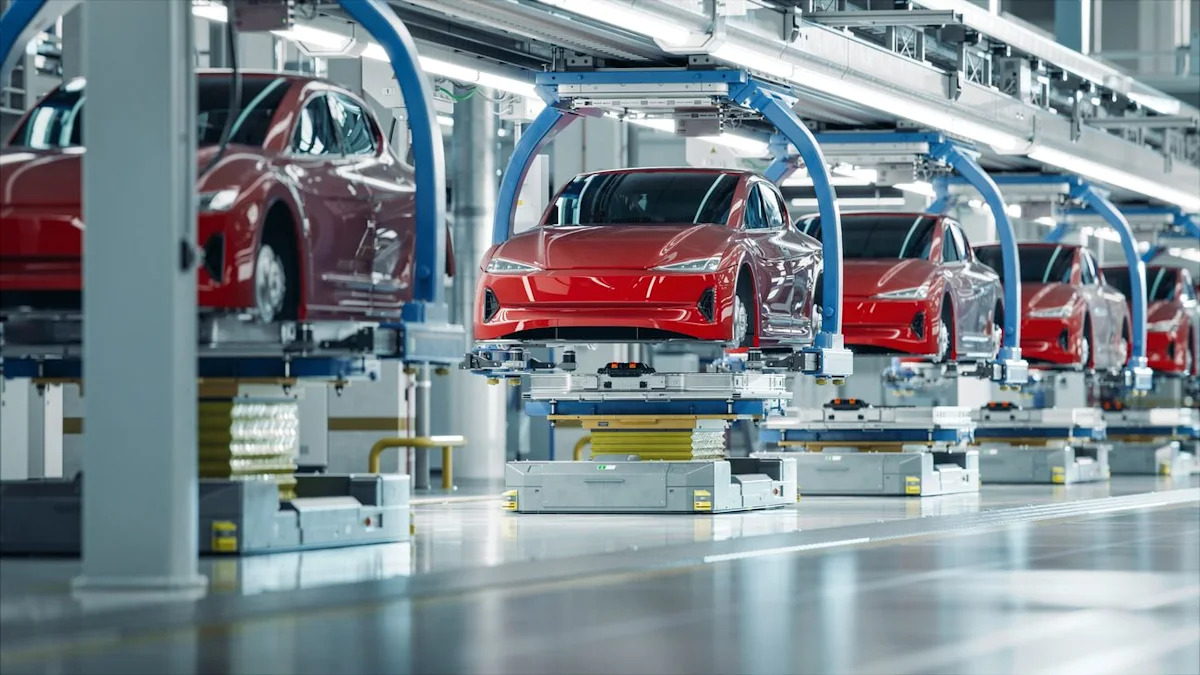
Tesla manufactures electric vehicles and energy storage products, selling them directly through its own retail network rather than using traditional dealerships. Its factories have the capacity to produce more than a million vehicles annually across North America, Europe, and Asia. The company also operates a global Supercharger network for car charging that is increasingly open to non-Tesla vehicles to support broader electric vehicle adoption.
In the 12 months ended Sept. 30, 2026, revenue reached $103.6 billion, which was year-over-year growth of 8.3%. Net income was $3.2 billion during this timeframe. This expansion comes as the company increases its manufacturing, assembly, and service operations globally while maintaining a net margin of 3.1%.
As of its December 2025 balance sheet, the debt-to-equity ratio was 0.1x, indicating a very low level of debt relative to shareholder equity. The current ratio stands at 2.2x, suggesting the company has ample liquid assets to cover near-term liabilities. In the fiscal year ended Dec. 31, 2025, free cash flow reached $6.2 billion.
General Motors faces intense competition from both legacy manufacturers and new software-driven automotive companies. Its electric vehicle strategy is vulnerable to slower consumer adoption and the potential loss of government tax incentives. Additionally, geopolitical tensions in China and a recent $220 million driver data privacy settlement present ongoing financial and reputational risks.
Tesla depends on successfully scaling autonomous products like the Cybercab and the Optimus robot. The company faces significant regulatory hurdles for its self-driving software and relies on suppliers like Contemporary Amperex Technology for battery cells. Financial performance is also sensitive to interest rate fluctuations, and the high concentration of management reliance on CEO Elon Musk.
Tesla carries a significantly higher valuation than General Motors based on its Forward P/E, which compares stock price to future earnings estimates. The P/S ratio measures market capitalization divided by sales over the past twelve months.
Valuation metrics include sourcing from Financial Modeling Prep (FMP) and may differ from other data providers.
Between General Motors and Tesla, I would prioritize buying Tesla stock. I used Tesla's Model Y vehicle to drive me around autonomously. It flawlessly and safely navigated around construction, bicyclists, and rush hour traffic. I describe this experience because it's the future, where self-driving cars chauffeur us while we relax, and Tesla has it available for consumers to own today, well before General Motors, which won't have similar capabilities until at least 2028.
Moreover, Tesla gains recurring revenue for its self-driving feature by charging a monthly subscription for car owners to enable it. This means Tesla continues to generate income beyond the car sale. Customer adoption is growing rapidly. The company reported 75% of new vehicle deliveries in North America adopted the capability in the third quarter, a 20% jump from Q2.
Tesla is leveraging its autonomous competencies for its robotaxi business, which offers ride hailing through a new vehicle designed specifically for self driving, called the Cybercab. The AV was unveiled in September of this year, and Tesla's robotaxi service is seeing double-digit weekly growth, providing an expanding new line of income.
Tesla is leaning heavily into its new AV direction, ending production of its Cybertruck around the middle of 2027 to make room for manufacturing Cybercabs.
Before you buy stock in General Motors, consider this:
The Motley Fool Stock Advisor analyst team just identified what they believe are the 10 best stocks for investors to buy now… and General Motors wasn't one of them. The 10 stocks that made the cut could produce monster returns in the coming years.
Consider when Netflix made this list on December 17, 2004... if you invested $1,000 at the time of our recommendation, you'd have $338,083!* Or when Nvidia made this list on April 15, 2005... if you invested $1,000 at the time of our recommendation, you'd have $1,021,163!*
Now, it's worth noting Stock Advisor's total average return is 830% — a market-crushing outperformance compared to 209% for the S&P 500. Don't miss the latest top 10 list, available with Stock Advisor, and join an investing community built by individual investors for individual investors.
*Stock Advisor returns as of November 13, 2026.
Robert Izquierdo has positions in Tesla. The Motley Fool has positions in and recommends Contemporary Amperex Technology, and Tesla. The Motley Fool recommends General Motors. The Motley Fool has a disclosure policy.
General Motors vs. Tesla: Which Is the Better Automotive Stock to Buy Going Into 2027? was originally published by The Motley Fool