Make California Post a Preferred Source Fourteen years ago, Pedro Guerrero thought his baseball career was ending.
Seven seasons into his minor-league career in the Dodgers’ organization, the utility infielder was 23 years old, still stuck in A-ball and, during a road trip to South Bend, Ind., with the club’s Great Lakes affiliate, coming off what he described as the worst game of his life.
The day before, the Dominican-born prospect got word from back home that his father had nearly died after suffering a stroke. Guerrero, however, kept the tragedy to himself, deciding to quietly play through the adversity as he chased an unlikely big-league dream.
In that night’s game, he dropped a routine pop-up with the bases loaded. After an emotional outburst in the dugout, he was benched for the rest of the evening. And the following day, he was informed that the team’s manager, longtime Dodgers minor-league coach John Shoemaker, was waiting to talk to him at the ballpark.
As he walked over from the hotel, Guerrero prepared himself for the worst.
“I’m like, ‘Oh, boy, this is it,’” he recalled. “My career is over.”
Rather than cutting Guerrero, Shoemaker had summoned him to ask what was wrong, sensing something was off with his typically levelheaded, hardworking minor-league veteran.
“I didn’t want to say, ‘I can’t play today’ or anything like that,” Guerrero recounted in an interview with the California Post this week. “But the fact he just listened to me, gave me a hug, and said, ‘I knew something was up, I’m sorry, I’m here for you,’ it just showed me that he cared enough to notice.”
“I told myself, ‘If I’m ever a coach, I want to be like that,’” Guerrero added. “That’s when I saw how to really make an impact on the player.”
A decade-and-a-half later, the moment has continued to guide Guerrero through a second chapter in his baseball life, inspiring him to pursue a coaching career of his own that, this week, came full circle when he was hired as the Dodgers’ new co-hitting coach in the wake of Aaron Bates’ unexpected departure.
“I can tell you how to change your swing, your bat path, your posture. I can give you drills, whatever it is,” he said. “But a lot of times, it’s not about that. It’s more like, ‘What’s going on in your head?’ What’s happening from the neck up?”
That philosophy has served Guerrero, now 37, well during his unlikely rise through the coaching ranks.
His playing career ultimately fizzled out in 2013, after he hit .236 with 23 home runs in 411 minor-league games. For the next couple of years after that, he worked odd jobs in construction (working on cell towers) and on a factory production line (making airbags for cars) to support his growing family.
But then, ahead of the 2016 season, he received a call from then-Dodgers farm director Gabe Kapler. The club was looking for a bench coach for its rookie-ball affiliate in Ogden, Utah. Guerrero had been recommended by several longtime staffers in the organization.
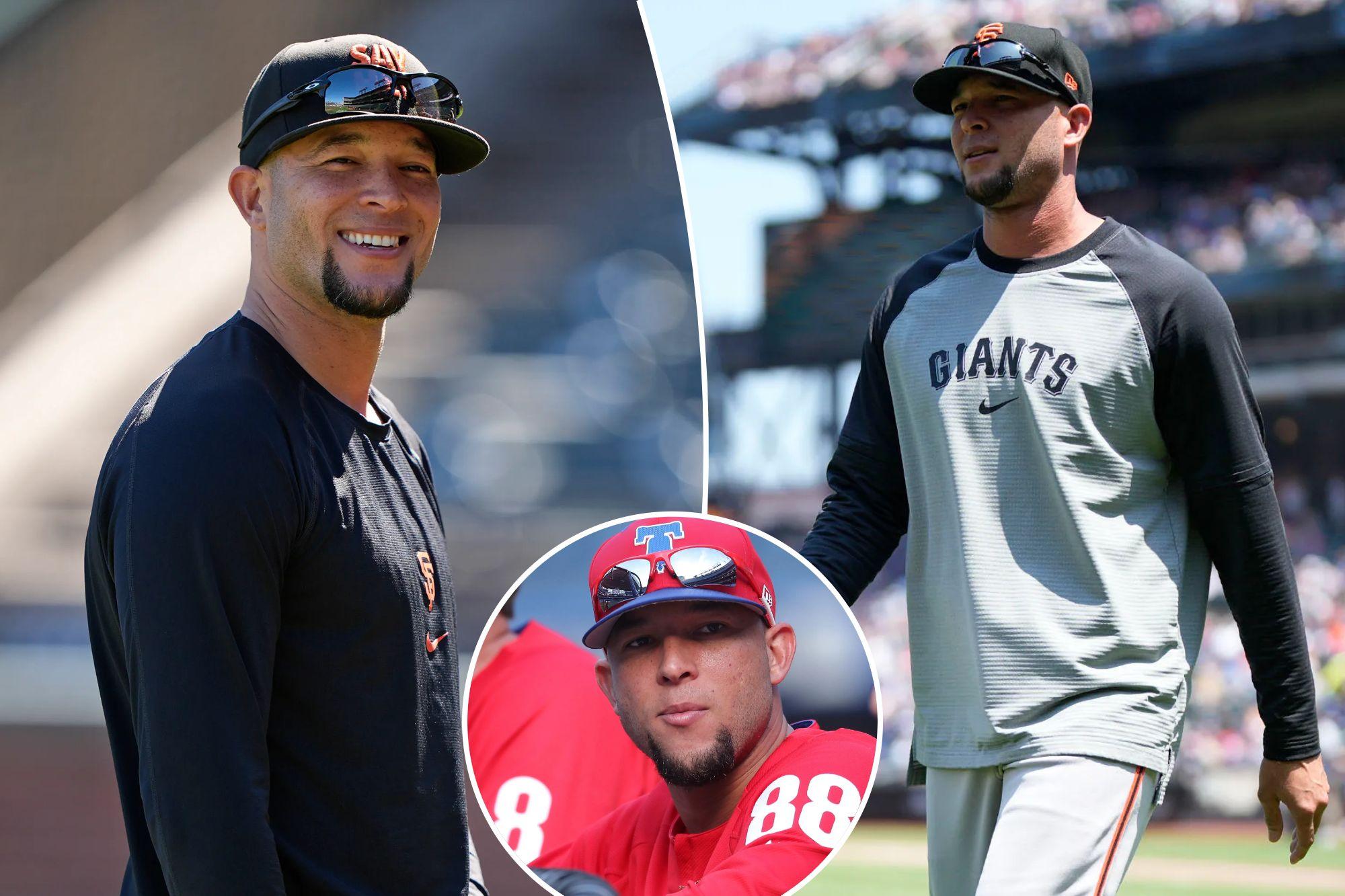
After two seasons in Ogden, Guerrero was hired as an assistant MLB hitting coach in 2018 by the Phillies, joining Kapler after he’d been tabbed as the club’s new manager. Following a four-year stint there, Guerrero reunited with Kapler again in 2022, becoming the assistant hitting coach on his Giants’ staff for the next three seasons.
In 2025, Guerrero got his first chance to be a lead hitting coach, hired by the Marlins after Kapler had joined their front office.
And though he wasn’t retained in Miami following this past season, his work with the club’s young offense (which ranked just 18th in scoring but top 10 in batting average, on-base percentage and OPS) had caught the attention of Dodgers officials, who had already begun pursuing him for an unspecified role when a contract impasse with Bates led to his unexpected departure last week.
“This is kind of something we’ve been talking about for a bit,” general manager Brandon Gomes, who was a pitching coordinator in the Dodgers’ farm system during Guerrero’s initial coaching stint with the club a decade ago, said after Guerrero’s hiring became official on Tuesday.
“[At first], it was independent of Aaron, to be honest. Thinking about how could we bring him on in some role. And then as things shaked out, we figured we would make it official and bring him on board, and then kind of see where we’re at from there.”
Now, Guerrero is preparing for his biggest opportunity –– and challenge –– yet, joining fellow co-hitting coach Robert Van Scoyoc in overseeing a star-studded-but-steadily aging Dodgers lineup.
This year, the team ranked top five in scoring, batting average and OPS. But it also endured a prolonged second-half slump and hit .195 during a failed World Series three-peat bid in the playoffs.
Even before Guerrero’s hiring, Gomes said the Dodgers were planning to “take a step back to reevaluate and understand what are some of the things that we can do better?”
That process will be complicated for Guerrero this offseason by MLB’s looming lockout. He will have just 2 ½ weeks to begin making connections across the roster before the league’s collective bargaining agreement expires on Dec. 1 –– at which point, all communication will be barred between team staff members and big-league players.
“It’s gonna be a little bit challenging,” he acknowledged.
That, however, is where he hopes his long-term familiarity with the franchise will help.
He still vividly remembers learning from club icons including Tommy Lasorda, Don Newcombe, Maury Wills and Manny Mota during his spring trainings as a player in Vero Beach, Fla. In his past coaching stops, he has tried to model the Dodgers’ modern-day success at swinging at strikes, limiting chase and grinding pitchers down with consistently tough at-bats.
“I like to think of it as building the player, not the swing,” he said, explaining how, especially with a roster as established and talented as the Dodgers, “the swings are kind of built at this point, so it’s going back to … are we having team at-bats? How do we execute [with runners in scoring position]? How are we gonna make it really tough for the starter?”
In other words, honing everything above the neck as much as everything below it –– just as he learned when the darkest day of his playing career turned into a launching point for his rise as a coach.
“Are you actually in the present when you have a job to do, like when it’s runners on first and third and you have to hit a sac fly to bring a run in?” he said. “Where’s your mind at? Are you focusing on what you got to do? Or [are other things] taking you away from the present, which is seeing the ball and trying to execute? Those are the things I like to talk about.”