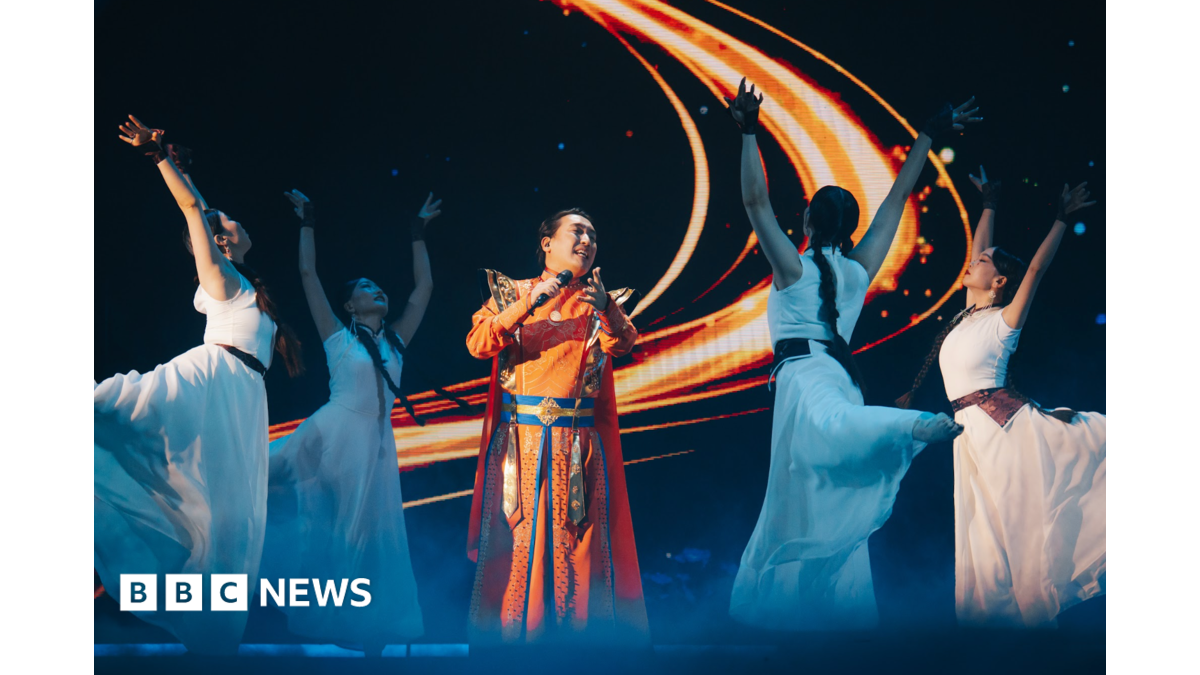
Image source, Eurovision Song Contest AsiaImage caption, Mongolia's Beck debuted as a singer in 2007 and has since made his mark in acting, hosting, modelling and producing
On Saturday, the biggest and longest-running international song contest will make a leap into unknown territory.
Eurovision, the pan-European competition famed for zany gimmicks, slick, sometimes over-the-top staging, the drama of its complex voting system and, occasionally, for outstanding music, celebrates its 70th birthday this year.
And to mark it, the European Broadcasting Union is trying out audiences in Asia.
It's an idea that's been talked about for two decades but never materialised, despite many false starts.
Until now - Eurovision Asia will hold its first grand final in Bangkok, starting at 20:30 ICT (13:30 GMT).
Transferring one of the most successful television formulas that has worked in Europe for 70 years to Asia has not been straightforward, says Sarun 'Note' Kungbunpot, a Eurovision enthusiast and Thai singer who has won several competitions in this region.
"It's still very new in Asia. I'm not sure many people have heard about it yet," he says, adding that he thinks it will take a bit of time for audiences to adjust.
"When we look at contests in Thailand, the Philippines and Korea, we actually compete based on the singer.
"It's all about popularity – fans are looking for their idols. But Eurovision is all about the song, not the singer. I think this needs to be communicated clearly."
Image source, Eurovision Song Contest AsiaImage caption, MANG x DAOU have winning form, having previously been declared champions of the show Thailand's Chosen One
Then there is the long history of Eurovision in Europe. It began in 1956 as a project to encourage greater cultural exchanges in a Europe which was trying to forge a common future after two world wars.
This was the very start of the age of mass television ownership, and Eurovision became such a fixture it is now an indelible piece of Europe's shared cultural heritage. It has no such resonance in Asia, and arrives in this region in the digital age, when traditional TV formats are struggling to cut through.
Only 11 countries are taking part in this first Eurovision Asia contest – host Thailand, along with Malaysia, the Philippines, Vietnam, Cambodia, Laos, South Korea, Mongolia, Bangladesh, Nepal and Bhutan.
Asian giants India, China, Japan and Indonesia are noticeably absent, although there are negotiations ongoing to try to get them into next year's contest, assuming there is one.
There have also been problems with the organisation of this event.
A sudden million-dollar (£760,000) budget cut just three weeks before the final meant many of the technicians familiar with staging Eurovision were not brought to Thailand, and there have been a number of staff resignations too.
Eurovision fans - and there are many passionate followers around the world - have noticed, criticising audio and lighting in rehearsal videos.
To play this video you need to enable JavaScript in your browser.This video can not be played
Watch: Eurovision is coming to Asia - but will it succeed?
The contest's unusual voting system will be unfamiliar to Asian audiences. Like in Europe, Eurovision Asia will determine the winner through a 50/50 mix of public voting and national juries from each of the 11 contesting countries, as well as a 12th "rest of the world" category.
Anyone can vote - you get eight votes once you register - but you cannot vote for your own country's contestant and you must give your votes to at least three others.
The public and jury votes are then converted into points. The most popular song among the Bhutanese or Mongolians, for example, will get 12 points from those countries, while the song ranked last will get zero - the famous "nul points".
Image source, Eurovision Song Contest AsiaImage caption, JUNHEE is a solo singer-songwriter from South Korea who produces bright, mainstream-sounding music
In Europe, there have long been reports of co-ordinated voting to back neighbours, for example the four Nordic countries voting for each other. This seems less likely in Eurovision Asia, but political differences, for example between Thailand and Cambodia after their border war last year, could influence how their audiences vote.
Filipinos, with their passion for singing, are expected to be enthusiastic participants and the 11 million who live overseas might make a difference. But as most live and work in countries which are not participating, their votes will only go into the "rest of the world" pool.
For Bhutan, with a population of less than a million, this is a rare chance to shine on a global stage, which puts some pressure on 24-year-old Thukten Nyendra, the singer representing the Himalayan kingdom in Bangkok with his song Lhayi Semo (The Angel). Before coming here he had never left his country or been on a plane before.
"I'm not a star. I'm just Nyendra over there," he told the BBC. "Nobody knows me. But Eurovision has given me a huge platform. Actually winning would mean the world to us... If I really make it through all of this, it would mean the entire freaking world to us."
Image source, Eurovision Song Contest AsiaImage caption, Nyendra, Bhutan's 24-year-old contestant, is also a journalism graduate
The other characteristic of Eurovision is the song format – no more than three minutes, no more than six people on stage, and no backing band, only taped music.
This encourages performers to prepare elaborate, sometimes outrageous choreography and stunts to impress the audience – think Poland's My Słowianie in 2014 with models in traditional costume churning butter on stage, or the Finnish heavy metal band Lordi donning flamboyant monster outfits in its 2006 entry.
There has also been a long association of Eurovision with LGBTQ+ artists. Eurovision Asia includes Malaysia and Bangladesh – where same-sex activity is illegal – and there are no visible LGBTQ+ elements this year.
Performers have been using the last days of rehearsals before the final to try to make their stage acts as striking as possible. Thinla from Laos has abandoned the short, sequinned dress she wore in the first video of her infectious reggaeton song Bae and is adopting Lao hill-tribe costume for her and her backing dancers.
Image source, Eurovision Song Contest AsiaImage caption, Thinla's music blends traditional Lao and contemporary genres, such as pop, R&B and dance
Perhaps the most ambitious choreography is in Vietnamese singer Tóc Tiên's song Em Tiên ("Fairy Maiden").
It has been exhausting just watching her rehearse the elaborate moves and costume changes for more than an hour at a time.
The entry from Bangladesh's Beatmosphere, Tumi Ele ("You Came"), is unusual as an a cappella and beatboxing performance by six men with little backing music.
The youngest contestant is 19 year-old Carmelle Collado from the Philippines, whose bubbling confidence and strong stage presence in her song Sobra-Sobra ("Too Much") belie her youth.
"I'm actually quite scared because I'm the youngest, but also really happy," she told us.
"The song is about feminine energy. It's about being brave, strong, fierce, and it's about how strong Filipino women are."
Image source, Eurovision Song Contest AsiaImage caption, Bangladesh's Beatmosphere blend traditional vocal harmony with beatbox culture
Image source, Eurovision Song Contest AsiaImage caption, Carmelle Collado rose to prominence through a selection of televised singing competitions in the Philippines
Eurovision is famous for putting unknown acts onto a global stage, and introducing musicians who went on to become megastars – think Abba, little known when they won in 1974 with Waterloo, and Celine Dion winning in Ireland in 1988.
Because of the lack of public awareness of Eurovision Asia many of the finalists chosen for this first contest are already well known in their home markets.
Aina Abdul is perhaps the most famous singer in Malaysia, known as much for dramatic costumes as her impressive vocal range. Her song Bluest Sky – which she told us was inspired by her late cat Hiro – is a strong contender to win the contest.
Image caption, Malaysia's Aina Abdul laughs as designer Melinda Looi adjusts her dress before a media shoot
Abdul's spectacular dress, by Malaysian designer Melinda Looi, who has travelled to Bangkok with her, had taken 600 hours to make, she told me. She said its glistening texture, made from materials brought from Italy and China, is meant to represent moving water.
If all goes well on the night, the organisers are hoping this could be the start of an expansion of the hugely successful Eurovision brand into a region which, after all, has half the world's population.
Eurovision Song Contest launches first-ever Asia edition
Eurovision is here! How much do you know about Europe's biggest pop spectacular?
Anti-work anthems, Boy George and controversial lyrics: A guide to all 35 Eurovision songs