The S&P 500 Has a “Pure Value” Version. RPV Gives Its Cheapest Stocks the Biggest Weights Ryne Mauck Fri, November 13, 2026 at 12:03 PM EST 5 min read ^GSPC -0.72% CNC -1.76% ADM +0.90% SPY -0.71% IVE -0.05% Explore stocks on Coinbase Trading disclosure Trading disclosure The above button links to Coinbase. Yahoo Finance is not a broker-dealer or investment adviser and does not offer securities or cryptocurrencies for sale or facilitate trading. Coinbase pays us for certain activity generated through this link. Prices displayed are informational.
RPV weights S&P 500 stocks by value score, so the cheapest companies get the biggest positions, and it has returned 21% this year.
RPV's top holdings include Centene and Archer-Daniels-Midland at roughly 3% and 2%, while SPY's tech giants are absent from the top.
Over ten years RPV gained 178% while SPY gained 250%, showing how long growth-led markets can leave pure value behind.
Many financial professionals are salespeople paid on what they push, not whether you end up wealthier. A fiduciary is the opposite. The SEC legally requires them to put your interests first. Advisor.com's free matching tool pairs you with vetted fiduciaries from major national firms, all in under three minutes. See who you match with today.
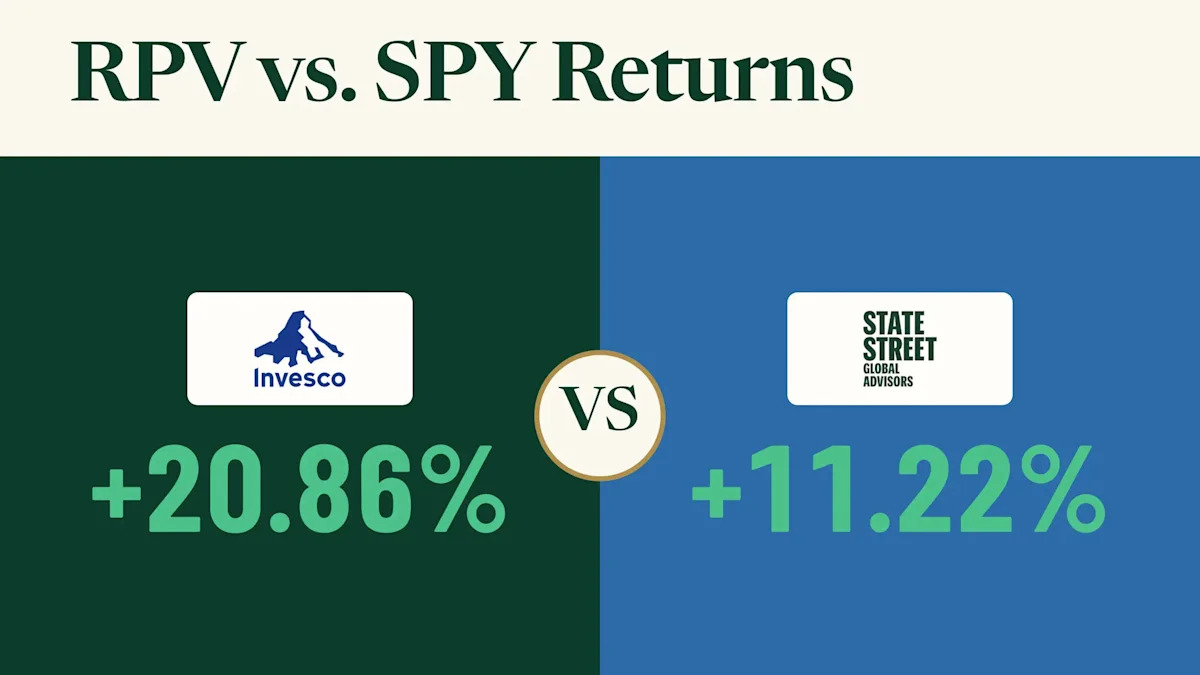
If you own an S&P 500 index fund, your largest positions are the companies that have grown the most. In SPDR S&P 500 ETF Trust (NYSEARCA:SPY), the top holding alone takes 7.58% of assets, and large technology and communications companies fill most of the top 10. A lesser-known version of the same index works the other way around. Invesco S&P 500 Pure Value ETF (NYSEARCA:RPV) picks from the same 500 companies and gives the cheapest ones the biggest weights. This year, that has paid off. RPV is up 20.86% year-to-date, while SPY is up 11.22%.
The S&P 500 Pure Value Index draws only from S&P 500 members, keeps the stocks with the strongest value characteristics, and weights them by value score rather than by company size. In practice, that means stocks trading at low pricing multiples. The deeper the discount, the larger the position.
The best-known value alternative works differently. iShares S&P 500 Value ETF (NYSEARCA:IVE) mirrors a benchmark of large-capitalization U.S. equities that exhibit value characteristics, but it weights those stocks by market cap. The biggest value companies still lead IVE. In RPV, the cheapest ones lead.
Most Americans suspect they're behind on retirement and never find out. Advisor.com's free matching tool pairs you in about three minutes with a vetted fiduciary advisor who can help you with investing, taxes, retirement, estate planning, and more. No minimums. No sales call. Find out where you stand.
In RPV's most recent holdings report, dated July 31, 2026, the largest position was Centene (NYSE:CNC) at 2.53% of net assets. Archer-Daniels-Midland (NYSE:ADM) came next at 2.20%. After those two came another health insurance company at 2.17%, a crop trader at 2.09%, a pharmacy chain at 2.07%, and two Detroit automakers at 2.02% and 1.89%. Further down the list are oil refiners, chemical makers, insurance companies, airlines and utilities.
None of SPY's tech leaders show up near the top. RPV's largest position is only about a third the size of SPY's, so the money is spread across many less-popular companies rather than concentrated in a few giants. The fund held $1.68 billion in net assets.
RPV and IVE figures are adjusted for distributions. SPY figures reflect price change only, which understates its total return. Over the past year, RPV led clearly. Over a decade, it trailed both funds.
On cost, IVE charges 0.18%, and SPY charges 0.0945%. RPV is more expensive at 0.35%. RPV pays distributions quarterly, totaling $2.52623 per share over the trailing 12 months, which works out to a yield of about 2.06% at the latest price of $122.73. Payments change from quarter to quarter. In 2025, they ran from $0.54696 to $0.81563.
Sector concentration: Health insurance companies, refiners, chemicals, automakers, and financial firms carry the largest weight, and these groups can stay out of favor for years.
Value traps: Some stocks are cheap for a reason, such as shrinking profits or legal pressure. A score-weighted index puts more money into the most deeply discounted names, which can include troubled ones.
Long periods of lagging: The ten-year gap against SPY shows how long a growth-led market can leave pure value behind.
Uneven income: Distributions change every quarter, so the fund is a poor fit for anyone who needs a fixed payment.
With $1.68 billion in net assets, RPV is a smaller fund next to the top S&P 500 trackers. Its returns can drift far from the index both ways, so advisors who are measured against the S&P 500 tend to avoid it. Score-based weighting is also harder to explain than market-cap weighting, and most retirement plans offer only the standard value and blend funds.
RPV could fit retirees whose portfolios are already heavily invested in the S&P 500's tech leaders and who want a balance tied to cheap valuations, quarterly income, and an index they already understand. It is a poor fit for investors who cannot stand years of trailing the market or who want a fixed payout. Things to track next: whether the gap in RPV's favor this year holds up, how its sector mix changes at the next rebalance, and how its expense ratio compares with IVE's.
Most Americans have no idea where they actually stand. Most guess, or hope Social Security and a 401(k) will work out. Advisor.com's new matching tool gives you a real answer, free.
They pair you with a fiduciary (required by law to put YOUR interest first) with questions related to taxes, estate planning, retirement, insurance analysis, and more. See who you match with today, and get the answers you need.
Contact editorial@247wallst.com for any questions or corrections.