NVIDIA Is Now Down 30% in a Month: Bessent Asks Whether NVIDIA Knew Its Clients, Dan Ives Says Huang Was Worth $1 Trillion David Moadel Fri, November 13, 2026 at 12:03 PM EST 6 min read NVDA -3.50% MRVL -6.49% MU -4.91% Explore stocks on Coinbase Trading disclosure Trading disclosure The above button links to Coinbase. Yahoo Finance is not a broker-dealer or investment adviser and does not offer securities or cryptocurrencies for sale or facilitate trading. Coinbase pays us for certain activity generated through this link. Prices displayed are informational.
NVIDIA (NVDA) has dropped 30% in a month after Jensen Huang resigned as CEO amid scrutiny of his ties to a Singapore chip-rental firm.
Treasury Secretary Scott Bessent says the real question is whether NVIDIA knew its clients and prevented chip leakage to China.
Dan Ives says Huang is worth $1 trillion, or $75 per share, while Ed Yardeni calls any selloff a buying opportunity.
Building a portfolio and living off one are two completely different skills, and almost nobody teaches the second. This problem is what The Definitive Guide to Retirement Income helps, and it is free today. Read more here. (Sponsor)
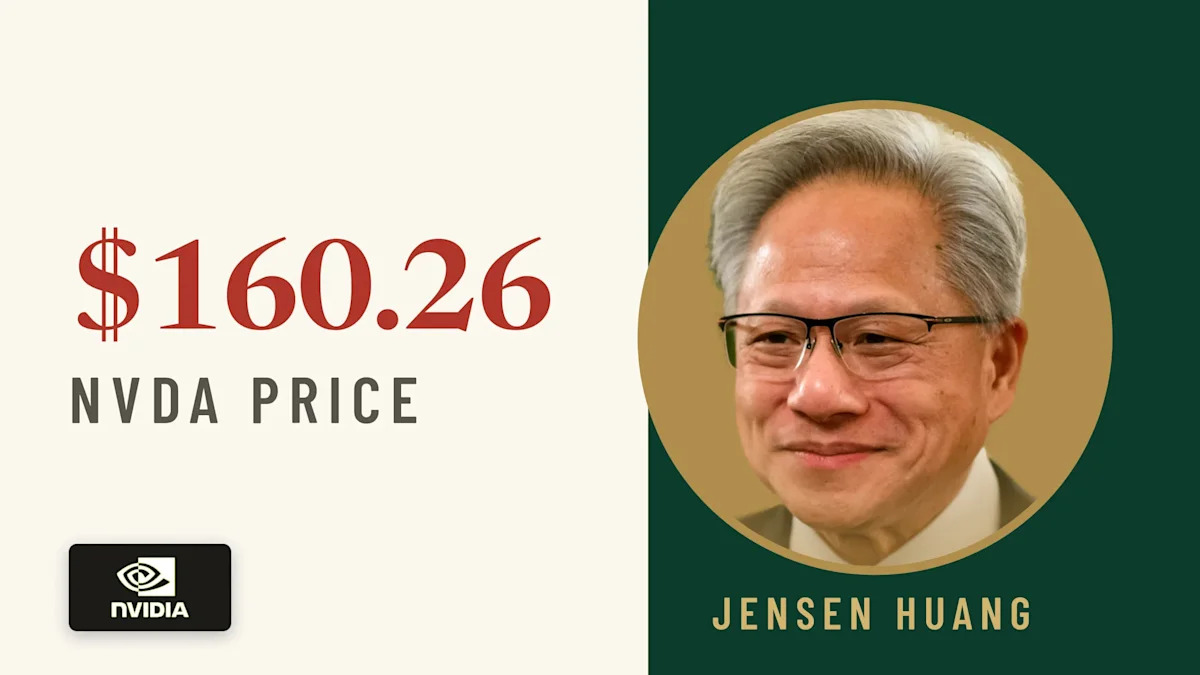
Washington has turned the leadership shock at NVIDIA (NASDAQ:NVDA) into a question about who ends up with its chips. NVIDIA stock is down 30% over the past month, trading at $160.26. The decline includes a 4% drop from the prior session's close, which came after Jensen Huang stepped down as CEO on November 12.
Huang's exit followed scrutiny of his ties to an executive linked to Megaspeed, a Singapore company that rents out NVIDIA chips. Interim leadership went to CFO Colette Kress, who keeps her finance role, Bloomberg reported. The company's independent directors had already hired former Acting U.S. Attorney Jun H. Kim to probe whether Huang was targeted by foreign intelligence.
Treasury Secretary Scott Bessent told CNBC on November 13 that the real story is "Did Nvidia know their client, and was there a robust effort at Nvidia to make sure that there was no leakage." He said decisions on Megaspeed's access to NVIDIA hardware rest with the Commerce Department's Bureau of Industry and Security. Bessent also repeated that China shouldn't receive any NVIDIA chips above H100s.
Many successful investors eventually reach the same moment. The saving is done, the portfolio is built, and the question quietly changes from how much can I grow this to how much can I take out? Get that second question wrong and decades of good investing can come apart in a handful of years.
That is exactly what The Definitive Guide to Retirement Income helps answer. It covers what your retirement could actually cost, which income sources are worth using, and the withdrawal math that decides whether the money lasts. It is free today from Fisher Investments. Read More Here ›
NVIDIA's clearest public answer came on its August 26 earnings call, when Kress said "In Q2, we shipped less than 1% of our total data center revenue in Hopper 200 products to customers based in China in accordance with U.S. government licenses." The company's forward outlook carries no China data center compute revenue, Kress noted. Reuters has identified more than $3 billion in Chinese computing projects built around restricted NVIDIA processors.
On the same call, Kress stated that "This compute we ship will be consumed by investment-grade customers or those that are backed by one." That call didn't explain how NVIDIA checks the ultimate users of its customers' systems, which is the gap Bessent's comments target.
Dan Ives of Yorkville Ives told Bloomberg TV that Huang was worth $1 trillion to NVIDIA's valuation. In per-share terms, Dan Ives framed it this way: "The valuation without Jensen is $225 per share. With him, it's $300."
NVIDIA remains two to three years ahead of China and its U.S. competitors, according to Dan Ives, though he said that Huang's departure "clearly evens the playing field." Yorkville Ives kept its Outperform rating on the chipmaker.
Ed Yardeni said in a research note that Huang's exit raises concerns about NVIDIA's role in financing AI infrastructure. His conclusion stayed constructive: "Our base case is that NVIDIA's financing strategy remains intact." Yardeni added that he'd treat any resulting selloff as "another buying opportunity for the AI trade."
That strategy sets NVIDIA apart from a conventional chip seller. On the August 26 call, Kress said the company would help frontier AI labs access infrastructure funded by long-term institutional capital, while adding "We're not making loans." She described a model in which "we get paid twice: once on the hardware sale and again through the share of rental revenue, a highly recurring stream layered on top of a one-time equipment purchase."
Huang agreed to testify in a closed-door House session before Thanksgiving. Commerce Secretary Howard Lutnick agreed to appear voluntarily before the Senate Banking Committee on December 10, putting NVIDIA's export approvals under a second spotlight.
The bears point to NVIDIA's balance-sheet commitments, including guarantee obligations capped at $108.5 billion for AI cloud and data center partners. NVIDIA's days sales outstanding also rose to 60 days from 45 days on extended payment terms. The bulls counter that NVIDIA's Q2 FY2027 revenue reached $96.22 billion, up 105.8% year over year (YoY), with data center revenue up 117% YoY. Management also guided its Q3 FY2027 revenue to $108 billion, excluding any China data center compute sales.
Certain, NVIDIA stock isn't the only technology stock that's down over the past month. For example, Micron (NASDAQ:MU) stock is down 20% over the past month to $758.04, and Marvell Technology (NASDAQ:MRVL) stock is down 43% during that timeframe to $153.56. Still, NVDA stock's recent decline is a cause for concern among tech-sector investors.
For NVIDIA, the issue now is whether the board's review and the coming testimony show a robust effort to keep restricted chips out of China. Key dates to watch for are Huang's House session and Lutnick's Senate appearance. A further checkpoint arrives when NVIDIA reports its Q3 results against the company's revenue outlook.
Clear answers on customer screening could let NVIDIA's growth record reassert itself, while fresh evidence of chip leakage could compound the decline. Volatility in NVDA stock could continue until Washington's review of NVIDIA's customer screening concludes.
(Sponsor) Most people spend their entire working lives focusing on one thing: growing a pile of money. Then they retire and discover the skill they actually need is close to the opposite. Turning that pile into steady income, year after year, through good markets and bad, without ever running out.
It may be the least discussed and most consequential transition in personal finance, and plenty of otherwise careful investors walk into it with no real plan. That is exactly what The Definitive Guide to Retirement Income helps answer. It is a free guide from Fisher Investments covering what your retirement will really cost, where the cash flow should come from, and how much you can safely withdraw each year. Learn more here. Learn More Here ›
Contact editorial@247wallst.com for any questions or corrections.