Vanguard Has an ETF That Chases Winning Stocks on Purpose. Most VOO Owners Have Never Heard of VFMO Ryne Mauck Fri, November 13, 2026 at 6:33 AM EST 6 min read VOO +0.28% ^GSPC -0.35% FTNT +0.80% AMD -1.76% AXTI +1.52% Explore stocks on Coinbase Trading disclosure Trading disclosure The above button links to Coinbase. Yahoo Finance is not a broker-dealer or investment adviser and does not offer securities or cryptocurrencies for sale or facilitate trading. Coinbase pays us for certain activity generated through this link. Prices displayed are informational.
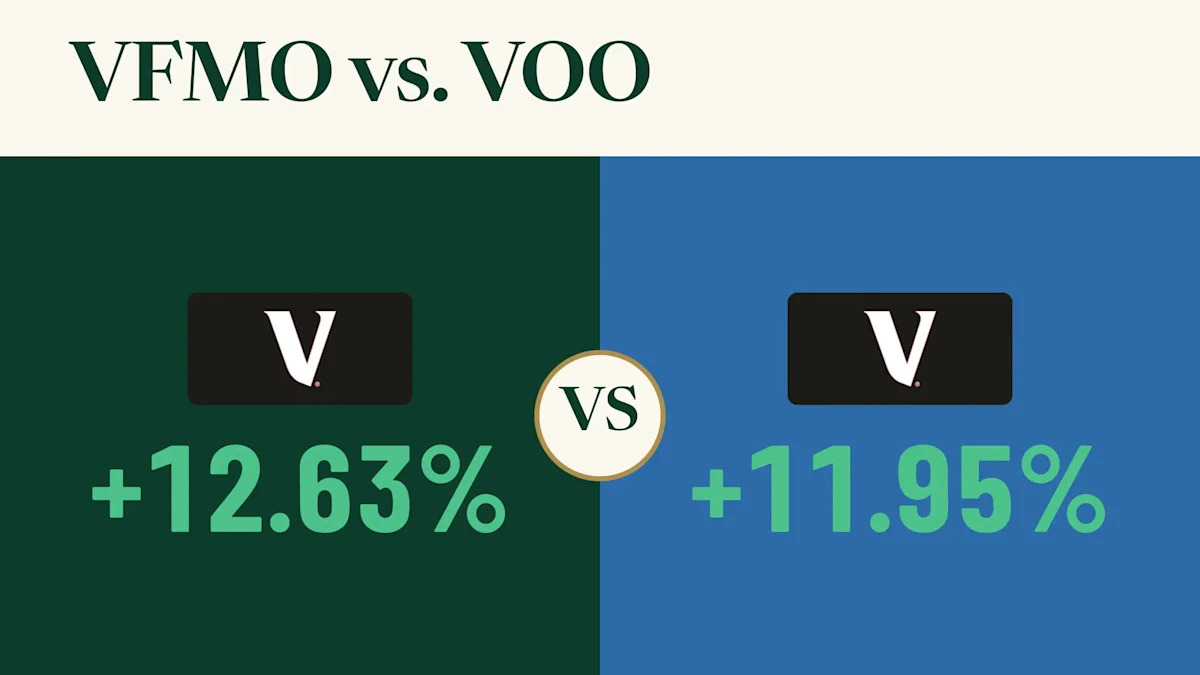
VFMO buys recent winners on purpose and has edged VOO this year, roughly 13% versus 12%, but trails badly over five years, 60% versus 74%.
VFMO reaches beyond mega caps, holding Fortinet and AMD as top positions alongside small companies like AXT Inc, with no single stock dominating.
Momentum can reverse sharply when market leadership shifts, so VFMO suits long-horizon investors as a small satellite next to VOO, not retirees drawing income.
Building a portfolio and living off one are two completely different skills, and almost nobody teaches the second. This problem is what The Definitive Guide to Retirement Income helps, and it is free today. Read more here. (Sponsor)
If you own the Vanguard S&P 500 ETF (NYSEARCA:VOO), you hold one of the best-known low-cost funds in the country. It charges a 0.03% expense ratio and owns the S&P 500 in proportion to each company's size. Vanguard also runs a fund built on a very different idea. The Vanguard U.S. Momentum Factor ETF (CBOE:VFMO) buys the stocks that have been winning, and does it on purpose. In 2026, it has slightly outpaced VOO while holding a very different portfolio.
Momentum investing means buying stocks that have recently outperformed, on the theory that winners keep winning for a while. Trends often continue because investors and analysts adjust their views slowly. A momentum fund tries to ride those trends and moves on once a stock's relative strength fades.
VFMO belongs to Vanguard's range of actively managed ETFs. Its managers use a quantitative methodology to evaluate U.S. companies of all sizes, then apply a rules-based screen to keep the portfolio diversified and limit exposure to thinly traded stocks. Its benchmark is the Russell 3000, but it owns a much smaller slice of that universe.
Many successful investors eventually reach the same moment. The saving is done, the portfolio is built, and the question quietly changes from how much can I grow this to how much can I take out? Get that second question wrong and decades of good investing can come apart in a handful of years.
That is exactly what The Definitive Guide to Retirement Income helps answer. It covers what your retirement could actually cost, which income sources are worth using, and the withdrawal math that decides whether the money lasts. It is free today from Fisher Investments. Read More Here ›
VOO weights its holdings by market cap, so the largest companies get the biggest share of every dollar you invest. VFMO weights holdings by its own model, and it reaches well past the mega caps. In its August 31, 2026 portfolio filing, the larger positions included Fortinet (NASDAQ:FTNT) at 0.88% of net assets and Advanced Micro Devices (NASDAQ:AMD) at 0.83%. Alongside them sat small companies such as AXT Inc (NASDAQ:AXTI) at 0.16%, plus a long list of small biotech and technology names.
No single stock dominates. The portfolio includes semiconductors, health care, biotechnology, financials, industrials, energy, transportation, consumer companies, and aerospace. Net assets reached $1.92 billion as of August 31, up from $1.84 billion at the end of May.
The two funds are compared on an adjusted-price basis through November 12, 2026:
VFMO has inched ahead this year and over the past 12 months, while VOO holds a clear lead over five years. Since February 15, 2018, VFMO has gained 200.53%. VFMO's one-week gain was more than double VOO's, and its one-month loss was roughly twice as deep.
On cost, VOO charges just 0.03%, while VFMO's fee is quite low for active management (0.13%).
Momentum strategies can reverse sharply when market leadership changes. When last year's winners suddenly fall out of favor, a momentum fund holds them at full weight until its model moves them out. Turnover is built into the design, since the portfolio must keep replacing fading leaders with new ones as market leadership shifts. The fund's small-company exposure adds another layer of volatility.
Vanguard built its reputation on indexing, and VFMO asks that same audience to trust active stock selection. Its own analysts acknowledge that, after decades of advocating the opposite, convincing investors that some managers can beat the market remains a challenge. The fund also has a shorter track record, with trading history going back to 2018, and it lists on Cboe instead of the exchanges where most of Vanguard's main ETFs trade. At roughly $1.92 billion in net assets, it is tiny next to VOO.
Some investors use VFMO as a small satellite position next to a core VOO holding. It suits investors with a long horizon for part of their portfolio who want exposure to mid and small caps that VOO leaves out, and who can sit through sharp monthly declines without selling. Chasing strength works best with safety rails, the ten rules we laid out in a free breakout guide on buying at new highs without one bad trade wrecking the account.
Its design may be a weaker match for retired people drawing regularly from their portfolio, anyone who needs predictable returns, and investors who want the lowest possible fee. For them, VOO's simplicity remains hard to improve on.
Going forward, track VFMO's next quarterly holdings filing to see where the model moves. Also watch whether its slim one-year lead over VOO holds if market leadership shifts away from today's winners.
(Sponsor) Most people spend their entire working lives focusing on one thing: growing a pile of money. Then they retire and discover the skill they actually need is close to the opposite. Turning that pile into steady income, year after year, through good markets and bad, without ever running out.
It may be the least discussed and most consequential transition in personal finance, and plenty of otherwise careful investors walk into it with no real plan. That is exactly what The Definitive Guide to Retirement Income helps answer. It is a free guide from Fisher Investments covering what your retirement will really cost, where the cash flow should come from, and how much you can safely withdraw each year. Learn more here. Learn More Here ›
Contact editorial@247wallst.com for any questions or corrections.