AI spending fears shake Wall Street as investors seek safety Ricki Lee Fri, November 13, 2026 at 2:00 AM EST 16 min read GC=F +0.38% AI spending concerns shake markets as small caps seek growth ©AI spending concerns shake markets as small caps seek growth Key Takeaways Investors are questioning whether massive AI infrastructure spending by technology giants will deliver sufficient returns.
US Treasuries are attracting safe-haven interest, while gold and silver have struggled despite market uncertainty.
Critical minerals financing remains active, although junior mining share prices have faced pressure.
Is Wall Street beginning to question the price of the artificial intelligence revolution?
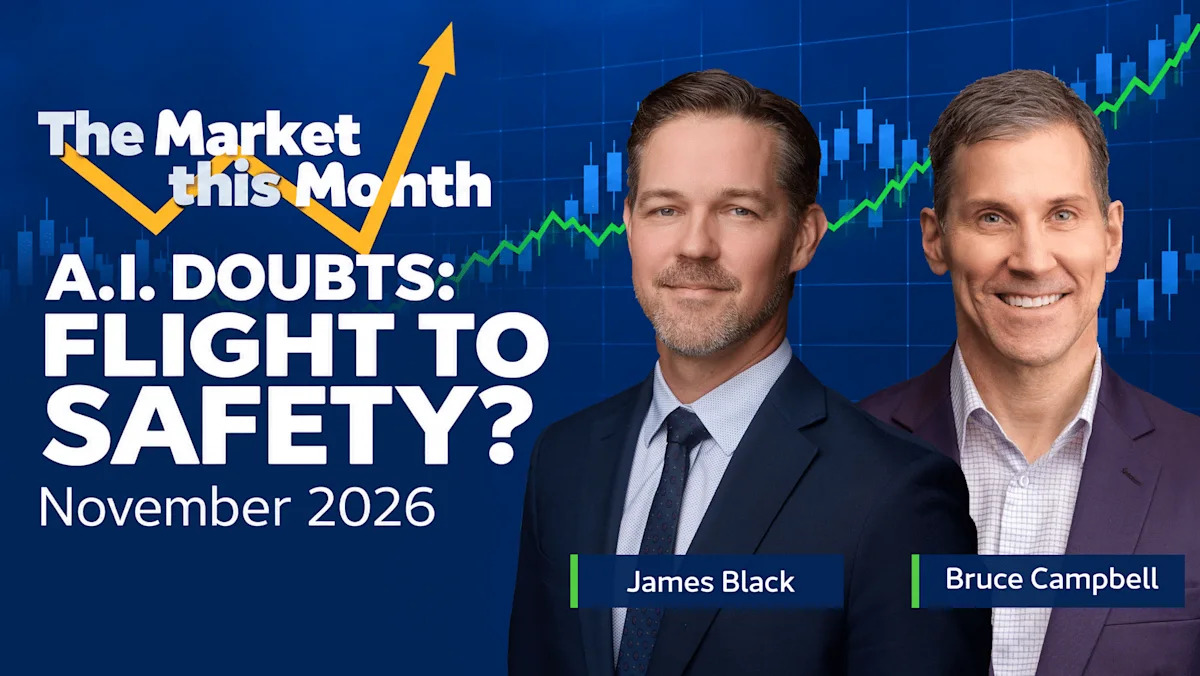
In the November edition of The Market This Month, Bruce Campbell of StoneCastle Investment Management joins Canadian Securities Exchange VP James Black to examine growing concerns about AI spending, market volatility and the outlook for smaller companies.
Campbell says major technology companies are committing enormous sums to AI infrastructure, with some moving from positive cash flow towards significant capital expenditure. Investors are increasingly questioning when those investments will generate returns.
Even relatively strong corporate earnings have struggled to reassure markets, with selling pressure affecting several prominent technology stocks.
This content has been prepared as part of a partnership with the Canadian Securities Exchange and StoneCastle Investment Management and is intended for informational purposes only.
The uncertainty has also influenced traditional safe-haven investments. While US Treasuries have attracted interest, gold and silver have weakened, prompting questions about the influence of interest rates and US dollar strength.
Campbell suggests an economic slowdown could eventually support precious metals, although the timing remains uncertain.
Beyond technology, the discussion examines Federal Reserve policy, inflation, gasoline prices and the potential implications of the US midterm elections for financial markets.
The junior mining sector also remains in focus. Black highlights Critical One Energy's announced antimony investment and offtake arrangement as an example of continued financing interest in strategic minerals.
Campbell notes that critical minerals companies have attracted capital despite weaker share-price performance, suggesting the sector could be experiencing a period of consolidation.
Looking ahead, the pair identify interest rates, trade negotiations and potential AI-related IPOs as developments worth monitoring.
Watch the full episode above or read the transcript below and join the discussion on iHub. Is the AI sell-off a temporary reset, or are investors beginning to reassess the valuations driving Wall Street's technology boom?
The Canadian Securities Exchange presents your go-to source for trends in junior and small-cap markets. Each month, join host Anna Brynelsen and financial expert Bruce Campbell in partnership with Stockhouse.
James Black: Hello, everyone, and welcome to the November edition of The Market This Month. I'm James Black, VP of Marketing and Communications at the Canadian Securities Exchange, sitting in for Anna Brynelsen.
A quick note before we start: we're recording on November 3, US election day. By the time you hear this, the results will be in from the midterms. So think of today's conversation as what markets were watching going in.
October gave them plenty. The AI trade that has carried US markets for the better part of three years ran into a brick wall.
The Nasdaq had its worst month since March 2025. On the last day of October, the Nasdaq 100 fell 3.5 per cent in a single session after earnings from some of the biggest AI spenders deeply disappointed.
The question investors are asking is simple: will hundreds of billions in AI spending pay for itself?
With a handful of mega-cap names making up roughly a third of the S&P 500, when they wobble, the whole index and market feels it.
And where did the money actually go? Into US Treasuries.
The 10-year yield hit its highest level since 2002 in early October, then fell back below five per cent as investors went looking for safety.
Meanwhile, central banks split. On October 28, the Fed held rates at 3.75 to four per cent, while the Bank of Canada raised its rate to 2.5 per cent, its first hike since 2023.
Gold and silver didn't get the safe-haven bid you might expect either. Both slid as the sell-off spread.
And at the pump, Americans headed to the polls with gasoline around US$4.30 a gallon, a record for this time of year.
Here at the CSE, we welcomed six new companies since our last episode: St. James Gold, Algo8 AI, ProAm Explorations, DGen Technologies, G3 Goldfields and Lunar Aerospace.
Capital kept moving, too. Aethra Metals closed an 8.36 million brokered LIFE offering. Lighthouse Gold upsized its private placement to up to 6.45 million. Temper Med launched a LIFE offering of up to eight million to support its global expansion. And Rise NanoOptics proposed a non-brokered placement of up to five million.
The big one was Critical One Energy announcing a $425 million investment and an offtake agreement for antimony from its Howells Lake project, a mineral governments now treat as strategic.
So, is the AI sell-off a reset or something bigger? Why didn't gold and silver hold up? And what does all this mean for small caps heading into year-end?
I'm joined, as always, by Bruce Campbell of StoneCastle Investment Management.
Welcome to this month's episode of The Market This Month. For those watching, I'm your special guest host, James Black, and I'm taking Anna's seat for today's episode.
Thank you, Anna, for letting me join Bruce for this special recording.
Bruce Campbell: Things are going well, for sure.
James Black: Awesome. Look, it's been another crazy, chaotic month in the markets. We both stand on the front lines of this thing, so where to begin?
This month, I definitely want to talk about the volatility in the world of AI.
We've seen havoc wreaked on the Dow Jones Industrial Average and the Nasdaq with all these changes we're seeing in the AI space.
In particular, there's distrust around all this expenditure, with very little understanding about when the payback is going to be.
From your perspective, where do you see this industry going? How would you even try to take its temperature as someone who's advising clients on where to be?
As we saw last month, a lot of money went back into Treasuries, which are considered a safe haven when things can't be understood in this space.
Bruce Campbell: It sure has been volatile.
That seems to be the thing everyone's puzzled by and trying to figure out: all this expenditure.
A lot of these big hyperscalers went from being cash-flow positive to burning cash to spend all this money building the physical infrastructure they need for AI.
The market's wondering: is there going to be payback? Is there going to be commoditization?
As we've seen over the last three or four months, it seems like it's sell first and ask questions later, rather than wait and see what happens.
The other thing we've seen is that even with relatively decent results from a lot of companies in that sector, the market now seems to be selling those names down.
It's certainly a time when we're seeing a lot of volatility.
James Black: Of course, we've seen Google, Alphabet as we know it now, get particularly hammered, and Meta as well.
Then, when you have the CEO of Anthropic putting out signals that they want to have a $2 trillion IPO, and you see the corporate governance structure for that company, it makes you wonder where this whole thing is headed.
I don't know what to predict, but all I know is I use this stuff every day now, and I'm coming to rely on it more and more.
Maybe there is proof here that there's an industry, but there's a lot to figure out.
Bruce Campbell: I think that's the case with most people.
There aren't too many people you talk to who aren't using it more and more.
Even people who may not recognize that they're using it are using it in a lot of cases. That's just going to continue to be adopted in software and applications that we use.
Even now, you're starting to see situations where you call to make an appointment somewhere and you're talking to an AI receptionist.
James Black: I can assure those watching today, we are not AIs.
Speaking of things that are tangible, obviously precious metals, silver and gold, you'd think that with a flight to safety, people would be flocking to these assets.
Bruce, I know you regularly keep your finger on the pulse of gold and silver prices.
Contrary to what we just discussed, shouldn't these assets have gone up in price rather than scaled back?
Bruce Campbell: You would certainly think that.
The most recent move is probably the most puzzling.
When we saw interest rates going up, you would expect gold, silver and other precious metals to start declining because there's no interest paid with gold.
From a competitive standpoint, you can buy Treasuries, and there would be some flow towards those investments.
But then we saw interest rates peak, especially in the US, and start to come down.
At the same time, we still haven't seen gold even start to find a base. It's still one step forward, two steps back on its way down.
It might have a little bit to do with the US dollar and a flight to safety into the dollar rather than gold itself.
We've been a little puzzled and continue to watch.
If we see an economic slowdown, that's a time when you could actually start to see gold accelerate.
Think back to 2008. I'm not saying that's the scenario now, but when we saw oil run up into the summer of 2008, we actually saw gold sell off quite dramatically.
Then, when it became apparent that the market and the economy were really starting to slow, we saw this big move up in gold.
If interest rates start coming down, perhaps we'll see a bigger move up in gold, or at least a sustained move.
James Black: When you consider those foundational pieces of how you project the market and look at what's going on, you're obviously a fan of looking at Fed rates.
We also recently saw the Fed hold and the Bank of Canada hike on the same day.
What does that mean for those watching the market and trying to predict what's happening?
Bruce Campbell: If you look at what happened with the Fed, I suspect a lot of that had to do with politics.
They probably would have hiked if there hadn't been an election approaching.
As a result, I think that gets pushed off into December. They probably would have hiked at the same time as the Bank of Canada, but politics got in the way.
At the beginning of the year, there was an expectation that rates were actually going to be lowered, and now they're going to be increased.
What we like to watch is the two-year yield versus the Fed funds rate.
When the two-year yield starts moving up, it tends to lead the Fed.
At one point, there was a whole one-percentage-point difference between those, which would mean four 25-basis-point Fed hikes.
We've now started to see that difference decline a little and come back into line.
It looks like the market is pricing in two hikes, but that will also have a lot to do with inflation.
We expect inflation will probably be higher over the next couple of months, but then the base effect from a year ago starts to bring inflation down.
Unless we see oil really exploding higher again, we should actually see inflation start to moderate.
Perhaps at that point, the Fed makes its hike in December and then sits tight.
James Black: That leads us to where we are today.
We're recording this on November 3, 2026, the day Americans go to the polls for the midterms.
They're obviously looking at a potential congressional flip, maybe a Senate flip, and there are a lot of issues being discussed around this election and its aftermath.
We're looking at around US$4.30 a gallon, which was a record for autumn.
What do you make of this, Bruce? Is there any effect here in Canada that we should be aware of?
And after the election, you've said there are some triggers that might be hit. But it really depends on who gets voted in, right?
Bruce Campbell: For sure. Gasoline is going to be an issue.
This is where central banks have such a fine line to manage.
They're trying to control inflation because they don't want it running away.
At the same time, they know higher gasoline prices work their way through the economy, which is inflationary, but also start to hurt consumers.
Then you could potentially see a slowdown in economic activity.
The last thing they want to be doing is hiking when the consumer and the economy start to slow.
The next thing is what happens with the election, and clearly we'll know after today.
If you look at prediction markets, they're saying there's going to be a Democratic sweep.
If you look at rates of return going forward, as long as we don't go into recession, they tend to be fairly good.
But they would certainly be better if one party held both the presidency and either the House or the Senate.
James Black: This isn't a political show, so we'll refrain from making any predictions.
We'll know after this airs where we're at, and I'm sure it'll be a topic for next month's episode.
We're a Canadian-produced program, and there's no shortage of American influences on our economy.
Despite the many issues between our two countries, we're interlocked.
As an aside, are you encouraged by what you're hearing about potential re-engagement on trade talks, or are we just getting talk?
Bruce Campbell: You're never certain until it's done, but it's certainly more encouraging than it was a couple of months ago.
Back then, it was a complete deadlock, everyone was calling each other names, and it seemed like we were never going to get a deal.
I think both countries recognize that it's in our best interests to have some type of deal.
It's a question of how it fits into each country's economy, and there's probably a little give and take with any negotiation.
The reality is that we've been standing arm in arm for years, and that's not going to change.
Even if we start looking at diversifying in certain ways in Canada, we're still going to have a huge trading partner in the US.
James Black: Absolutely. Ties are also getting tighter with the European Union and others over there to ensure we have options. It's all about optionality.
In particular, we recently saw Critical One Energy announce a $425 million investment and an offtake deal for antimony.
This is a junior company, and it seems to be a bit of an outlier.
We've observed some pretty sizable financings here at the CSE.
Antimony is a fairly niche but increasingly understood material as people look to use it for things like munitions development.
From your perspective, Bruce, what's catching your eye when you see deals of this size in the junior market?
Bruce Campbell: It's actually been quite interesting because a lot of these critical metals haven't been performing too well lately.
There's certainly been no shortage of capital, as you mentioned. It doesn't seem like they have any issue financing the deals.
But the stock prices themselves have really been in decline.
That's interesting because, at the same time, the Americans are trying to secure critical minerals in places that are politically easier to access.
We have a lot of that here in Canada, or Canadian companies have access to it, and we really haven't seen that appreciation.
I actually think this is probably one of those times when we're getting consolidation, and then there'll be another acceleration and leg up at some point in that sector.
James Black: Bruce, a lot to chew on looking back at the past month.
Looking ahead, what should people be keeping their eyes on as we get through November?
Bruce Campbell: So many things to keep our eyes on.
A lot of the things we talked about: politics, what happens with trade, and what happens with interest rates.
Those are probably the biggest things, with inflation on top of that, and whether or not we start to see it moderate.
That will give investors a better sense of what's happening with the economy and whether we continue to expand.
From the beginning of our conversation, there's also going to be a lot of attention on the potential IPOs of Anthropic and OpenAI.
What happens with those, both in terms of valuations and the amount of money raised?
And will they draw money away from other companies in those sectors to finance their offerings, much like we saw happen with SpaceX?
James Black: Absolutely. There could potentially be some blockbusters, and it's going to be interesting to see what impact that has on the market.
All I know is I'm going to keep using these programs to help me with my work, but not replace me. I don't want to be replaced yet.
Bruce, thanks so much for your insights this month.
Anna, if you're watching, thanks again for letting me host, and thanks to Stockhouse for helping publish this content.
For those watching on LinkedIn, please follow us or Stockhouse. And subscribe if you're watching on YouTube.
This is James Black, your host for The Market This Month this month.