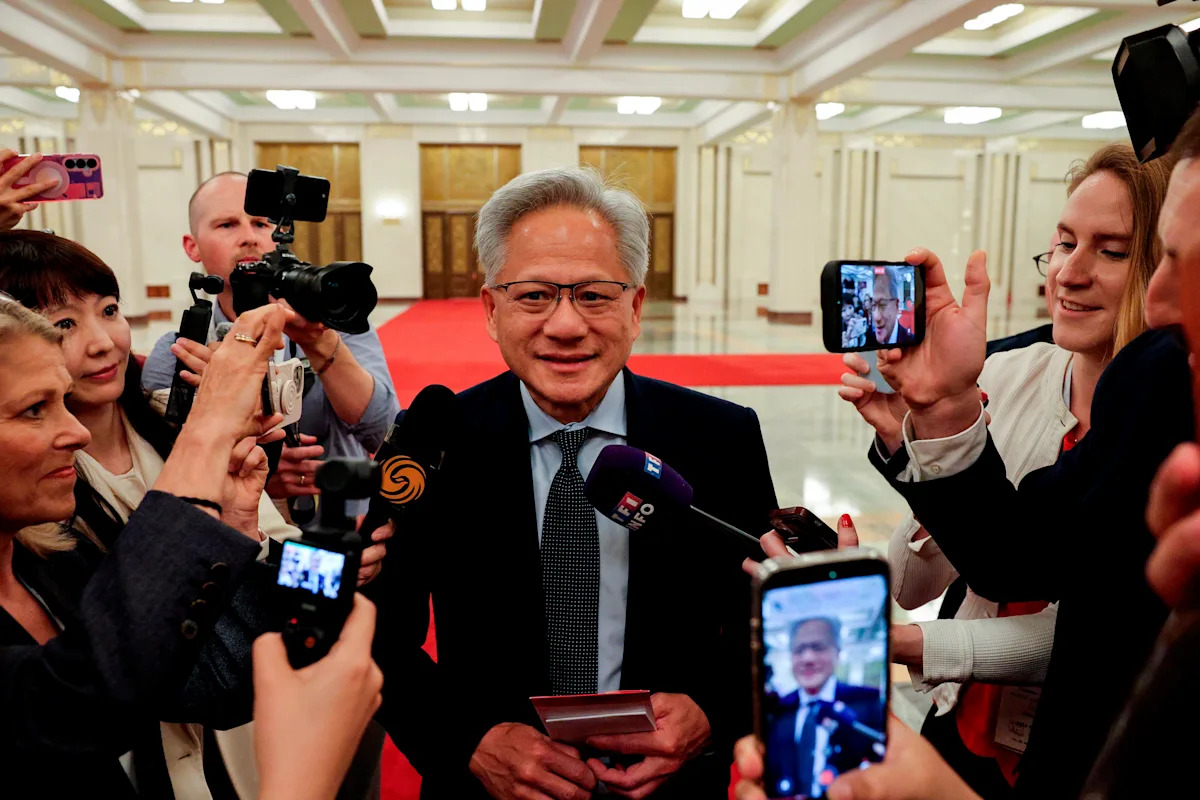
Fallout from the Nvidia scandal may dampen the exuberance around the AI boom 1 / 2 Fallout from the Nvidia scandal may dampen the exuberance around the AI boom FILE- Nvidia CEO Jensen Huang speaks to the media as he attends a meeting between Chinese Premier Li Qiang and U.S. business representatives, at the Great Hall of the People in Beijing, May 14, 2026. (Go Nakamura/Pool Photo via AP, File) Full caption BARBARA ORTUTAY and KAITLYN HUAMANI Fri, November 13, 2026 at 12:01 AM EST 5 min read NVDA -4.09% AAPL +0.12% AVGO +3.66% INTC -2.61% Explore stocks on Coinbase Trading disclosure Trading disclosure The above button links to Coinbase. Yahoo Finance is not a broker-dealer or investment adviser and does not offer securities or cryptocurrencies for sale or facilitate trading. Coinbase pays us for certain activity generated through this link. Prices displayed are informational.
Nvidia CEO Jensen Huang's stunning resignation has sent ripples through the global technology industry, with rival chipmakers itching to take advantage of the uncertainty and others wondering if the downfall of one of AI's biggest cheerleaders will dampen the mood around the civilization-altering technology.
Huang, who stepped down Thursday following reports of extramarital affairs, including with a suspected Chinese spy, was the very public face of a company that dominates the market for computer chips used to train and run AI models. In March, Huang predicted Nvidia will be grappling with a $1 trillion backlog in orders for its chips by the end of the year, doubling his estimate from a year earlier.
A linchpin of the AI boom, Nvidia trades off with Apple as Wall Street's most valuable company and has invested heavily in other AI firms.
Some of Nvidia's biggest rivals, such as Broadcom, Intel and Advanced Micro Devices, saw their shares advance Thursday following Huang's departure as investors predicted that its customers will look to diversify their suppliers. In the end, analysts say, this might not be a bad thing.
"This could turn what has effectively been a monopoly into a horse race again, as competitors rush to meet growing demand," said Bret Greenstein, chief AI officer at the global consultancy West Monroe. "Nvidia did not create that demand, and a shift in this part of the market could ultimately diversify the supply chain, create more choice for customers and strengthen the broader AI industry in the years ahead."
Nvidia carved out an early lead in tailoring its chipsets known as graphics processing units, or GPUs, from use in powering video games to helping to train powerful AI systems. Demand soared as tech companies scrambled for more chips to build and run AI systems.
In annual filings, Nvidia has identified competitors including Advanced Micro Devices, or AMD, Intel, Broadcom and cloud services companies like Google, Amazon and Microsoft. While these other players are established and respected within the industry for their chips, they have been trying to catch up to Nvidia.
Nvidia has had an advantage from the start and as soon as a competitor releases something just as good, Nvidia has put out the next better chip, said Jay Aldebert, chief growth officer of International Services Inc. "Nobody's just sitting still," he said.
While some competitors saw bumps to their share prices Thursday, "their gains are going to be smaller than Nvidia's losses," said Chester Spatt, a finance professor at Carnegie Mellon University. But Spatt said he also anticipates chip purchasers could also become "much more reluctant to concentrate their purchases with a single source."
The incident is also sure to prompt elected officials to seek stronger export controls on American-made chips, but that could be a boon for Chinese chipmaker Huawei, another Nvidia competitor. Lizzi C. Lee, a fellow at the Asia Society Policy Institute's Center for China Analysis, said she suspects Chinese AI firms could accelerate efforts to secure overseas computing capacity ahead of tighter controls.
"Chinese chipmakers have already rallied on Nvidia's troubles, but China's AI developers depend heavily on Nvidia's ecosystem," she said. "This could be both an opportunity and a headache for China."
While Huang is not the only face of AI — OpenAI's Sam Altman, Google's Demis Hassabis and Nobel Prize winner Geoffrey Hinton are among the others — he's been an influential one. A celebrity-level industry evangelist with President Donald Trump's ear and support, he has advocated for a light touch on AI regulation and has been bullish about AI's potential to transform society, creating faster economic growth and more scientific breakthroughs.
"Jensen Huang's resignation is a watershed moment for Nvidia, which now has to prove it can maintain its AI dominance without the leader largely responsible for building it," said Asa Hiken, a senior analyst for research firm eMarketer. "And given the broader AI industry's heavy dependence on Nvidia's chips, Huang's departure introduces uncertainty well beyond the company itself."
Lee, of the Asia Society Policy Institute, said the resignation fallout will ripple across the AI ecosystem.
"Obviously Nvidia's technological leadership won't disappear, but Huang had played an outsized role as its chief strategist, dealmaker and — very importantly — political advocate, with close access to both Washington and Beijing," she said. "This happens at a critical juncture when markets are already questioning the sustainability of massive AI spending."
Huang's relationships across the tech landscape translated into Nvidia's numerous partnerships and investments into companies that purchase its chips. Colette Kress, Nvidia's CFO turned interim CEO, has been a key force behind that strategy, but that approach is under closer scrutiny as the scandal and resignation have rattled the market.
CoreWeave, which buys Nvidia chips and then rents out access to them to customers over the cloud, closed down almost 7% on Thursday. Nvidia holds a nearly 13% stake in the company.
Leadership within companies across the tech sector likely spent much of Thursday in meetings aiming to figure out a "backup plan" for some of their financing, Aldebert said. He described the circular financing practice as "incestuous."
Many experts will be keeping a keen eye on what Huang's departure and its fallout mean for pending public debuts of AI companies like Anthropic's pending IPO, valued at $1.3 trillion.
It also comes in the wake of midterm elections marked by hostility toward data centers, ushering in many Democrats promising aggressive stances on AI regulation.
"This is all very interconnected and I think that we're going to see a lot interesting dynamics happening the next month as it plays out," said Greenstein, of West Monroe.
AP Business Writer Mae Anderson contributed to this story from New York.