Jeremy Bowman, The Motley Fool Fri, November 13, 2026 at 12:28 AM EST 5 min read NVDA -5.72% Trade NVIDIA on Coinbase Trading disclosure Trading disclosure The above button links to Coinbase. Yahoo Finance is not a broker-dealer or investment adviser and does not offer securities or cryptocurrencies for sale or facilitate trading. Coinbase pays us for certain activity generated through this link. Prices displayed are informational.
In Wall Street and Silicon Valley, the debate over the difference between founder and non-founder-led companies has long raged.
According to research from Bain & Co., founder-led companies outperformed non-founder-led by 2.1x over a period from 2015 to 2025, generating a shareholder return of 443% compared 215% for non-founder-led companies.
Missed AI's "Act 1"? Act 2 Could Be 16x Bigger. Most investors think they missed the AI boat because they didn't buy Nvidia in 2005. But according to our analysts, we're only at the end of "Act 1"—the R&D phase. "Act 2" is the global rollout. Continue »
In the tech sector, the difference was even starker with founder-led tech companies beating their tech peers by 2.6x.
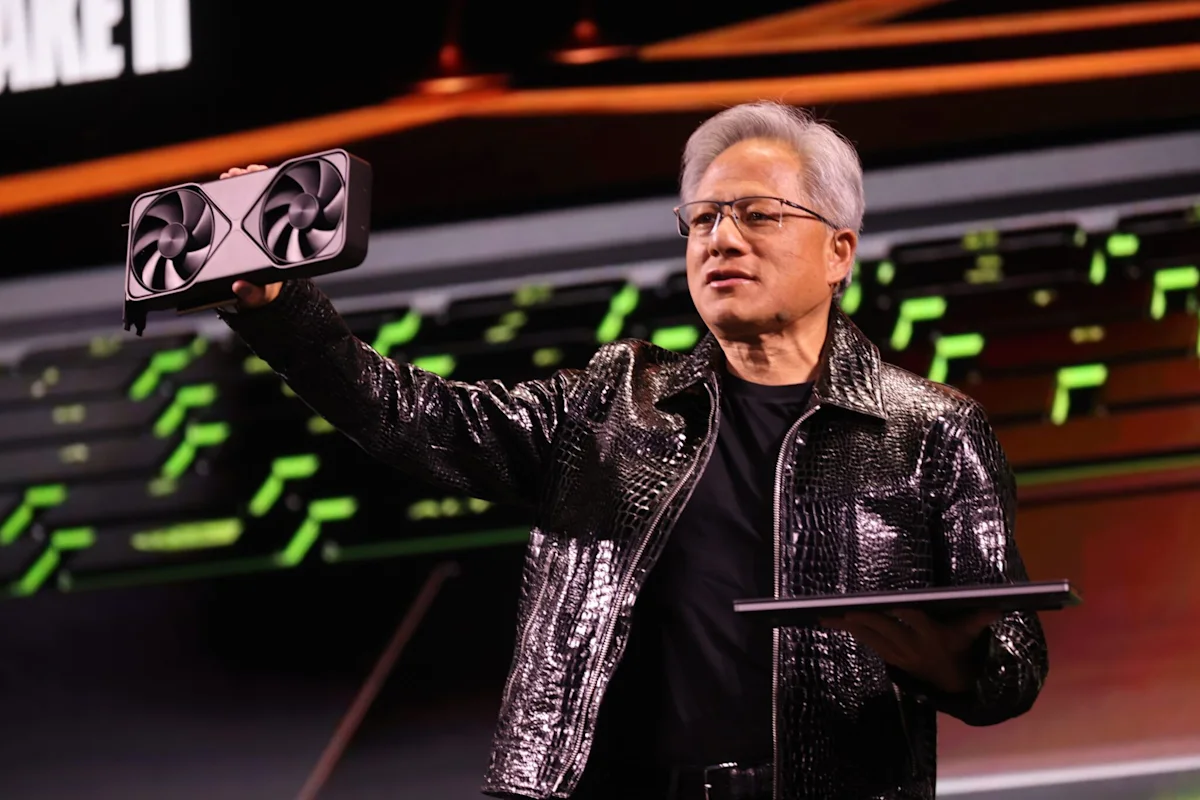
That question is especially relevant following the exit of Nvidia's (NASDAQ:NVDA) Jensen Huang, who was embroiled in a scandal that began with his admission that he had an affair with a suspected Chinese spy.
Some commentators have noted that several other big tech companies have lost their founder CEOs and continued to perform well. Notably, Tim Cook ably took the reins from Steve Jobs, and Amazon has continued its strong growth under Andy Jassy.
However, those situations are considerably different than the one facing Nvidia. The AI chip titan had no succession plan in place, and Huang ran the company with an unusually high degree of control with approximately 60 direct reports. The board was not expecting to make such a decision, and employees were shocked by the sudden move. Some have circulated a petition calling for Huang's return, and at Nvidia headquarters, there were flowers laid by the entrance and video of a woman crying.
A number of Huang's fellow founders have weighed in on the move, criticizing the board's decision. Shopify's Tobi Lütke called it a generational blunder, adding, "There's no replacing a founder like Jensen," and that the new company would be a thing cosplaying as Nvidia. Elon Musk affirmed another post saying, "You do not simply replace the founder," while Binance's Changpeng Zhao said it was a mistake for the board to let Huang resign.
Founders likely have their own biases toward founder-led companies, but they're also intimately familiar with the characteristics that separate founder-led companies from the rest.
CFO Colette Kress has taken over as interim CEO, and speculation has already built about who will become permanent CEO. The board is considering both internal and external candidates, and early frontrunners for the job include Ian Buck, the Vice President and General Manager of Hyperscale and High-Performance Computing (HPC) at Nvidia. Buck built CUDA, the software platform that's central to the company's industry dominance. Apple's chief hardware officer, Johny Srouji, is also reportedly being considered as a permanent CEO.
Nvidia's book of business for the next year or two is mostly set, but the real test for the next CEO will be over the next three to five years from now, which will be greatly influenced by the planning and strategy it sets now.
Even before Huang's job appeared to be in jeopardy, Nvidia stock looked undervalued. The stock had slumped through much of October and early November on fears that rising interest rates could pressure the AI Infrastructure build-out and then on fears that Democrats could crack down on data centers following the midterm elections.
Currently, Nvidia is expected to generate $15.93 in adjusted earnings per share next year, meaning it trades at less than 11 times forward earnings. That looks remarkably cheap for a company with Nvidia's competitive advantages and that's expected to grow revenue 68% next year.
Of course, the stock just became significantly riskier, but the valuation helps provide a floor on the stock that it wouldn't otherwise have.
There are a lot of variables at play here, including the outcome of any federal investigations on the company and Huang. Investors will gradually get some answers as to what to expect from Nvidia in the coming quarters and years.
However, this also might be the most definitive test yet for the value of a founder. If Nvidia continues to thrive, that will be a testament to the company that Huang built, even if it means he was ultimately replaceable.
The Motley Fool Stock Advisor analyst team just identified what they believe are the 10 best stocks for investors to buy now… and Nvidia wasn't one of them. The 10 stocks that made the cut could produce monster returns in the coming years.
Consider when Netflix made this list on December 17, 2004... if you invested $1,000 at the time of our recommendation, you'd have $348,060!* Or when Nvidia made this list on April 15, 2005... if you invested $1,000 at the time of our recommendation, you'd have $1,067,492!*
Now, it's worth noting Stock Advisor's total average return is 849% — a market-crushing outperformance compared to 210% for the S&P 500. Don't miss the latest top 10 list, available with Stock Advisor, and join an investing community built by individual investors for individual investors.
*Stock Advisor returns as of November 13, 2026.
Jeremy Bowman has positions in Amazon, Nvidia, and Shopify. The Motley Fool has positions in and recommends Amazon, Apple, Nvidia, and Shopify. The Motley Fool has a disclosure policy.
What's the Value of a Founder? Nvidia Offers the Greatest Test Yet was originally published by The Motley Fool