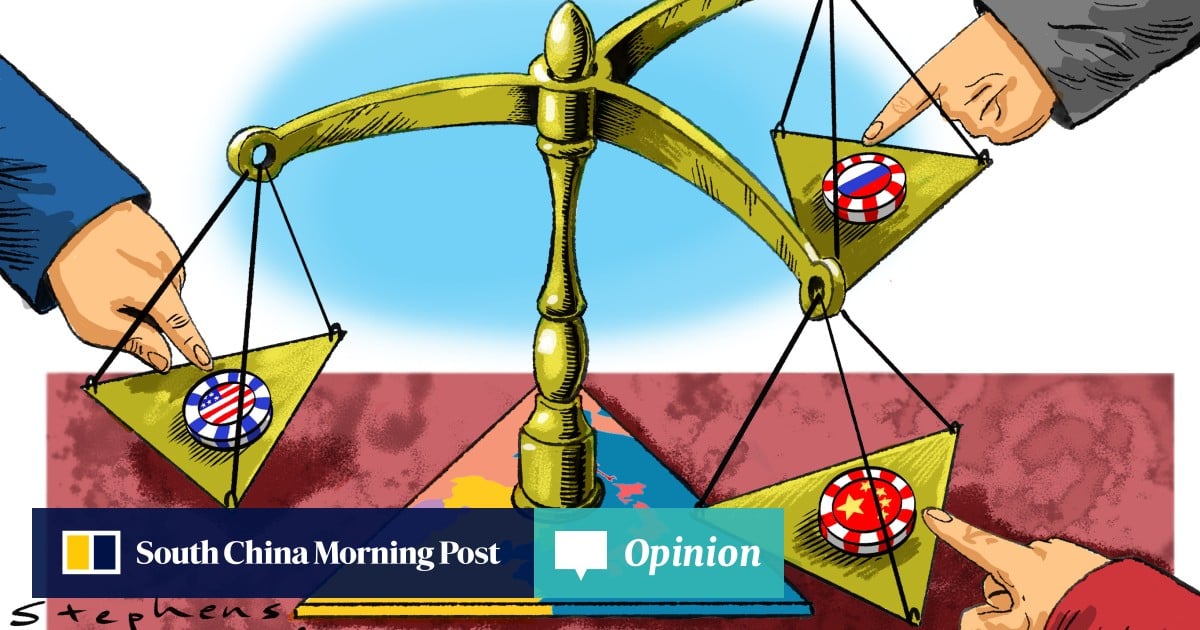
As great-power bargaining between the US, China and Russia collides with three regional triangles, finding a balance will be key to managing competition
3-MIN READ3-MINHao NanHao Nan is a research fellow with the Charhar Institute, a 2025 Korean Peninsula specialist fellow with the National Committee on American Foreign Policy, and a Nuclear Futures fellow (2025-2026) with the Ploughshares Fund & Horizon 2045. Published: 5:30am, 27 May 2026When Washington, Beijing and Moscow begin to treat one another as bargaining partners again, northeast Asia feels the pressure. Taiwan, Korea, sanctions, energy routes, nuclear risks and missile defence are no longer separate theatres. They increasingly belong to one strategic conversation between the US, China and Russia.Northeast Asia itself is already being reorganised through three trilateral structures with different purposes, degrees of institutionalisation and strategic effects. Thus the region is now shaped by four layers of trilateralism: an emerging US-China-Russia great-power management; the US-Japan-South Korea deterrence partnership; China-Japan-South Korea functional cooperation; and a China-Russia-North Korea counter-alignment.Northeast Asia is not being divided by one line. It is being pulled by several overlapping triangles.
This layer functions as a pressure regulator. If US-China-Russia bargaining stabilises Taiwan, Ukraine, nuclear risk and sanctions, it can lower the temperature in northeast Asia. If it becomes opaque, transactional or dismissive of regional interests, it will make US allies, China’s neighbours and North Korea more anxious. Great-power management can lower regional tensions; great-power trading can intensify them.