Nvidia (NVDA) Has Always Been Jensen Huang’s Company. What Happens to the Stock if That Changes? TipRanks Thu, November 12, 2026 at 3:39 PM EST 6 min read NVDA -3.34% CRWV -6.43% GOOG +1.87% MSFT +0.24% MSF Explore stocks on Coinbase Trading disclosure Trading disclosure The above button links to Coinbase. Yahoo Finance is not a broker-dealer or investment adviser and does not offer securities or cryptocurrencies for sale or facilitate trading. Coinbase pays us for certain activity generated through this link. Prices displayed are informational.
Nvidia (NVDA) stock would likely take a sharp initial hit if CEO Jensen Huang stepped down, but I believe the long-term investment case would remain intact. Huang has led Nvidia since co-founding it in 1993, making his leadership central to the chipmaker's identity and success. Its board is now investigating reports that he was the target of a Chinese intelligence effort.
Management has never shared a clear succession plan on who would take over if Huang left, but I'm still bullish on NVDA. The probe hasn't touched the enormous demand for these chips so far, and the stock seems to be priced as if the worst case has happened.
As investors and spectators would expect, this probe goes straight to the top. On November 8, the board said a committee of independent directors would run the review with outside counsel. It added that it had no reason to believe that national security or company secrets were compromised. Huang is cooperating and stays on as CEO for now, a welcome update from those who have been following the company closely and appreciate the significant role that Huang has played in the development of the sector, and of course the company.
Get 75% Off TipRanks Premium and unlock powerful investing tools to make smarter, more confident investment decisions
At the center of the alleged scandal is Alice Huang (no relation), a former executive at Megaspeed, an Nvidia customer based in Singapore. The New York Times reported that U.S. officials believe she was a Chinese intelligence asset, and that Megaspeed bought more than $4.8 billion worth of Nvidia chips over two years. Huang then admitted to a personal relationship with her in a note to staff. Beijing has naturally called the spying claims smears.
Of course, this story became highly political almost immediately, and most of Washington isn't letting it go. Three House committee chairs want Huang at a closed-door briefing on November 18, one day after earnings. Committee chair Brian Mast is reportedly weighing a subpoena if Huang says no. House Democratic leader Hakeem Jeffries has also backed limits on chip sales to China in the annual defense bill.
Thinking about all of this as a potential investor, Nvidia has surprisingly never named a successor or explained how it would pick one. Semafor found that the word "succession" doesn't appear once in Nvidia's latest annual report. Microsoft (MSFT) uses it 25 times and Alphabet (GOOGL) uses it 16 times. Huang also has more than 50 people reporting directly to him, so there's no obvious number two to step up, with the exception of some family members perhaps.
To me, that's a very deliberate move. Huang has said on occasion that planning around a small, hand-picked group of heirs is toxic, and he'd rather grow a wider group of leaders across the company. Asked in January 2026 how long he'd stay, his answer was "for as long as I deserve it." It's worked pretty well so far for shareholders. However, it also leaves the board without a ready answer if it suddenly needs one.
Some analysts are now putting a number on that gap. Analyst Dan Ives of Yorkville Ives said Nvidia would be worth 25% to 30% less if Huang were removed. Bernstein downgraded the stock to Outperform with a $200 price target. The names floated as potential stand-ins, such as CFO Colette Kress and co-founder Chris Malachowsky, come from media speculation, not from anything the board has actually said. These feel like safe hands to me, but the sheer power of leadership Huang has demonstrated would be almost impossible to match.
Meanwhile, the business momentum Nvidia carried into the fall remains hard to ignore. Q2 Fiscal 2027 revenue rose 106% year-over-year to $96.2 billion. Data center sales climbed 117% to $89 billion, and gross margins held at 75%.
For Q3, management guided to about $108 billion in revenue, give or take 2%. That outlook notably assumes zero data center compute sales to China. CFO Colette Kress has also said she expects 70% revenue growth in FY28. If Nvidia hits its guide on November 17, the conversation should shift back to demand, at least for a while.
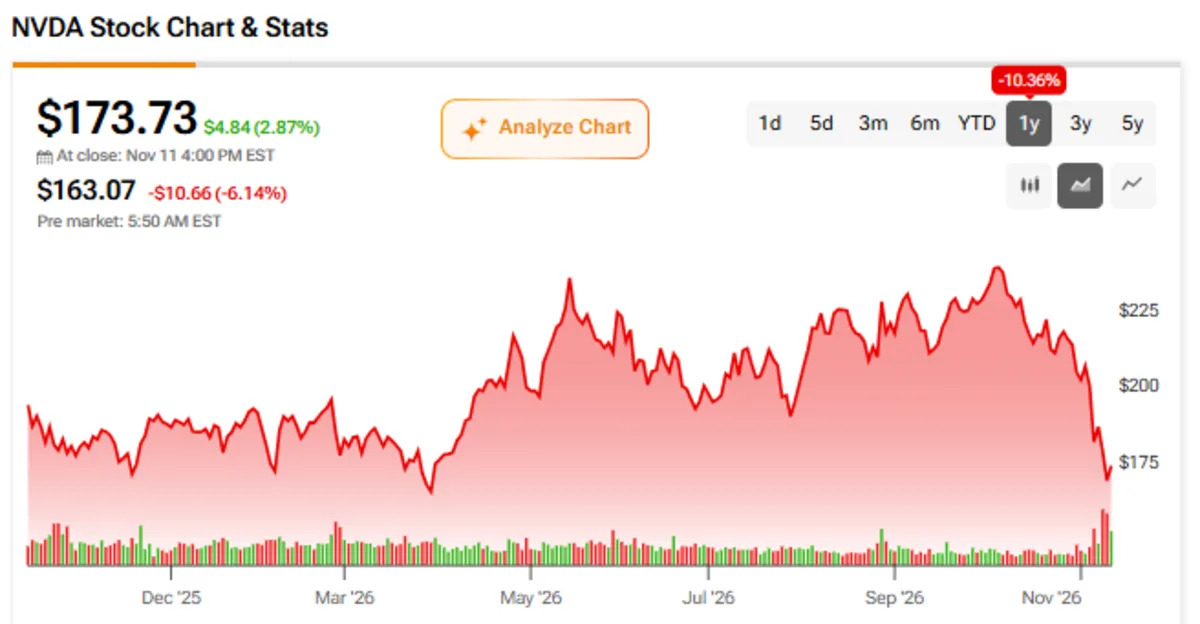
Wednesday gave a hint of that. Shares jumped about 5% in early trading after AI cloud provider CoreWeave (CRWV) raised its outlook, which is a reminder that Nvidia's biggest customers are still spending. Even so, the stock is still down about 15% in November. Much of the slide started before the probe, with the stock losing roughly 22% to 24% from its early-October peak through the post-midterm chip sell-off.
I would tend to think that a fair amount of the leadership risk is already baked in after such a heavy news event. Nvidia trades at about 21x trailing earnings. On a forward basis, some analysts put the stock at 18.65x. The semiconductor industry's median forward P/E is close to 20.31x, so Nvidia trades at a modest discount of roughly 8% to its peers.
Against its own history, the gap is much wider. At 18.65x, the stock is valued at less than half its five-year average of 41.38x, even after more than doubling its sales last quarter.
So what's the company worth without its charismatic CEO? At 18.65x, the market is assuming forward earnings of about $9.32 per share. Some analysts speculate that Nvidia without Huang might trade at 10x to 12x, which, by my calculations, comes to roughly $93 to $112. Knock 25% to 30% off today's price, as Ives suggests, and you land at roughly $122 to $130, which is a milder downside than the multiple-compression case.
If the board clears Huang and the multiple drifts back toward the sector median of 20.31x, the numbers point to around $189. I'd take that trade, as long as earnings estimates hold up. However, not everyone agrees: Baird cut NVDA to Hold with a $200 target on November 11, and Citi (C) trimmed its target to $225.
Wall Street is still firmly behind Nvidia, though the support has thinned slightly this week. NVDA has a Strong Buy consensus based on 29 Buys and seven Holds over the past three months. The average NVDA price target of $290.90 implies 67.44% upside from the last price.
For 33 years, Nvidia and Huang have been almost synonymous, and this probe makes it understandable for investors to picture one without the other. With no clear successor, I'd expect a pretty sharp drop if he were forced out. However, the business itself still looks strong, and the shares already trade well below their own history and the sector. I see the current price as a fair entry for long-term investors willing to sit through some near-term noise.