The Premium Team, The Motley Fool Thu, November 12, 2026 at 2:16 PM EST 7 min read NVDA -5.60% Trade NVIDIA on Coinbase Trading disclosure Trading disclosure The above button links to Coinbase. Yahoo Finance is not a broker-dealer or investment adviser and does not offer securities or cryptocurrencies for sale or facilitate trading. Coinbase pays us for certain activity generated through this link. Prices displayed are informational.
Jensen Huang resigned as Nvidia's (NASDAQ: NVDA) chief executive this morning amid controversies over his personal conduct and questions about whether Nvidia's chips reached China through a customer in Singapore.
His exit followed a week of reports about his personal life. The first concerned an affair with an executive at Megaspeed, one of Nvidia's customers in Singapore. U.S. officials suspected the executive of spying for China, which China denied. On Wednesday, a second relationship, with one of Huang's direct reports, came to light. The board met that night, and the company announced Huang's resignation Thursday morning.
Missed Nvidia in 2009? This Rare Signal Is Flashing Again. In 2009, a "Double Down" signal flashed for a little-known chipmaker called Nvidia. For the first time in years, that same "Total Conviction" signal is flashing for a company 1/100th the size of Nvidia. Continue »
We think investors are right to take Huang's departure seriously. In our view, though, today's sell-off prices in more damage than the business has shown so far.
If you've followed Nvidia for any length of time, you know how central Huang has been. He co-founded the company in 1993 and led it for all 33 years. His leadership structure was also known for being unusually flat, as he had 33 direct reports at last count, according to CNBC.
Huang pushed Nvidia as an innovator and technologist. He launched CUDA (software that lets developers program Nvidia's chips) in 2006 and boldly committed the company to artificial intelligence (AI) computing long before it became a mainstream market. He also managed Nvidia's largest customer relationships himself and represented the company in Washington on export rules for China.
That is a lot for one person to hand off, let alone overnight, and Nvidia has no named successor to take it on. For now, CFO Colette Kress, who has worked alongside Huang since 2013 and has joined him on every earnings call, will serve as interim CEO while the board searches for a permanent replacement.
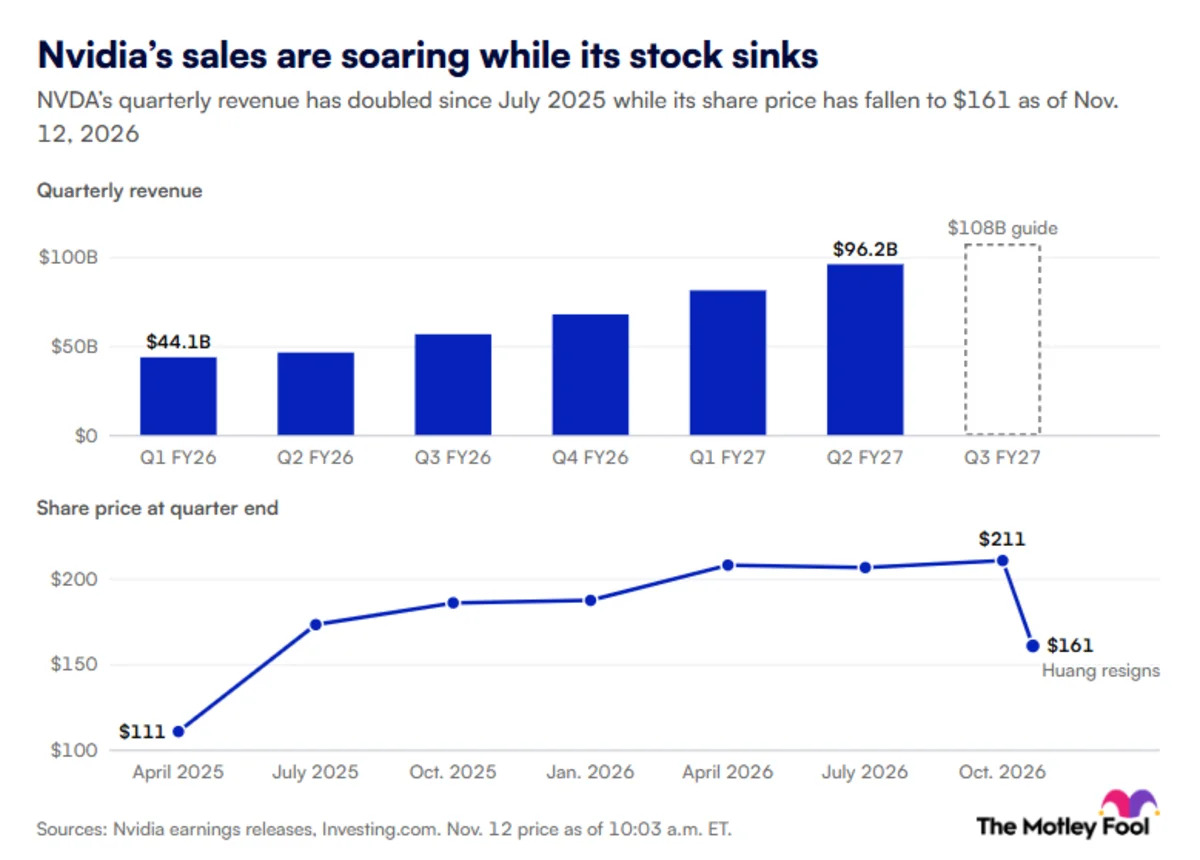
We understand why the market reacted so sharply. A company that leaned this heavily on one person's judgment now has to make its next big decisions without him, and under federal scrutiny. Analyst Dan Ives estimates Nvidia is worth 25% to 30% less without Huang, and some discount is warranted. With shares down about 7% this morning to around $161, after dipping below $149 at the open, the market has already applied much of it.
What reassures us is that Huang's exit on its own is unlikely to change Nvidia's revenue much over the next two years. Demand for its chips is still growing quickly. Last quarter, revenue reached $96.2 billion, up 106% from a year earlier, and the company guided to $108 billion for the quarter that ended in October. By any measure, that's a business in good health.
Chips take years to design, so the products Nvidia will sell through 2027 were planned while Huang was still in charge, and customers have already ordered many of them. Even if regulators cut off sales routed through Singapore, we estimate Nvidia would lose no more than about 5% of its revenue.
A broader crackdown would cost more, and the investigations will help decide whether one comes.
Over the longer term, our biggest concern is export policy, and the investigations could make that risk more immediate. If they confirm that Nvidia chips reached China through Singapore, lawmakers would have fresh reason to tighten export rules, and those rules could reach well beyond one customer. Nvidia would lose sales either way, and how much depends on whom the rules cover. Limits on every U.S. chipmaker would shrink the market Nvidia sells into. AMD (NASDAQ: AMD) and others would face the same limits, though, so Nvidia would likely keep its share of what's left. Penalties aimed at Nvidia alone would do more damage, because customers could shift orders to AMD and other chipmakers that face no such restrictions.
Pricing power is a slower-moving concern. Even before this week, Nvidia was offering customers concessions, customers were taking longer to pay, and its guidance pointed to lower gross margins. Microsoft (NASDAQ: MSFT), Amazon (NASDAQ: AMZN), and Google (NASDAQ: GOOG) now design some of their own chips, and AI tools are making it easier to move software off CUDA. A leadership change gives those customers more leverage on price.
That leverage could grow if regulators step in. Since 2024, the Justice Department has been examining whether Nvidia's sales practices made it harder for customers to buy from competitors. No charges have been filed, and an inquiry is not a finding of wrongdoing. Still, a new CEO will inherit that review, and any changes it forces would strengthen customers' hand on price.
In a word, volatility. Until the board names a successor and the investigation runs its course, expect Nvidia's stock price to carry a discount for everything still unknown and to swing with each major development.
Even so, Nvidia's price already reflects a good deal of bad news. Shares trade around $161 (20 times trailing earnings), and the analysts who downgraded the stock overnight still set their price targets well above that. Bernstein's $200 target is about 24% above today's price, and Citi's (NYSE: C) $225 target is about 40% above it.
Nvidia reports quarterly results on Nov. 17, its first under Kress. We'll be looking at guidance, any signs that customers are delaying orders, and what management says about the investigation into its sales through Singapore. Over the following months, we'll also watch whom the board picks as permanent CEO and whether Nvidia's senior engineers and executives stay.
Many Motley Fool members hold large positions because the stock has risen so much. The Rule Breakers team first recommended Nvidia in Stock Advisor in March 2005, at a split-adjusted cost basis of $0.16 per share. As of midday Nov. 12, the stock is up about 100,000% from that first recommendation.
Since that 2005 pick, both our Rule Breakers and Hidden Gems investing teams have recommended Nvidia multiple times, and it has remained an active Motley Fool recommendation throughout.
On Nov. 11, before Huang resigned, our Rule Breakers team removed Nvidia from Stock Advisor's Foundational Stocks list, our core picks for new investors. The team cited the security questions and key-person risk. It kept the stock rated a buy while it decides whether to move it to the Penalty Box, our watchlist for troubled picks, or issue a sell.
How you handle your own shares depends on how big your position is and why you own it. If Nvidia is a large share of your portfolio and you bought it for Huang's judgment, his exit and the open legal questions are good reasons to reassess how much risk you want to carry. If it's a smaller position held for Nvidia's products, its software, and its place in AI spending, those remain intact.
Huang built a company with the products, people, and customers to outlast him, and we expect Nvidia to come through this.
The Motley Fool Stock Advisor analyst team just identified what they believe are the 10 best stocks for investors to buy now… and Nvidia wasn't one of them. The 10 stocks that made the cut could produce monster returns in the coming years.
Consider when Netflix made this list on December 17, 2004... if you invested $1,000 at the time of our recommendation, you'd have $348,060!* Or when Nvidia made this list on April 15, 2005... if you invested $1,000 at the time of our recommendation, you'd have $1,067,492!*
Now, it's worth noting Stock Advisor's total average return is 849% — a market-crushing outperformance compared to 210% for the S&P 500. Don't miss the latest top 10 list, available with Stock Advisor, and join an investing community built by individual investors for individual investors.
*Stock Advisor returns as of November 12, 2026.
Citigroup is an advertising partner of Motley Fool Money. The Motley Fool has positions in and recommends Advanced Micro Devices, Alphabet, Amazon, Microsoft, and Nvidia. The Motley Fool has a disclosure policy.
Nvidia CEO Resigns: What It Means for Your Shares was originally published by The Motley Fool