Daniel Miller, The Motley Fool Thu, November 12, 2026 at 11:53 AM EST 5 min read F -1.97% GM -1.90% NVDA -4.92% Explore stocks on Coinbase Trading disclosure Trading disclosure The above button links to Coinbase. Yahoo Finance is not a broker-dealer or investment adviser and does not offer securities or cryptocurrencies for sale or facilitate trading. Coinbase pays us for certain activity generated through this link. Prices displayed are informational.
Ford Motor Company (NYSE:F) and General Motors (NYSE:GM) investors have plenty of reasons to cheer when customers choose high-priced trucks, SUVs, and premium trims. Selling a richer mix of vehicles can help drive profits without requiring a dramatic increase in sales, and it's nice to fight the low-margin narrative the auto industry faces. That last point is especially true, given that automakers' electric vehicles struggle with profitability.
There is a bit of a growing problem, however: Consumers still have to actually pay the bill. Cox Automotive's affordability index put the typical new-vehicle monthly payment at $776 in September, its highest reading since December 2023.
Missed Nvidia in 2009? This Rare Signal Is Flashing Again. In 2009, a "Double Down" signal flashed for a little-known chipmaker called Nvidia. For the first time in years, that same "Total Conviction" signal is flashing for a company 1/100th the size of Nvidia. Continue »
That raises a question for investors: How much room do automakers have to keep asking customers to spend more?
September's average new-vehicle transaction price reached $50,562. Slightly lower interest rates and increased incentives weren't enough to prevent affordability from worsening compared with August, according to Cox. Its typical payment figure is an estimate from the index, rather than an observed average across every borrower.
For automakers, that creates a balancing act. Higher prices can support revenue as well as operating margins, but customers have limits. Eventually, the payment is where the sales pitch meets the grocery bill, and analysts increasingly say that the U.S. new-vehicle market is in an affordability crisis.
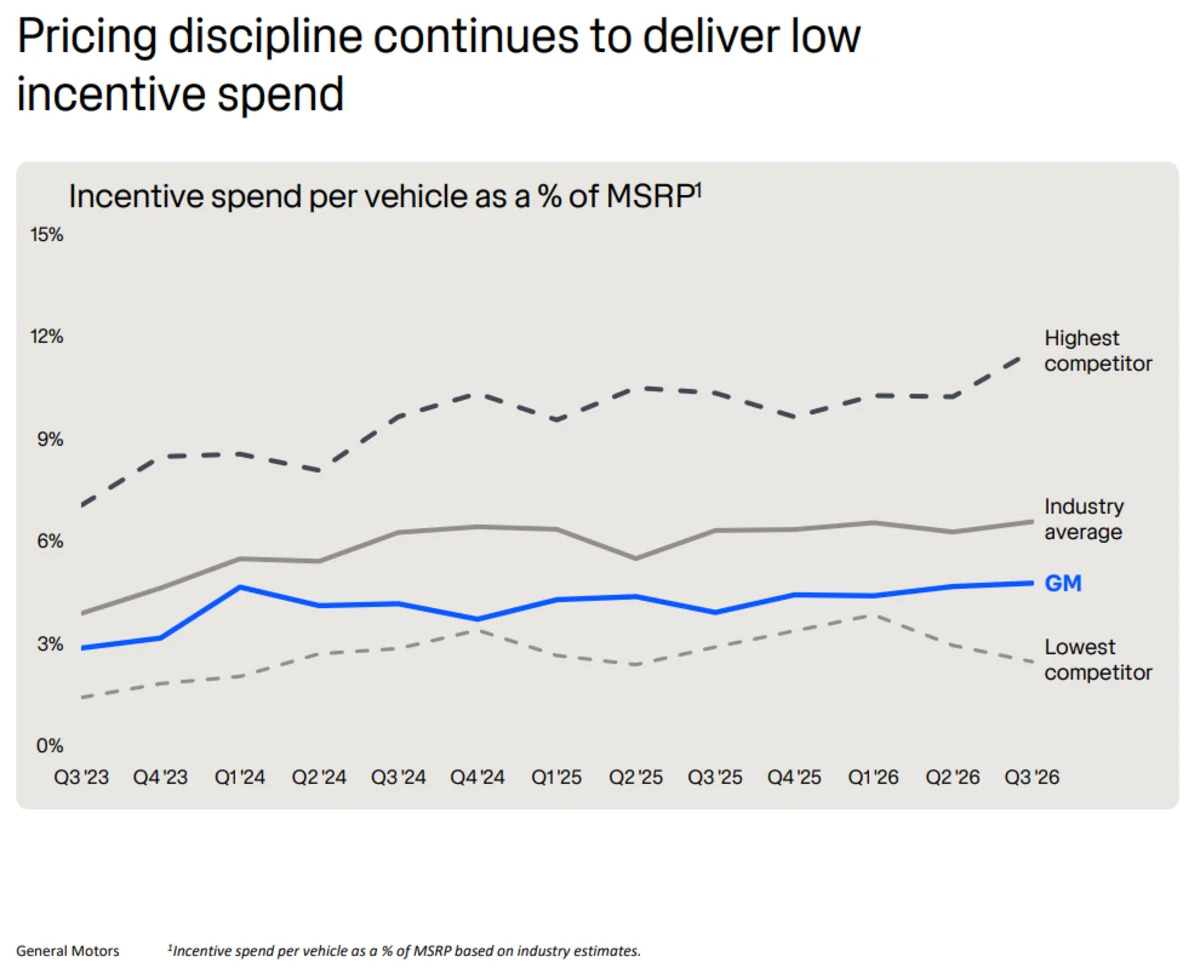
Manufacturers can offer discounts or subsidized financing to reduce payments. Those offers, however, come at a cost, and automakers such as GM often tout spending less on incentives than the industry average.
If increasingly generous incentives become necessary to maintain sales of higher-priced vehicles, investors need to consider how much profit those sales leave behind. On this note, General Motors has performed well versus the broader industry.
GM often touts its below-industry incentive spend. Image source: General Motors' Q3 earnings report.
Fluctuating incentives are why rising vehicle prices alone don't tell shareholders whether the business is improving or deteriorating.
Ford's recent results show that customers remain willing to pay for additional capability and equipment. Its off-road performance vehicles and packages, including popular nameplates such as the Bronco, Raptor, and Tremor, represented 24% of company sales through September, up a solid 3.8 percentage points from a year earlier. GM also delivered stronger profitability during the third quarter. Its North American adjusted earnings before interest and taxes margin increased to 8.7%, compared with 6.2% a year earlier.
Ford's popular Raptor off-road truck. Image source: Ford Motor Company.
Neither result suggests investors should abandon profitable trucks and SUVs, of course; that's Detroit's bread and butter! But there certainly seems to be growing demand at the more affordable end of the market, and automakers that capitalize on this quickly could see a boost in market share, sales volume, and revenue, though perhaps at the expense of higher margins.
There is an encouraging detail. Despite September's monthly setback, Cox found that affordability improved compared with a year earlier as higher incomes and lower interest rates helped buyers a bit. The weeks of median income needed to purchase the average new vehicle declined from 36.5 to 35.7.
The rising car payment warning deserves attention, but it doesn't establish that demand is about to collapse, and really it should be equally viewed as an opportunity for more affordable vehicle designs and development.
For Ford and GM shareholders, the next step is watching incentives, sales mix, and margins together.
If premium vehicles keep attracting customers, margins should strengthen even if market share potentially drops a little. If discounts climb and margins feel the pinch, strong sales totals become less celebratory for investors.
More affordable models also give manufacturers a way to reach buyers who won't stretch for the most expensive trims. And just because a certain consumer can't purchase a high-priced trim now doesn't mean they won't be in that market down the road — bringing a customer in and creating long-term loyalty is hugely valuable in the automotive industry.
Ultimately, investors shouldn't judge Detroit's pricing power by how high vehicle prices climb. They should watch how much profit remains after automakers convince customers to pay them, and automakers should watch the rising consumer payments closely, because there is a limit to how far they can be pushed.
Before you buy stock in Ford Motor Company, consider this:
The Motley Fool Stock Advisor analyst team just identified what they believe are the 10 best stocks for investors to buy now… and Ford Motor Company wasn't one of them. The 10 stocks that made the cut could produce monster returns in the coming years.
Consider when Netflix made this list on December 17, 2004... if you invested $1,000 at the time of our recommendation, you'd have $348,060!* Or when Nvidia made this list on April 15, 2005... if you invested $1,000 at the time of our recommendation, you'd have $1,067,492!*
Now, it's worth noting Stock Advisor's total average return is 849% — a market-crushing outperformance compared to 210% for the S&P 500. Don't miss the latest top 10 list, available with Stock Advisor, and join an investing community built by individual investors for individual investors.
*Stock Advisor returns as of November 12, 2026.
Daniel Miller has positions in Ford Motor Company and General Motors. The Motley Fool recommends General Motors. The Motley Fool has a disclosure policy.
A $776 Car Payment Is a Warning for Ford and General Motors was originally published by The Motley Fool