Jensen Huang Is Out. Here’s How Much Nvidia’s Selloff Cost a $10,000 QQQ Position Ryne Mauck Thu, November 12, 2026 at 11:29 AM EST 6 min read NVDA -5.50% QQQ -0.02% SMH -0.91% XLK -0.22% Explore stocks on Coinbase Trading disclosure Trading disclosure The above button links to Coinbase. Yahoo Finance is not a broker-dealer or investment adviser and does not offer securities or cryptocurrencies for sale or facilitate trading. Coinbase pays us for certain activity generated through this link. Prices displayed are informational.
Nvidia plunged as much as 13% after Jensen Huang resigned, yet QQQ slid just 0.58% because Nvidia makes up only about 8% of the fund.
Narrower funds take far bigger hits: Nvidia fills about 15% of XLK and 18% of SMH, so selloffs hurt them more than QQQ.
Holding QQQ, XLK, SMH and an S&P 500 fund stacks Nvidia exposure, so portfolios that look diversified can carry hidden concentration.
Building a portfolio and living off one are two completely different skills, and almost nobody teaches the second. This problem is what The Definitive Guide to Retirement Income helps, and it is free today. Read more here. (Sponsor)
Nvidia (NASDAQ:NVDA) shares were down 5.01% at $165.03 as of 10:29 AM ET on Thursday, after Jensen Huang resigned as chief executive. Axios reported that the stock fell as much as 13% after the news and then recovered some of that loss. Investors who hold Nvidia through the Invesco QQQ Trust (NASDAQ:QQQ) took a much smaller hit, because of how little of the fund Nvidia makes up.
Per Axios, Nvidia's board named longtime CFO Colette Kress interim CEO and started a search for a permanent replacement. Axios reported that Nvidia did not give a reason for the resignation. The departure follows press reports about Huang's personal relationships. Axios noted that The New York Times reported Wednesday that Huang had a relationship with a senior Nvidia executive who reports to him.
Axios also reported that on Nov. 8, Nvidia's board announced an independent investigation after reports that Huang may have been targeted by a foreign intelligence effort. The New York Times reported that U.S. officials believed a businesswoman with close ties to Huang was gathering intelligence for Beijing.
In a note to staff quoted by Axios, Kress wrote: "I believe deeply in this company and in its future." According to the same report, the board expects operations, customer commitments and the product roadmap to continue without interruption.
Many successful investors eventually reach the same moment. The saving is done, the portfolio is built, and the question quietly changes from how much can I grow this to how much can I take out? Get that second question wrong and decades of good investing can come apart in a handful of years.
That is exactly what The Definitive Guide to Retirement Income helps answer. It covers what your retirement could actually cost, which income sources are worth using, and the withdrawal math that decides whether the money lasts. It is free today from Fisher Investments. Read More Here ›
Huang leaves a business that was still growing quickly. For the fiscal second quarter, reported Aug. 26, 2026, Nvidia posted revenue of $96.22 billion, up 105.8% YoY. Non-GAAP EPS came in at $2.22, beating the $2.09 consensus. Third-quarter guidance called for revenue of $108.0 billion, plus or minus 2%. When Nvidia next reports, leadership questions will now sit beside the data center story (Morningstar).
As of 10:29 AM ET, QQQ was down 0.58%. On a $10,000 position, that comes to about $58. Over the past month, QQQ has dropped 8%, or about $800 on the same investment.
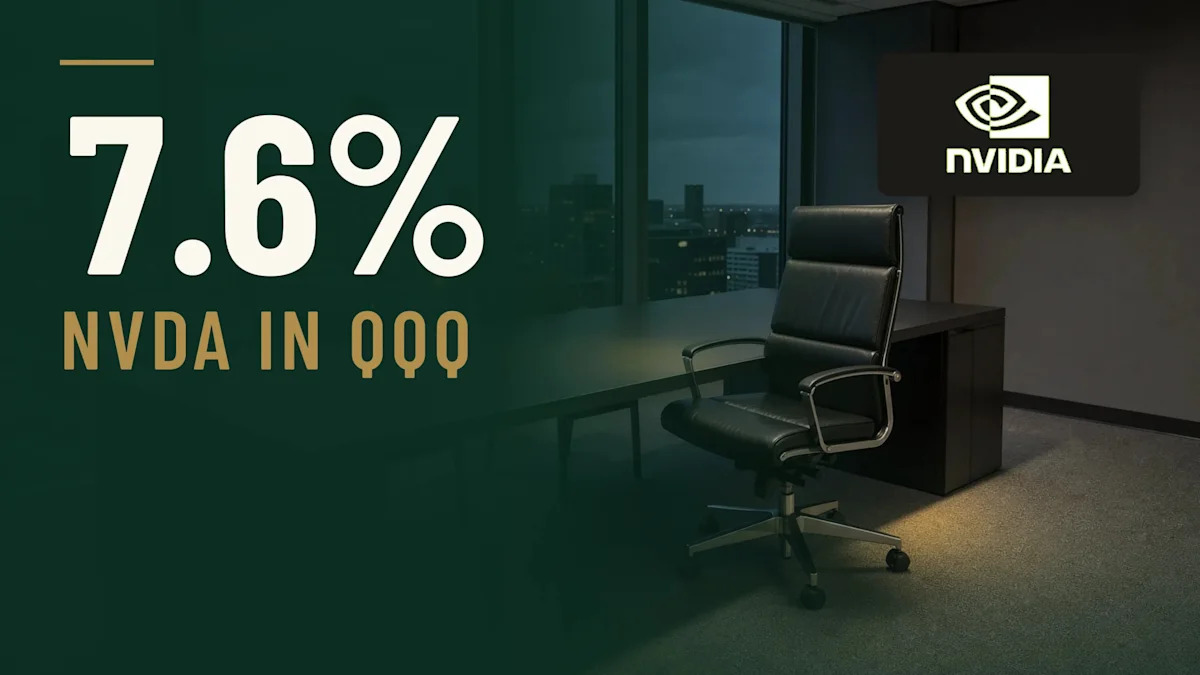
The fund's most recent holdings filing, dated June 30, 2026, places Nvidia at about 7.6% of net assets. On that date, roughly $760 of a $10,000 position was in Nvidia. Applying today's Nvidia decline to that weight, Nvidia accounts for about $38 of today's loss. Over the past month, the calculation points to about $206. These are rough estimates. Nvidia's actual weight has changed since June.
A direct investment shows the difference. Over the same windows, $10,000 in Nvidia shares lost about $501 today and about $2,708 over the month, as the stock fell 27.08%.
A holding's weight sets a limit on how much it can move the fund. When a stock is about 7.6% of the portfolio, even a 27% drop takes only a small cut off the total. QQQ tracks the Nasdaq-100, which uses a "modified market capitalization-weighted" method. Under its rules, no single component may exceed 24% of the index.
Narrower funds offer less of that cushion. As of June 30, 2026, Nvidia made up 14.65% of the Technology Select Sector SPDR Fund (NYSEARCA:XLK) and 17.55% of the VanEck Semiconductor ETF (NASDAQ:SMH). With that much weight in one stock, a selloff like this month's hurts those funds more than it hurts QQQ.
QQQ reported net assets of about $490.1 billion as of June 30, and its Nvidia investment was worth about $37.2 billion. Axios put it this way: because of Nvidia's size, the move has "massive implications for every American with a retirement account." As a few mega-caps take up more of these funds, a leadership crisis at one company hits portfolios that were built to spread risk around.
Overlap can be easy to miss. Someone who holds QQQ, XLK, and SMH has Nvidia three times, and an S&P 500 index fund in the same account would likely add a fourth position. Each fund looks diversified by itself. Combined, the Nvidia exposure can end up well above what any single fund shows.
Next up are the CEO search and Nvidia's next earnings report. Analysts are already considering the leadership change. According to a summary posted on X, Goldman Sachs kept a Buy rating with a $220 price target but expects a search for the "right multiple." For QQQ holders, the losses so far have been small compared with what direct shareholders took in.
(Sponsor) Most people spend their entire working lives focusing on one thing: growing a pile of money. Then they retire and discover the skill they actually need is close to the opposite. Turning that pile into steady income, year after year, through good markets and bad, without ever running out.
It may be the least discussed and most consequential transition in personal finance, and plenty of otherwise careful investors walk into it with no real plan. That is exactly what The Definitive Guide to Retirement Income helps answer. It is a free guide from Fisher Investments covering what your retirement will really cost, where the cash flow should come from, and how much you can safely withdraw each year. Learn more here. Learn More Here ›
Contact editorial@247wallst.com for any questions or corrections.