Nvidia live updates: Jensen Huang resigns, CFO Colette Kress to serve as interim CEO Yahoo Finance Updated Thu, November 12, 2026 at 10:14 AM EST 2 min read NVDA -4.55% Trade NVIDIA on Coinbase Trading disclosure Trading disclosure The above button links to Coinbase. Yahoo Finance is not a broker-dealer or investment adviser and does not offer securities or cryptocurrencies for sale or facilitate trading. Coinbase pays us for certain activity generated through this link. Prices displayed are informational.
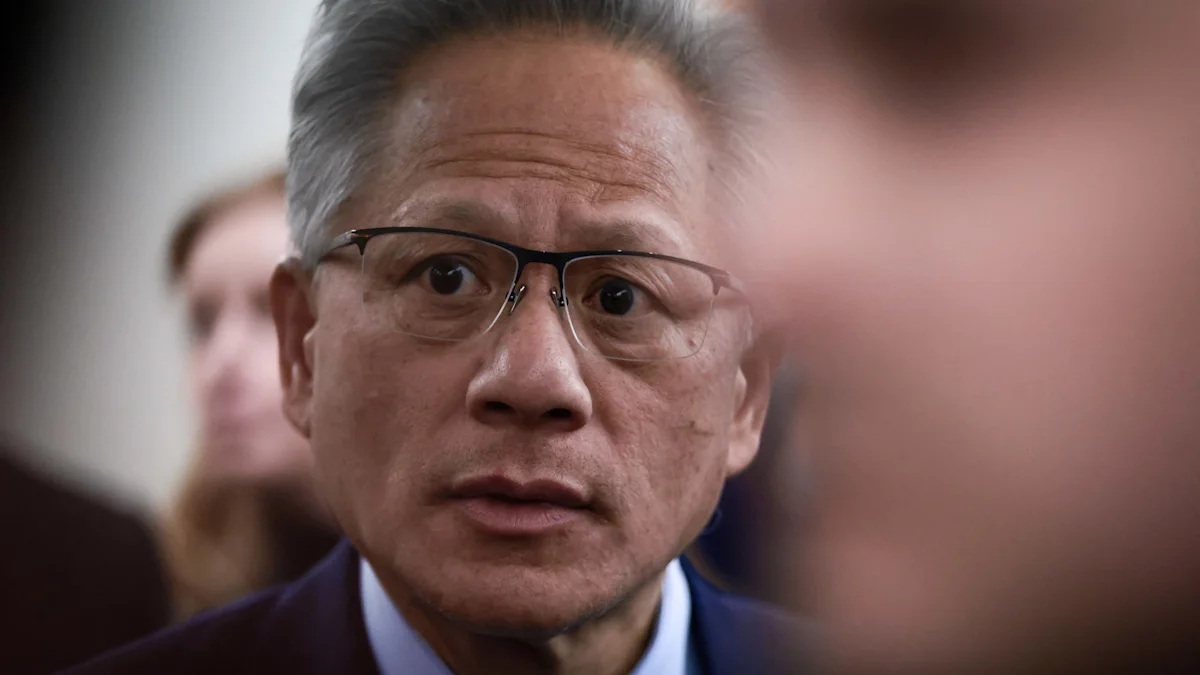
Nvidia (NVDA) stock tanked in premarket trading after Jensen Huang resigned as CEO. The company's CFO, Colette Kress, will serve as the interim head of the business until a permanent successor is named.
Nvidia stock dropped 13% on the news before paring losses.
The leadership shakeup followed a report from The New York Times on Wednesday that embattled Nvidia (NVDA) CEO Jensen Huang was allegedly involved in a second extramarital affair. The company's board was reportedly meeting on Wednesday night to determine if it will oust Huang as chief executive, the Wall Street Journal reports.
According to the report, Huang, whose relationship with a woman alleged to be a Chinese spy has embroiled the company in scandal this week, also had a relationship with Nvidia executive Kimberly Powell. The Times report says that Huang and Powell were seen being affectionate at a hotel during a company conference in March.
Huang was already under investigation for an affair with Alice Huang, an alleged Chinese spy. The CEO admitted the affair in a memo to employees. "I was unfaithful to my wife. My actions hurt her and our children. There is no excuse for what I did. I am deeply sorry," Huang wrote.
The Information reported on Tuesday that Alice Huang is believed to be involved in a network of Chinese companies that facilitated the shipment of $7.5 billion in chip sales to China.
Given the size and importance of Nvidia in the stock market today, the revelation marks one of the biggest CEO-personal conduct scandals in history. It also highlights Nvidia's key-person risk and uncertain succession plan as questions swirl about whether the board will ask Huang to step down.
The news has drawn immediate and varied reactions from leaders ranging from the US president to other CEOs. President Trump stood by Huang, calling him "an honorable guy," but other members of the president's party are expected to put more scrutiny on the company. Trump also stated on Monday that the FBI was looking into Huang's relationship.
Follow along for live updates and reactions.
Featured Today at 1:59 PM UTC Grace O'Donnell Nvidia CEO Jensen Huang resigns Nvidia's board of directors announced on Thursday that longtime CEO Jensen Huang will resign, effective immediately.
The company's CFO, Colette Kress, will step in on an interim basis as chief executive.
"NVIDIA's strength has always come from its people, and together with our leadership team, I am committed to building on the extraordinary foundation Jensen created over the last 33 years," Kress said. "We will continue advancing the work that has made NVIDIA a leader in accelerated computing and AI, and execute on the opportunities ahead. Our focus remains on serving our customers, partners, developers and shareholders."
The board noted Huang's "profound" contributions to the business, despite his recent downfall due to two extramarital affairs.
Nvidia will still report earnings on Tuesday, Nov. 17, as scheduled.
Nvidia (NVDA) CFO Colette Kress has been named interim CEO after Jensen Huang stepped down amid allegations of an affair with a Chinese spy and a company executive.
Kress, one of Nvidia's more prominent executives, joined the company in 2013 and helped guide the company's financial success from a video game company to the AI juggernaut it is today.
In a statement, Kress said she is committed to building on the work Jensen has done to turn Nvidia into the company it has become.
"We will continue advancing the work that has made Nvidia a leader in accelerated computing and AI, and execute on the opportunities ahead. Our focus remains on serving our customers, partners, developers and shareholders," she said.
Kress regularly provides financial updates during Nvidia's quarterly earnings call, making her well known among analysts and investors.
Prior to joining the company, she served as the senior vice president and CFO for Cisco's (CSCO) Business Technology and Operations Finance group, according to her Nvidia biography.
Before joining Cisco, she held positions at Microsoft (MSFT) for 13 years, including as CFO of the company's server and tools group. She also worked at Texas Instruments (TXN) in several roles. Read more.
Interim Nvidia CEO Collette Kress told Nvidia staffers that she believes "deeply in the company" and that "NVIDIANs" are the company's "greatest strength"
Here's a look at some of the Nvidia board members tasked with ousting longtime CEO Jensen Huang, from Bloomberg:
Harvey C. Jones joined Nvidia's board in 1993, while serving as CEO of chip-design software maker Synopsys Inc. Since 2004, he has been a managing partner at private investment firm Square Wave Ventures. Last year, Nvidia bought a $2 billion stake in Synopsys.
Stephen Neal joined the Nvidia board in 2019. He is chairman emeritus and senior counsel at Cooley LLP, Nvidia's long-time law firm.
VC Tench Coxe has been on the Nvidia board since 1993. He was a managing director at Palo Alto-based Sutter Hill Ventures from 1989 to 2020, and was an early investor in Nvidia.
John Dabiri has been on Nvidia's board since 2020. He is a professor of aeronautics and mechanical engineering at the California Institute of Technology.
Dawn Hudson, a board member since 2013, was previously chief marketing officer of the National Football League and, before that, CEO of Pepsi-Cola North America.
Melissa Lora joined in 2023. Before that, she was president of Taco Bell International.
A. Brooke Seawell joined the board in 1997. He is a partner at the venture capital firm New Enterprise Associates and was an executive at NetDynamics Inc. He also previously worked at Synopsys.
Aarti Shah has been on the board since 2020. She was formerly senior vice president and chief information and digital officer at Eli Lilly.
Mark Stevens, an early investor in Nvidia, served on its board from 1993-2006 and rejoined in 2008. He was managing partner at Sequoia Capital and is managing partner at S-Cubed Capital.
Suzanne Nora Johnson joined the board in July. She spent 21 years at Goldman Sachs Group, where she was vice chair.
The resignation of Jensen Huang as Nvidia CEO marks the end of an era for one of the longest-serving corporate leaders.
Huang, who is 63, co-founded Nvidia in April 1993, alongside Curtis Priem and Chris Malachowsky, who still serves as senior vice president for engineering and operations.
In total, Huang's tenure as CEO lasted 33 years. That made Huang the third-longest-serving CEO of an S&P 500 company until he stepped down today.
Huang's tenure was up there with that of Stephen Schwarzman, who has led private equity firm Blackstone (BX) for about 41 years, and Leonard Schleifer, CEO of Regeneron Pharmaceuticals (REGN) for 38 years.
Yahoo Finance's Brian Sozzi, Julie Hyman, and Deirdre Bosa discuss the fallout from the Nvidia scandal and the subsequent ouster of longtime CEO Jensen Huang.
In a note to clients, Dan Ives, Senior Managing Director Yorkville Ives, said there is a good chance Nvidia's board looks to the outside for a CEO, "and this could include a host of names, including Apple's Tim Cook as a dark horse candidate in our view given the global importance of Nvidia to the overall US tech industry."
He also praised Nvidia's interim CEO, Colette Kress. As CFO, Kress "has built enormous credibility internally and externally and we are big fans of her strategically. We always believed she would eventually be CEO of a major public tech company, but she would have to leave Nvidia after many years there."
The tech analyst predicts the Jensen Huang scandal won't hurt the company in the long run.
"Nvidia remains the clear leader in GPU chips for the AI Revolution. They are roughly 2-3 years ahead of the nearest competitor and the demand trajectory the next few years is not changing because Jensen is gone. The strategic roadmap is already essentially built around the next few family of chips and physical AI with 42k employees driving it. We assume clear headwinds/scrutiny on the China business and any loopholes (Singapore) which is a dynamic already being factored into the stock at current valuation in our view.
Valuation at roughly 10x 28 EPS is way too cheap once Nvidia gets through this storm and emerges on the other side. The $3 trillion to $4 trillion of AI capex is not changing and Nvidia remains the one chip in the world fueling the AI Revolution."
Nvidia (NVDA) stock dropped as much as 13% in the first few minutes of trading, on track to destroy roughly $440 billion in value, after CEO Jensen Huang resigned.
Nvidia's market cap dropped to $3.75 trillion. At one point, Nvidia was a $5 trillion company and the largest company in the world. On Thursday, the company slipped to No. 3 by market cap, falling behind Apple (AAPL) and Microsoft (MSFT).
Go deeper with AlphaSpace 165.82 -7.91 (-4.55%) As of 10:25:25 AM EST. Market Open. 52 mins ago Ben Werschkul Planning Nvidia investigations, top Democrats tell Trump administration to 'preserve all records' Democratic Senators Elizabeth Warren of Massachusetts and Chris Coons of Delaware have formally asked the Trump administration to "preserve all records" related to the administration's dealings with Nvidia (NVDA) as Democrats prepare to take power on Capitol Hill in 2027 and promise to probe the issues surrounding CEO Jensen Huang's departure.
The request came in a letter Wednesday evening targeting any administration materials related to the chipmaker's exports to China as well as the ousted CEO's affair with a suspected Chinese intelligence asset.
The letter was directed to Commerce Secretary Howard Lutnick, Secretary of State Marco Rubio, and White House chief of staff Stephen Miller and noted reports that Trump officials were aware of concerns about Nvidia "yet did not move to block the continued flow of advanced AI chips to Megaspeed or other companies affiliated with the suspected operative."
The White House didn't offer an immediate response Thursday morning. The letter asked the officials to confirm by next Tuesday that they will comply and have begun the document preservation process. Read more.
Nvidia (NVDA) stock sank 13% at the open on Thursday after the AI chip giant announced that Jensen Huang has resigned as CEO and CFO, and Collette Kress will be interim CEO until a permanent successor is selected.
The company's market cap fell below $4 trillion. Shares of the AI chip maker are down more than 30% over the past month.
Yorkville's Dan Ives has lowered his price target on Nvidia following reports that the AI chip giant's board is working with an outside firm to identify a possible successor to CEO Jensen Huang.
"We are lowering our price target from $300 to $225 now factoring in Jensen Huang is no longer CEO of Nvidia and will likely be removed by the board over the next 24 hours," wrote Ives on Thursday morning.
"While this is a quickly moving story, the NY Times second affair story was the straw that broke the camel's back for the board in our view, along with what in shaping up to be a groundswell gaining major momentum on both sides of the aisle in DC to focus on Jensen, Nvidia, Megaspeed, and China chips," he added.
The challenges for Nvidia (NVDA) are only just beginning should embattled founder Jensen Huang get ousted. The company's board is reportedly meeting to determine if it will remove Huang as chief executive, the Wall Street Journal reported late Wednesday.
"In our view, what matters for the stock from here is less whether a change occurs than how it is executed," Stifel analyst Ruben Roy said.
Here are several challenges for the legion of Nvidia investors to follow in this unusual, fast-moving situation.
The read-through of any interim CEO
Huang famously has 60 or so direct reports at Nvidia and no succession plan — at least one he has shared publicly. If Huang is ousted, longtime CFO Colette Kress could get the interim CEO tag. She is one of the most respected CFOs in the game.
However, if an interim CEO stays on for a while, it could only increase the uncertainty on Nvidia's future.
In either outcome — Kress or an outside CEO — Nvidia's valuation could be capped in the near term given uncertainty about who will drive the product vision Huang has set since founding in 1993.
Wall Street is finally moving to distance itself from stricken former AI stock darling Nvidia (NVDA) given the uncertainty surrounding its embattled founder, Jensen Huang.
Oppenheimer just took the eye-opening move (at least from a stock analyst perspective) to completely remove its price target on Nvidia as the Jensen Huang saga ratchets up.. This action is usually taken on sub-$10 stocks that are highly volatile after a major negative event. Not one of the world's largest, most important companies.
Oppenheimer's Rich Schafer: "We are downgrading shares of NVDA and removing our price target following reports (WSJ, NYT) of founding CEO Jensen Huang's imminent departure amidst allegations of a 2nd extramarital affair. Credible media reports circulated Wednesday evening that NVDA's board is preparing to part ways with Huang following a widely reported relationship with an alleged Chinese spy compounded by new allegations of a relationship with an NVDA executive. This "one-two" punch appears to have forced the board's hand. Huang's role as the "face of AI" cannot be overstated. His uniquely skillful, forward-thinking, steady and tireless leadership has been critical to NVDA's success in becoming the undisputed AI leader and world's largest company. Huang is a hands-on leader with dozens of direct reports. We believe he is deeply involved in all strategic decision making. We see massive shoes to fill and no obvious successor. His departure presents a material, potentially thesis-changing event. NVDA boasts an incredibly deep bench of talent. We see risk that a Huang departure creates a 'brain drain' situation at the AI giant, threatening NVDA's pace of innovation — a critical competitive advantage."
There was still no word Thursday morning on the outcome of an Nvidia board meeting held Wednesday to determine Jensen Huang's future, following a New York Times report that the CEO had a second extramarital affair, this time with an Nvidia executive who reported to him.
The Wall Street Journal reported that the board was preparing to oust Huang, while Bloomberg reported that directors were working with an outside firm to identify potential successors and were considering naming an interim CEO.
If Nvidia's (NVDA) board moves to oust Jensen Huang, history suggests the first day's move won't say much.
Yahoo Finance looked at six big companies whose CEOs left over relationships or misconduct allegations: Boeing (BA) in 2005, HP (HPQ) in 2010, Best Buy (BBY) in 2012, Wynn Resorts (WYNN) and Intel (INTC) in 2018, and McDonald's (MCD) in 2019.
First-day reactions ranged from a drop of about 8% to a gain of nearly 9%, with a median dip of about 3%.
The year that followed was rougher. Four of the six stocks trailed the S&P 500 (^GSPC) over the next 12 months, by a median of about 12 percentage points.
The worst of the six was HP. Mark Hurd was a star operator Wall Street trusted to keep the turnaround going, and the stock lagged the market by nearly 40 points in the year after he left. Wynn Resorts, the only founder in the group, jumped on Day 1 and then trailed the market by more than 20 points.
Admittedly, sample is small, spans different eras, and has no founder of a $5 trillion company.
Jensen Huang's immense amount of control over Nvidia, and the lack of a clear successor to take up the mantle, has placed on the chip giant a large dose of so-called key-man risk. It's something Nvidia's disclosed before.
Writing in its 2026 annual filing, the company acknowledged it is "highly dependent on the services of our longstanding executive team," helmed by leaders like Huang.
"Failure to ensure effective succession planning, transfer of knowledge, and smooth transitions involving executives and key employees," the company disclosed, "could hinder our strategic planning, execution, and long-term success."
If Huang were to step down from his position or be removed by Nvidia's board, the move would leave a gaping leadership hole at the top of one of the world's most important companies.
The succession of hits to Nvidia (NVDA) from the post-election sell-off to CEO Jensen Huang's affairs is driving shares to their lowest level in over a year.
The once $5 trillion company — the largest in the world — is likely to open with a market capitalization below $4 trillion, surpassed by both Apple (AAPL) and Microsoft (MSFT) in value.
The Wall Street Journal reported on Wednesday that top Democratic Sens. Elizabeth Warren and Chris Coons are asking the Trump administration to retain records related to Nvidia CEO Jensen Huang's affair with a suspected Chinese spy and the company's chip exports to China.
"This incident raises significant concerns about the federal government's ability to effectively enforce our export controls and protect our national security," the senators wrote in the letter, per the Journal.
The request to preserve records often precedes an investigation. Democrats in Congress have sent similar letters to American corporations amid fresh scrutiny over affordability concerns and ties to the Trump administration.
Alice Huang, the alleged Chinese spy and Megaspeed executive at the center of the Jensen Huang scandal, is believed to be living in Beijing, according to Bloomberg.
According to the report, Chinese security officials are aware of her presence in the capital, though it's unclear when she traveled there. Beijing has denied that Huang was a spy.
Nvidia's board launched an investigation into her relationship with CEO Jensen Huang, sparking a firestorm of controversy for the company, its AI peers, and its investors.
Nvidia stock's market value keeps dropping with every Jensen Huang update.
At its overnight low of $156.20, Nvidia had lost more than $600 billion in market value since last Thursday, by Yahoo Finance calculations. Most of that came after Wednesday's closing bell.
Measured from its Oct. 6 record close of $239.24, the damage comes to about $2 trillion. That's more than the entire market value of Meta (META), Broadcom (AVGO) or Tesla (TSLA).
The plunge also knocked Nvidia through a floor near $164 that had held twice in the past 14 months, in September 2025 and again in March. At the overnight low, the stock was at its lowest level since July 2025.
Watch whether Nvidia can climb back above $164. If it can't, the old floor becomes a ceiling, and the next shelf sits near $141 to $144. That's the base the stock built in June 2025 before it launched higher.