Bernstein Just Gave Up on Nvidia, Cutting Its Target in Half to $200 Omor Ibne Ehsan Thu, November 12, 2026 at 8:05 AM EST 6 min read NVDA -8.35% AVGO +0.37% Explore stocks on Coinbase Trading disclosure Trading disclosure The above button links to Coinbase. Yahoo Finance is not a broker-dealer or investment adviser and does not offer securities or cryptocurrencies for sale or facilitate trading. Coinbase pays us for certain activity generated through this link. Prices displayed are informational.
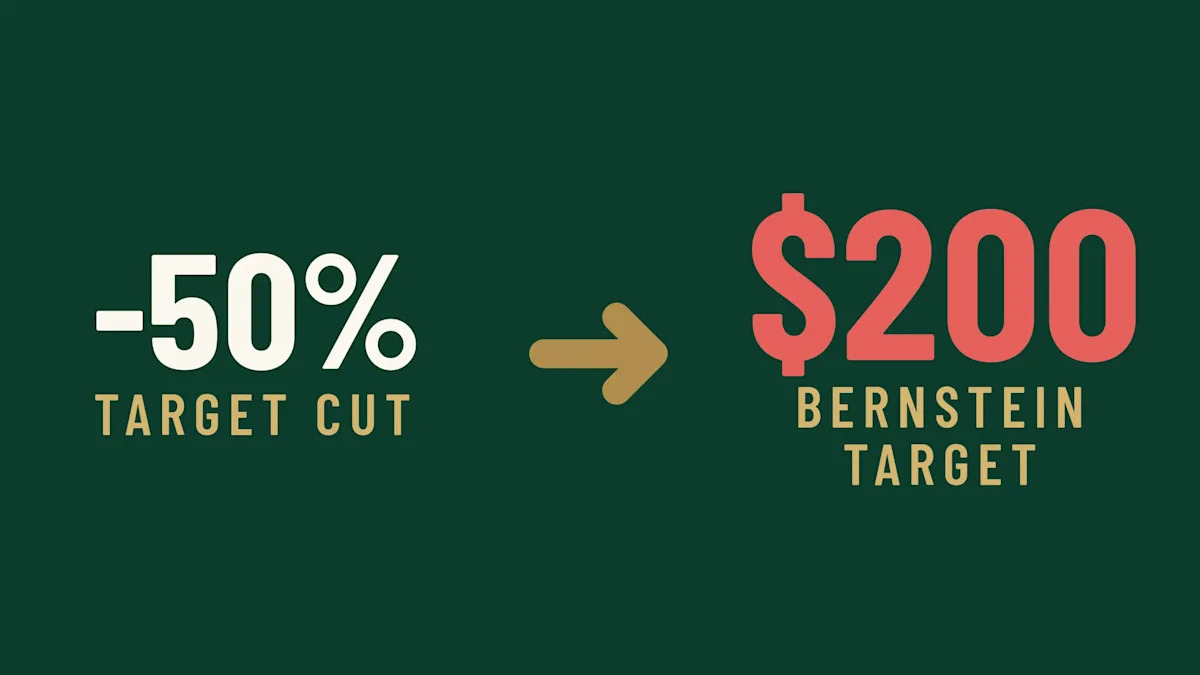
Nvidia (NVDA) plunged 9% after hours to $159, below its 52-week low, as Bernstein halved its target to $200 and board-ouster rumors swirled around Jensen Huang.
Baird cut its target to $200 from $500, saying poor visibility made it hold off on publishing 2027 data center forecasts.
Broadcom (AVGO) shows AI chip exposure without leadership drama: AI semiconductor revenue jumped 221% last quarter, yet shares are up just 0.29% this year.
Building a portfolio and living off one are two completely different skills, and almost nobody teaches the second. This problem is what The Definitive Guide to Retirement Income helps, and it is free today. Read more here. (Sponsor)
NVIDIA (NASDAQ:NVDA) closed Wednesday's regular session at $173.73, up $4.84, or 2.87%. By 7:59 p.m. ET it traded at $158.76, down $14.97, or 8.62%, which put it below its 52-week low of $164.27.
Two things happened between those prices. Reports emerged that NVIDIA's board is reportedly preparing to oust CEO Jensen Huang, which the company has not confirmed. Regardless, with two back-to-back affairs in the past few days, many board members are seeing Huang as a liability.
Then Bernstein downgraded the stock to Market Perform from Outperform and cut its target to $200 from $400, a 50% reduction. The team wrote that it had "had enough."
Meanwhile, the 62 analysts covering NVIDIA still average a Strong Buy rating and a $316.48 target, roughly 82% above the close. That average has not yet absorbed a day with two downgrades and a top-pick removal, so the upside it implies is probably too high.
Many successful investors eventually reach the same moment. The saving is done, the portfolio is built, and the question quietly changes from how much can I grow this to how much can I take out? Get that second question wrong and decades of good investing can come apart in a handful of years.
That is exactly what The Definitive Guide to Retirement Income helps answer. It covers what your retirement could actually cost, which income sources are worth using, and the withdrawal math that decides whether the money lasts. It is free today from Fisher Investments. Read More Here ›
Baird moved first on Wednesday morning, cutting NVIDIA to Neutral from Outperform and lowering its target to $200 from $500. Baird said visibility had deteriorated enough that it is holding off on publishing 2027 data center forecasts. It expects slower AI spending growth from large cloud companies in 2027 and flagged uncertainty over whether Huang stays into 2027, although it noted that demand for NVIDIA chips still exceeds supply.
Bernstein's evening call reached the same $200 figure. The full reasoning has not been made public, so investors have to work with the rating, the target, and the "had enough" line. Two identical targets in one day give the market a new reference point, and $200 now sits beside the consensus average as a number traders will anchor to.
A fundamental downgrade says earnings will fall short. A visibility downgrade says the analyst can no longer forecast with confidence, which is what Baird described when it held back its 2027 numbers.
Morgan Stanley's move was mechanical. Analyst Joseph Moore removed NVIDIA as the firm's top semiconductor pick under a stop-loss policy after a drop of more than 25% since October, while keeping an Overweight rating and a $300 target.
Bank of America removed NVIDIA from its top U.S. stock-pick list on Tuesday. These moves track holdings and price rules, so they offer less insight into the business than a cut to earnings forecasts would. So far, the reasons on record point to visibility and leadership, while the demand picture from the latest quarter has held.
NVIDIA trades at a trailing P/E of about 22 and a forward P/E of about 14x. For a stock long priced as a premium growth name, a mid-teens forward multiple implies the market questions whether current earnings estimates will hold or expects growth to fade quickly after next year.
Those estimates rest on strong results. Second-quarter fiscal 2027 revenue reached $96.22 billion, up 105.8% year over year, and guidance called for $108.0 billion, plus or minus 2%, excluding China data center compute.
Management projected roughly 70% revenue growth in fiscal 2028 and called it "a supply-constrained outlook." It also guided gross margins down to 71% to 72% in the fourth quarter as memory costs climb.
Even the downgraders sit above the price. Bernstein's target is about 15% above the close and about 26% above the after-hours price, so its neutral rating means limited reward for the risk, while still implying upside from current levels.
Shares fell 13.19% over the past week and 23.24% over the past month. Year to date, the stock is down 6.63%, while the S&P 500 is up 11.42%.
Thin after-hours trading amplifies moves, so Thursday's open will set a more reliable price. The next catalyst is the quarterly report, expected next Tuesday after the close.
The valuation looks reasonable. At about 14 times forward earnings, with demand above supply, the market is pricing NVIDIA as if its growth is ending.
The pessimistic view deserves respect. Leadership uncertainty, weaker visibility into 2027 cloud spending, and analysts unwilling to publish forecasts can keep the stock under pressure even if earnings arrive on schedule.
Next week's report matters because it will show whether customers paused. If guidance holds and the board clarifies succession, the $316.48 average looks reachable over time, although no target is a guarantee.
Broadcom (NASDAQ:AVGO) offers a useful comparison for AI chip exposure without the leadership question. Its AI semiconductor revenue rose 221% to $16.70 billion last quarter; it guided to $21.7 billion next quarter, and its shares are up just 0.29% year to date. Broadcom is one piece of a wider AI expansion that extends well beyond the chipmakers, and we covered seven of those suppliers, from power to cooling, in a free report you can grab here.
(Sponsor) Most people spend their entire working lives focusing on one thing: growing a pile of money. Then they retire and discover the skill they actually need is close to the opposite. Turning that pile into steady income, year after year, through good markets and bad, without ever running out.
It may be the least discussed and most consequential transition in personal finance, and plenty of otherwise careful investors walk into it with no real plan. That is exactly what The Definitive Guide to Retirement Income helps answer. It is a free guide from Fisher Investments covering what your retirement will really cost, where the cash flow should come from, and how much you can safely withdraw each year. Learn more here. Learn More Here ›
Contact editorial@247wallst.com for any questions or corrections.