CoreWeave Just Had Its Best Day Since June 2025 and Says It’s Sold Out Through 2027 Omor Ibne Ehsan Thu, November 12, 2026 at 7:51 AM EST 6 min read CRWV -10.09% NVDA -7.65% GS +0.07% MS +0.69% MUFG +0.05% Explore stocks on Coinbase Trading disclosure Trading disclosure The above button links to Coinbase. Yahoo Finance is not a broker-dealer or investment adviser and does not offer securities or cryptocurrencies for sale or facilitate trading. Coinbase pays us for certain activity generated through this link. Prices displayed are informational.
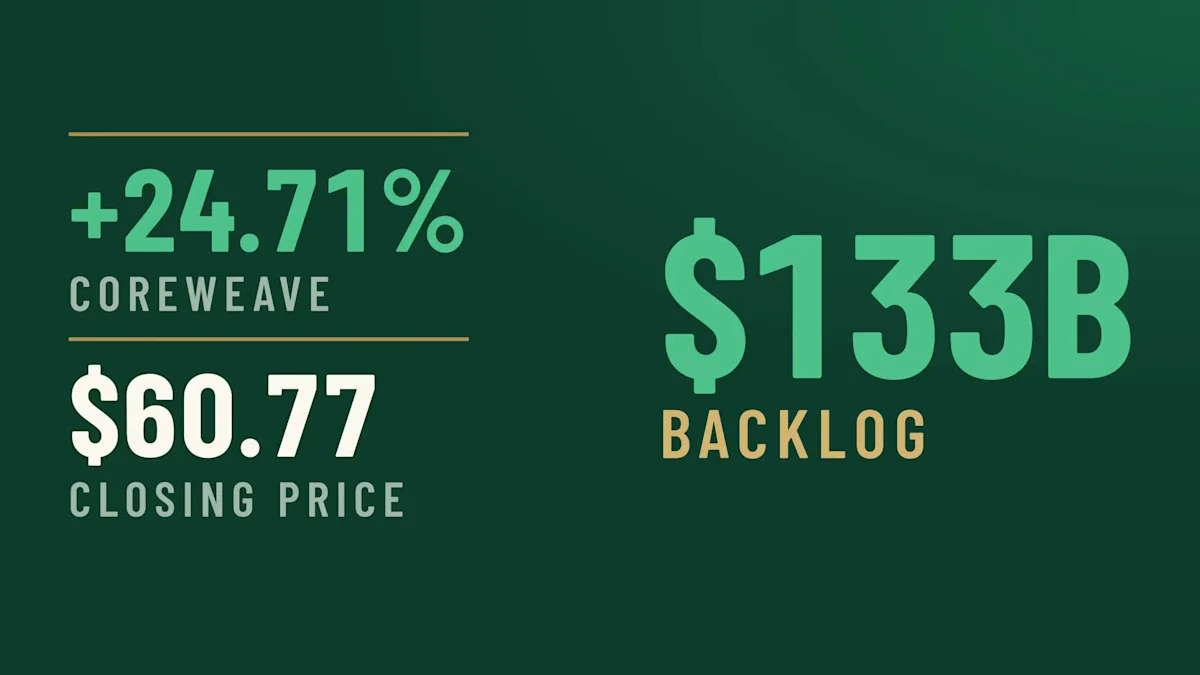
CoreWeave (CRWV) soared 25% to $61, its third-best day ever, after CEO Michael Intrator said, "We are largely sold out through 2027."
NVIDIA (NVDA) owns about 10% of CoreWeave and buys its unused capacity, so reports of a Jensen Huang ouster sent shares down 6% after hours.
Despite $3.7 billion in quarterly revenue, CoreWeave lost $709 million as $846 million of interest expense swamped operating profit.
Building a portfolio and living off one are two completely different skills, and almost nobody teaches the second. This problem is what The Definitive Guide to Retirement Income helps, and it is free today. Read more here. (Sponsor)
CoreWeave (NASDAQ:CRWV) closed at $60.77 on Wednesday, November 11, 2026. The stock gained $12.04, or 24.71%, which brought its market value to $33.52 billion.
It was the stock's biggest gain since June 3, 2025 (25.19%) and the third-best day in its history. The only bigger gain came on April 1, 2025 (41.77%), days after the IPO. Wednesday's move also beat December 19, 2025 (22.64%) and July 30, 2026 (21.51%).
Shares closed at $48.73 on November 10 and at $43.66 on November 5 during the AI selloff. Even with a 25.51% gain over one week, the stock is still down 24.28% over one month and 15.14% for the year. What comes next for the stock depends on how CoreWeave pays for its expansion and how much it relies on NVIDIA (NASDAQ:NVDA).
On the November 10 earnings call, a Goldman Sachs (NYSE:GS) analyst asked about demand. CEO Michael Intrator answered, "We are largely sold out through 2027." He said every bit of 2028 capacity CoreWeave has offered so far has sold, with more still to offer, and demand for that year is several times the capacity available.
Many successful investors eventually reach the same moment. The saving is done, the portfolio is built, and the question quietly changes from how much can I grow this to how much can I take out? Get that second question wrong and decades of good investing can come apart in a handful of years.
That is exactly what The Definitive Guide to Retirement Income helps answer. It covers what your retirement could actually cost, which income sources are worth using, and the withdrawal math that decides whether the money lasts. It is free today from Fisher Investments. Read More Here ›
Third-quarter revenue was $3.7 billion. That was up 168% from a year earlier and more than $1 billion above the second quarter. Backlog, meaning revenue already under contract, grew 138% to about $133 billion. Active power passed 1.7 gigawatts, while contracted power reached 4.6 gigawatts.
CoreWeave raised its 2026 revenue outlook to $13.0 billion to $13.3 billion, above the $12.9 billion consensus. It also raised its adjusted operating income outlook to $1.275 billion to $1.375 billion. By year-end, it expects to bring in revenue of $20 billion to $21 billion.
Third-quarter adjusted operating income was $379 million, a 10% margin. Even so, the company posted a net loss of $709 million. Operating profit already covers heavy depreciation on new hardware, and $846 million of net interest expense exceeded what was left.
CoreWeave plans to spend $37 billion to $39 billion on capital projects this year, far more than its revenue. Borrowed money covers the difference.
Intrator said CoreWeave raised GPU prices about 25% in July and about 10% more later in the quarter. Prices kept rising into the fourth quarter.
CoreWeave prices its capacity per megawatt. That figure is the annual revenue from the servers that one megawatt of power can run. New four- and five-year contracts are moving to $20 million to $25 million per megawatt, and short-term capacity has sold for more than $40 million.
About 130,000 GPUs come off contract in 2027 and 170,000 in 2028. Renting them out again at current prices could add annual revenue approaching $10 billion without new capital spending, and that revenue is not counted in the backlog. CoreWeave also said it was the first cloud provider to bring NVIDIA's Vera Rubin online for Cognition.
After the close, reports said CoreWeave is preparing an investment-grade loan led by Morgan Stanley and MUFG (NYSE:MS, NYSE:MUFG). Early yield talk is 7% to 7.5%, about half the yield on CoreWeave's existing high-yield debt. Cheaper borrowing would reduce the interest bill.
The loan could launch the week of November 16, and its terms may change. CoreWeave did not comment.
The stock still fell 6.37% to $56.90 in after-hours trading as of 7:59 p.m. ET. One outlet linked the drop to reports that NVIDIA's board could move to remove CEO Jensen Huang, which NVIDIA has not confirmed. The worry is that a leadership change could alter NVIDIA's commitments to CoreWeave. NVIDIA owns about 10% of the company and has agreed to buy its unused capacity through April 2032.
Analysts rate CoreWeave a Moderate Buy. The split is 21 Buy, 7 Hold, and 3 Sell ratings, with an average price target of $107.96.
We remain cautious despite the rally. Demand looks durable, but the company still depends on heavy borrowing and still loses money. It also leans on NVIDIA as its supplier, a major owner and the buyer of its unused capacity (we highlighted seven of the companies quietly supporting the AI data-center expansion, from power to cooling, in a free report you can grab here).
NVIDIA reports earnings on November 17, the same week the loan could launch. If the loan prices as discussed and NVIDIA's commitments hold, that would ease our caution. A close below Tuesday's $48.73 would deepen it. CoreWeave has not yet set the date of its next earnings report.
(Sponsor) Most people spend their entire working lives focusing on one thing: growing a pile of money. Then they retire and discover the skill they actually need is close to the opposite. Turning that pile into steady income, year after year, through good markets and bad, without ever running out.
It may be the least discussed and most consequential transition in personal finance, and plenty of otherwise careful investors walk into it with no real plan. That is exactly what The Definitive Guide to Retirement Income helps answer. It is a free guide from Fisher Investments covering what your retirement will really cost, where the cash flow should come from, and how much you can safely withdraw each year. Learn more here. Learn More Here ›
Contact editorial@247wallst.com for any questions or corrections.