First Majestic Reports Positive Exploration Results at Jerritt Canyon and Provides Restart Progress Update TMX Newsfile Thu, November 12, 2026 at 7:00 AM EST 28 min read AG -2.03% GC=F -1.22% AG -2.03% Explore stocks on Coinbase Trading disclosure Trading disclosure The above button links to Coinbase. Yahoo Finance is not a broker-dealer or investment adviser and does not offer securities or cryptocurrencies for sale or facilitate trading. Coinbase pays us for certain activity generated through this link. Prices displayed are informational.
Strong exploration drilling results support the potential for open-pit mining as part of the restart plan
Jerritt Canyon continues to advance toward a targeted restart in the second half of 2027
Vancouver, British Columbia--(Newsfile Corp. - November 12, 2026) - First Majestic Silver Corp. (NYSE: AG) (TSX: AG) (FSE: FMV) (the "Company" or "First Majestic") is pleased to announce positive drill results from its ongoing 2026 exploration program at the Jerritt Canyon Gold Mine ("Jerritt Canyon" or "JCG") in Nevada, USA. Near-surface drilling has returned significant gold intercepts that further support a potential open-pit operation at the mine. The Company also provides an update on the broader Jerritt Canyon restart plan, which continues to advance toward a targeted restart in the second half of 2027.
Near-surface reverse circulation ("RC") drilling at Saval has returned significant gold intercepts containing higher-grade intervals. Highlights include 48.8 metres ("m") grading 4.24 g/t Au, including 19.8 m at 7.39 g/t Au, in hole SC-26-030, and 36.6 m grading 5.87 g/t Au, including 9.1 m at 19.67 g/t Au, in hole SC-26-023. The results support continued evaluation of Saval as a source of open-pit mill feed that could complement underground production at the planned restart. The total surface drilling program has completed 15,983 m across 146 holes, with assays pending for many of the holes, particularly in the northern part of the property. Two diamond drill rigs are also following up on positive 2025 results in the Smith underground mine. Surface and underground drilling will continue through the end of 2026 and will continue into 2027.
"At Jerritt Canyon, we are increasingly encouraged by Saval, where the existing open-pit permit, shallow mineralization and recent drill results highlight the potential for a meaningful source of open-pit mill feed alongside the underground operation." said Keith Neumeyer, CEO of First Majestic. "We continue to make strong progress towards restarting Jerritt Canyon, with underground development advancing and critical upgrades to the processing plant and site infrastructure underway. Together, these initiatives continue to strengthen the opportunity for a successful restart of Jerritt Canyon".
First Majestic continues an extensive surface RC drilling campaign to test near-surface gold mineralization and evaluate potential open-pit mining opportunities as part of the Jerritt Canyon restart studies. The historic Saval open-pit area is a key target within the program and is located northwest of the SSX and Smith underground mines.
The 2026 surface drilling program began at Saval, where 8,753 m were completed across 85 holes. In addition, targets in the northern part of the property have been advanced, where a further 7,230 m were completed across 61 holes. In total, the program has completed 15,983 m across 146 holes. The drilling is intended to improve geological confidence and to evaluate whether Mineral Resources at Jerritt Canyon can be expanded or upgraded in class. Assays remain pending for a substantial number of holes, particularly from the northern targets drilled later in the program.
Upon completion of drilling the targets in the northern part of the property, one rig was redeployed to evaluate gold mineralization at the Mahala and Javelin target areas surrounding the SSX and Smith underground mines, to follow up on the encouraging results returned in 2025. The second rig was reassigned to hydrogeological drilling to support key technical investigations for the restart. In parallel, two diamond drill rigs continued drilling within priority areas of the Smith underground mine, where preparations for the planned restart are advancing.
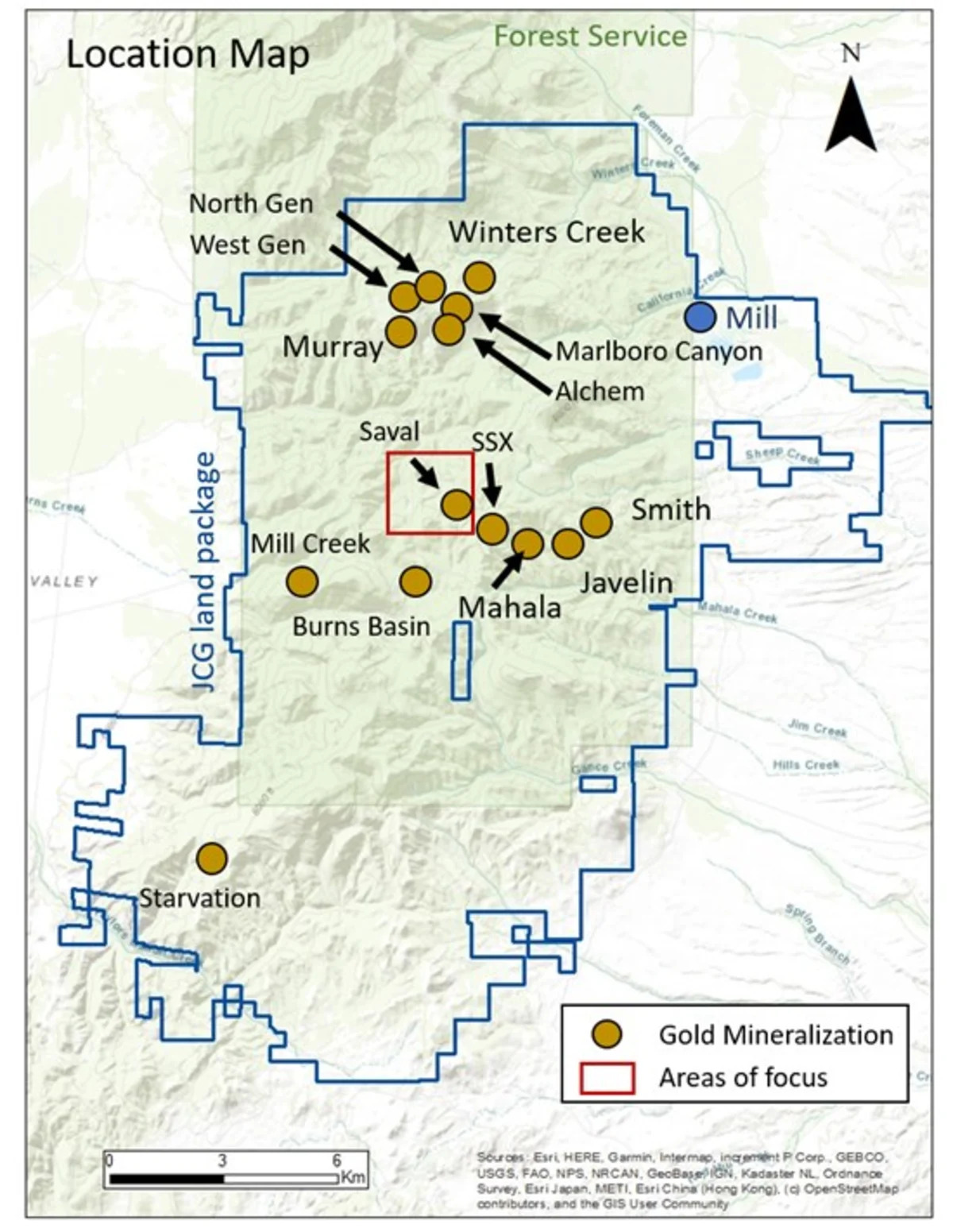
Near-surface drilling at Saval has returned broad gold intercepts containing higher-grade intervals. Table 1 summarizes selected significant gold intercepts from the 2026 Saval drilling program, and Figure 1 shows the location of Saval within the Jerritt Canyon district.
Table 1: Selected Significant Gold Intercepts from the 2026 Saval Open-Pit Drilling Program
Reported intervals are drilled lengths; true widths have not yet been determined. Based on the interpreted predominantly sub-horizontal stratigraphic controls and near-vertical surface drilling, true widths are not expected to differ materially from drilled lengths.
Figure 1: Jerritt Canyon District Map Highlighting the Saval Area and Significant Drilling Intercepts
To view an enhanced version of this graphic, please visit:https://images.newsfilecorp.com/files/1475/323686_33eecc1794347b06_002full.jpg
Saval is a key target area in the Company's evaluation of potential open-pit mill feed sources for the Jerritt Canyon restart. The area is already permitted for open-pit mining, which could allow future mining to advance without the permitting timelines commonly associated with developing a new open pit. Gold mineralization occurs in broad, near-surface, predominantly sub-horizontal zones that could support low strip ratios. Saval was historically mined at significantly higher cut-off grades, leaving lower-grade mineralization that was uneconomic at that time but may have value at current gold prices.
The 2026 drilling program was designed to better define the extent and continuity of mineralization remaining around the historical Saval pits, including areas where backfill obscures the limits of former mining. The program targeted mineralization remaining in the host bedrock to improve geological confidence and support potential additions and class upgrades to Mineral Resources. Follow-up work is planned in areas where the boundary between historical backfill and bedrock remains uncertain.
Drilling results include significant gold intercepts from both the northern and southeastern portions of Saval. Figure 2 below shows the drilling layout, selected significant intercepts and the locations of cross-sections A-A′ and B-B′.
Figure 2: Saval Historical Open Pit to SSX Underground Corridor Showing Cross-Sections A-A′ and B-B′. Plan View
To view an enhanced version of this graphic, please visit:https://images.newsfilecorp.com/files/1475/323686_33eecc1794347b06_003full.jpg
In the northern portion of Saval, drilling intersected continuous, near-surface gold mineralization, as shown along section A-A′, and provided additional information to support the evaluation of Mineral Resource classification upgrades.
Highlighted results include 48.8 m grading 4.24 g/t Au, including 19.8 m at 7.39 g/t Au, in hole SC-26-030, and 36.6 m grading 5.87 g/t Au, including 9.1 m at 19.67 g/t Au, in hole SC-26-023. These broad intercepts contain significant higher-grade intervals and further support the assessment of North Saval as a potential source of open-pit mill feed. Figure 3 plots the drilling results and geological interpretation along section A-A′.
Figure 3: Northern Saval Cross-Section A-A′. Section Location Shown in Figure 2; Section Thickness ±27.5 m
To view an enhanced version of this graphic, please visit:https://images.newsfilecorp.com/files/1475/323686_33eecc1794347b06_004full.jpg
In the southeast portion of Saval, drilling along section B-B′ tested shallow gold mineralization identified by historical drilling and helped define the boundary between backfill in the open pits and mineralized bedrock.
Drilling returned multiple significant near-surface gold intercepts. The broad, shallow mineralized intervals support continued evaluation of Southeast Saval as a potential open-pit Resource. Additional work is required where RC drilling did not clearly identify the boundary between backfill and bedrock. Figure 4 shows the drilling results and geological interpretation along section B-B'.
Figure 4: Southeast Saval Cross-Section B-B′. Section Location Shown in Figure 2; Section Thickness ±27.5 m
To view an enhanced version of this graphic, please visit:https://images.newsfilecorp.com/files/1475/323686_33eecc1794347b06_005full.jpg
Table 2 presents significant gold intercepts reported through the end of Q3 2026 from the Saval historical open-pit area.
Table 2: Significant Gold Intercepts from the 2026 Saval Open-Pit Drilling Program
"Resource Addition" and "Resource Conversion" describe the objective of each drill hole and do not represent demonstrated changes to Mineral Resources.
All drill holes were completed using reverse circulation drilling.
From and To measurements are reported in metres. Reported intervals are drilled lengths; true widths have not yet been determined. Based on the interpreted predominantly sub-horizontal stratigraphic controls and near-vertical surface drilling, true widths are not expected to differ materially from drilled lengths.
See Appendix for details regarding drill hole locations, sample type, azimuth, dip and total depth.
Significant gold intercepts were composited using length-weighted averages of uncapped sample assays, a minimum grade of 0.45 g/t Au and a minimum composite length of 9.1 m (drilled width). Up to 4.6 m below the minimum grade was allowed as internal dilution. Where necessary to achieve the minimum length, one sample below the cut-off grade was permitted within the composite.
Where present, consecutive intercepts with intervals of 4.6 m or greater with more than 3.0 g/t Au are highlighted as "Including" within each intercept.
JERRITT CANYON GOLD MINE RESTART UPDATE
Jerritt Canyon continues to advance toward a targeted restart of operations in the second half of 2027. Senior leadership and key technical roles have been filled, while underground development and rehabilitation are advancing toward the initial planned mining areas. Technical, engineering and operational readiness activities are also progressing. Work remains focused on defining the optimal pathway to sustained, long-term production, with recent drilling results further supporting the potential for combined underground and open-pit operations.
The Company continues to advance with the initial restart plan announced on April 2, 2026, and has brought forward investments from 2027 into 2026. Some of these investments include the foundation work for a vertical roller mill ("VRM") and long-lead mining and processing equipment.
The Company's decision to replace the existing crushing, grinding and drying circuit at Jerritt Canyon with a VRM is a key component of the restart plan. The VRM will prepare ore from the underground and potential open-pit operations for processing through the existing roasting facility. The new circuit is expected to provide a more reliable and efficient feed to the plant, increase throughput, reduce operating costs and improve utilization of Jerritt Canyon's existing roasting capacity.
The Company also completed the acquisition of an adjacent property, totaling 2,971 Acres (1,202 Hectares). The additional land is expected to support mine dewatering requirements and provide potential employee accommodation very close to site. This purchase includes several liveable buildings allowing the staff at Jerritt Canyon to live on site saving people travel time to and from the mine each day. The purchase of this strategic land package may also provide conservation offsets to support future permitting requirements beyond the current mine plan.
The ongoing technical studies and exploration programs will inform the restart plan, with findings to be summarized in an updated technical report (the "Report") that will be prepared in accordance with National Instrument 43-101 Standards of Disclosure for Mineral Projects ("NI 43-101"), which the Company expects to issue at the end of Q1 2027. The Report will incorporate the latest available exploration, engineering and mine planning information. Mine planning and engineering will continue beyond the issuance of the Report as additional drilling results and technical information are incorporated into the restart plan.
QUALITY ASSURANCE AND QUALITY CONTROL
First Majestic's drilling programs at Jerritt Canyon follow established quality assurance and quality control ("QA/QC") protocols, including the insertion of standards, blanks and duplicates into the sample stream. All RC drill-hole samples were placed in bags labelled with the hole ID, sample ID and sample interval, and were submitted to Bureau Veritas Minerals Laboratories ("BV"), an ISO/IEC 17025:2017-accredited laboratory.
At BV, samples are dried, crushed to 70% passing 2 mm and pulverized to 85% passing 75 μm. Gold is analyzed by lead-collection fire assay with an atomic absorption spectrometry finish (FA430). Samples returning gold grades above 10 g/t are reanalyzed using a 30 g lead-collection fire assay with a gravimetric finish (FA530).
For further information concerning QA/QC and data verification procedures, key assumptions, parameters and methods used to estimate Mineral Resources and Mineral Reserves, and for a detailed description of known legal, political, environmental, and other risks that could materially affect the Company's business and the potential development of Mineral Resources and Mineral Reserves, see the Company's most recently filed Annual Information Form available under the Company's SEDAR+ profile at www.sedarplus.ca and the Company's Annual Report on Form 40-F for the year ended December 31, 2025 filed with the United States Securities and Exchange Commission on EDGAR at www.sec.gov/edgar.
David Rowe, CPG, the Company's Vice-President of Exploration and a "Qualified Person" as defined under NI 43-101, has reviewed and approved the scientific and technical information contained in this news release. Mr. Rowe has verified the exploration data contained in this news release, including the sampling, analytical, and test data underlying such information.
First Majestic is a publicly traded mining company focused on silver and gold production in Mexico and the United States. The Company presently owns and operates four producing underground mines in Mexico: the Los Gatos Silver Mine (the Company holds a 70% interest in the Los Gatos Joint Venture that owns and operates the mine), the Santa Elena Silver/Gold Mine, the San Dimas Silver/Gold Mine, and the La Encantada Silver Mine, as well as a portfolio of development and exploration assets, including the Jerritt Canyon Gold Mine located in northeastern Nevada, U.S.A, which the Company is currently in the process of re-starting.
First Majestic is proud to own and operate its own minting facility, First Mint, LLC, and to offer a portion of its silver production for sale to the public. Bars, ingots, coins, and medallions are available for purchase online at www.firstmint.com, at some of the lowest premiums available.
For further information, contact info@firstmajestic.com, visit our website at www.firstmajestic.com or call our toll-free number 1.866.529.2807.
Cautionary Note Regarding Forward-Looking Statements
This news release contains "forward‐looking information" and "forward-looking statements" under applicable Canadian and U.S. securities laws (collectively, "forward‐looking statements"). These statements relate to future events or the Company's future performance, business prospects or opportunities that are based on forecasts of future results, estimates of amounts not yet determinable and assumptions of management made in light of management's experience and perception of historical trends. Forward-looking statements in this news release include, but are not limited to, statements with respect to: surface and underground drilling continuing at Jerritt Canyon for the remainder of 2026 and into 2027; the objectives and potential results of the ongoing 2026 drilling program at Jerritt Canyon, including potential Mineral Resource additions and classification upgrades; follow-up work being planned in areas at the Saval open-pit where the boundary between historical backfill and bedrock remains uncertain; the potential for open-pit mining and combined underground and open-pit operations at Jerritt Canyon; the planned restart investments and their anticipated benefits; the VRM preparing ore from the underground and potential open-pit operations for processing through the existing roasting facility; the Company's expectations that the new processing circuit will provide a more reliable and efficient feed to the plant, increase throughput, reduce operating costs and improve the utilization of Jerritt Canyon's existing roasting capacity; the recently purchased adjacent property supporting mine dewatering requirements, providing potential employee accommodation close to the mine and resulting in conservation offsets to support future permitting requirements beyond the current mine plan; the scope and timing of an updated technical report for Jerritt Canyon; and the restart of operations at Jerritt Canyon commencing in the second half of 2027. The proposed restart at Jerritt Canyon is not based on a completed pre-feasibility or feasibility study of Mineral Reserves demonstrating the economic and technical viability of the restart plan. There is increased uncertainty related to the economics of the project and increased technical risks of failure associated with a decision to restart production without such a study. Assumptions may prove to be incorrect and actual results and future events may differ materially from those anticipated. As such, investors are cautioned not to place undue reliance upon forward-looking statements as there can be no assurance that the plans, assumptions, or expectations upon which they are placed will occur. Any statements that express or involve discussions with respect to predictions, expectations, beliefs, plans, projections, objectives or future events or performance (often, but not always, using words or phrases such as "seek", "anticipate", "plan", "continue", "estimate", "expect", "may", "will", "project", "predict", "forecast", "potential", "target", "intend", "could", "might", "should", "believe" and similar expressions) are not statements of historical fact and may be "forward‐looking statements". Statements concerning proven and probable mineral reserves and mineral resource estimates may also be deemed to constitute forward-looking statements to the extent that they involve estimates of the mineralization that will be encountered as and if the property is developed. Mineral Resources that are not Mineral Reserves do not have demonstrated economic viability.
Actual results may vary from forward-looking statements. Forward-looking statements are subject to known and unknown risks, uncertainties and other factors that may cause actual results to materially differ from those expressed or implied by such forward-looking statements, including but not limited to: material adverse changes; general economic conditions including inflation risks; labour relations; relations with local communities; changes in national or local governments; exchange rate fluctuations; environmental risks; requirements for additional capital; outcomes of pending litigation; unexpected changes in laws, rules or regulations, or their enforcement by applicable authorities; the failure of parties to contracts with the company to perform as agreed; social or labour unrest; changes in commodity prices; and the failure of exploration programs or studies to deliver anticipated results or results that would justify and support continued exploration, studies, development or operations as well as those factors discussed in the section entitled "Description of Business - Risk Factors" in the Company's most recent Annual Information Form for the year ended December 31, 2025 filed with the Canadian securities regulatory authorities under the Company's SEDAR+ profile at www.sedarplus.ca and in the Company's Annual Report on Form 40-F for the year ended December 31, 2025 filed with the United States Securities and Exchange Commission on EDGAR at www.sec.gov/edgar. Although the Company has attempted to identify important factors that could cause actual results to differ materially from those contained in forward-looking statements, there may be other factors that cause results not to be as anticipated, estimated, or intended.
The Company believes that the expectations reflected in these forward‐looking statements are reasonable, but no assurance can be given that these expectations will prove to be correct and such forward‐looking statements included herein should not be unduly relied upon. These statements speak only as of the date hereof. The Company does not intend, and does not assume any obligation, to update these forward-looking statements, except as required by applicable laws.
Cautionary Note to United States Investors
The Company is a "foreign private issuer" as defined in Rule 3b-4 under the United States Securities Exchange Act of 1934, as amended, and is eligible to rely upon the Canada-U.S. Multi-Jurisdictional Disclosure System, and is therefore permitted to prepare the technical information contained herein in accordance with the requirements of the securities laws in effect in Canada, which differ from the requirements of the securities laws currently in effect in the United States. Accordingly, information concerning mineral deposits set forth herein may not be comparable with information made public by companies that report in accordance with U.S. standards.
Technical disclosure contained in this news release has not been prepared in accordance with the requirements of United States securities laws and uses terms that comply with reporting standards in Canada with certain estimates prepared in accordance with NI 43-101.
NI 43-101 is a rule developed by the Canadian Securities Administrators that establishes standards for all public disclosure an issuer makes of scientific and technical information concerning the issuer's material mineral projects.
Table A1: Drill Hole Collar Location, Sample Type, Azimuth, Dip and Total Depth from Jerritt Canyon
Depth(m)
All drill hole collar coordinates are determined using total station equipment after hole completion with UTM WGS84, Zone 13 (metres) as the reference system.
To view the source version of this press release, please visit https://www.newsfilecorp.com/release/323686