Sean Williams, The Motley Fool Thu, November 12, 2026 at 5:26 AM EST 6 min read NVDA -6.01% Trade NVIDIA on Coinbase Trading disclosure Trading disclosure The above button links to Coinbase. Yahoo Finance is not a broker-dealer or investment adviser and does not offer securities or cryptocurrencies for sale or facilitate trading. Coinbase pays us for certain activity generated through this link. Prices displayed are informational.
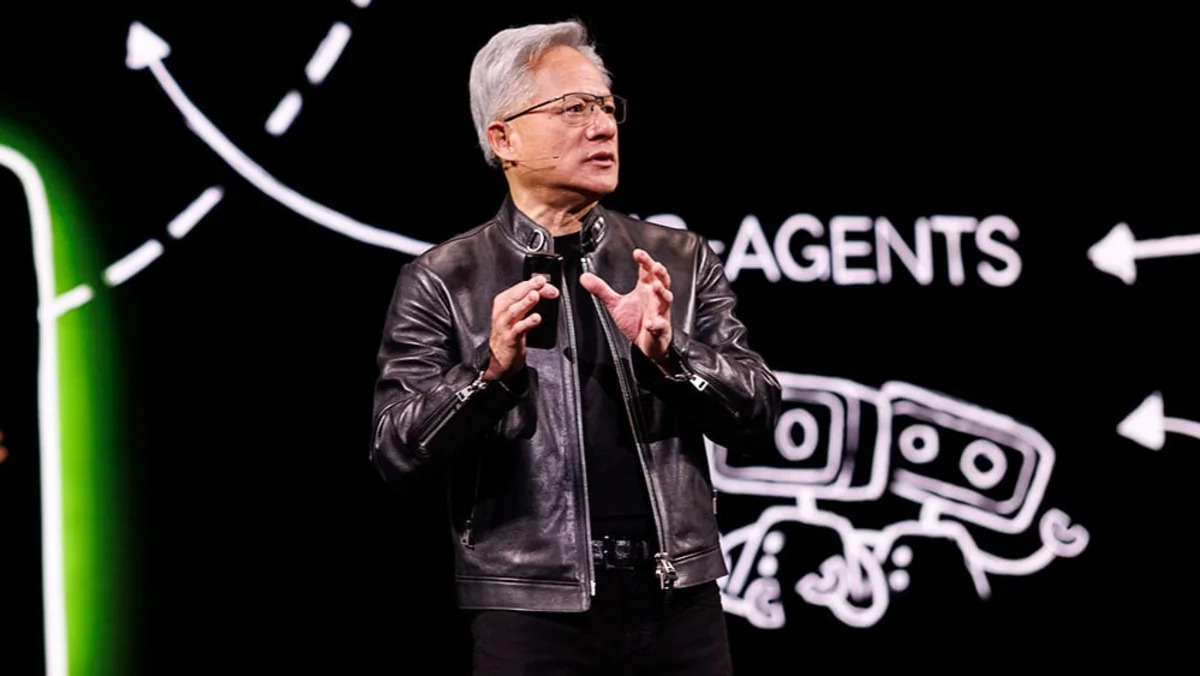
Earlier this week, the backbone of the artificial intelligence (AI) revolution, Nvidia (NASDAQ:NVDA), rocked Wall Street. According to CNBC, the company's co-founder and CEO, Jensen Huang, admitted to an affair with an alleged Chinese spy. Then, on Nov. 11, The New York Times reported that Huang had a second affair with an employee who reported to him.
Not only is Huang synonymous with Nvidia's success, but he's arguably the figurehead of the AI data center build-out. Nvidia's graphics processing units are what make data centers tick, and the company's seemingly countless deals have fueled the AI infrastructure build-out. An investigation launched by Nvidia's board has clearly unnerved investors, and there's now, as of 7:30 p.m. ET on Nov. 11, talk of the board ousting Huang as CEO.
Missed Nvidia in 2009? This Rare Signal Is Flashing Again. In 2009, a "Double Down" signal flashed for a little-known chipmaker called Nvidia. For the first time in years, that same "Total Conviction" signal is flashing for a company 1/100th the size of Nvidia. Continue »
While Jensen Huang's affair is certainly headline-worthy and pertinent to Nvidia's shareholders, there are far bigger issues with the AI trade than the goings-on in Huang's personal life.
For example, Election Night threw AI stocks for a loop.
On the one hand, prediction markets correctly forecast a Democratic blue wave in Congress weeks in advance. However, the gubernatorial blue wave was unexpected, with at least five Democratic candidates flipping governorships previously held by Republicans. Two states remain uncalled by the Associated Press, as of Nov. 9.
The concern is where Democratic governors won: Texas, Ohio, and Georgia. These three states are near the top of the list in terms of future data center capacity. Texas Gov.-elect Gina Hinojosa has pledged to ban new data center approvals until her state's legislature passes laws governing electricity and water rights, among other factors.
The stock market entered 2026 at its second-highest valuation over the last 156 years. The AI infrastructure build-out is the only reason investors have tolerated such an aggressive premium. If this build-out slows, even marginally, at the state level, it could have significant ripple effects throughout the AI trade.
Furthermore, the bond market is sending Wall Street and investors a message that can no longer be swept under the rug.
While some companies are using cash on hand or issuing stock to fund their data center expansion or large language model development, many are relying on debt. When public companies issue debt, it's typically priced around a par value of $1,000, which financial websites express as $1. When bond traders are confident that a company will meet its debt obligations, bond prices often hover around $1.
Throughout much of 2026, we've witnessed an absolute rout in bond prices for AI companies. The 2056 notes issued by Elon Musk's Space Exploration Technologies (NASDAQ:SPCX) (better known as SpaceX) in June have fallen precipitously to $0.83. Meanwhile, Nvidia's 2060 notes are trading at just $0.63.
These discounts imply serious concern about the sustainability of capital expenditures tied to the AI build-out.
Don't forget that every game-changing tech innovation since (and including) the advent and proliferation of the internet has navigated an eventual bubble-bursting event early in its expansion. It's unlikely that AI will be the exception to this unwritten rule, and bond traders know it.
While Jensen Huang's admission of an affair is front-page news, it doesn't hold a candle to the structural issues facing the stock market's No. 1 catalyst.
The Motley Fool Stock Advisor analyst team just identified what they believe are the 10 best stocks for investors to buy now… and Nvidia wasn't one of them. The 10 stocks that made the cut could produce monster returns in the coming years.
Consider when Netflix made this list on December 17, 2004... if you invested $1,000 at the time of our recommendation, you'd have $341,157!* Or when Nvidia made this list on April 15, 2005... if you invested $1,000 at the time of our recommendation, you'd have $1,037,753!*
Now, it's worth noting Stock Advisor's total average return is 834% — a market-crushing outperformance compared to 207% for the S&P 500. Don't miss the latest top 10 list, available with Stock Advisor, and join an investing community built by individual investors for individual investors.
*Stock Advisor returns as of November 12, 2026.
Sean Williams has no position in any of the stocks mentioned. The Motley Fool has positions in and recommends Nvidia and Space Exploration Technologies. The Motley Fool has a disclosure policy.
Forget Nvidia CEO Jensen Huang's Affair Scandal -- There Are Far Bigger Issues With the AI Trade was originally published by The Motley Fool