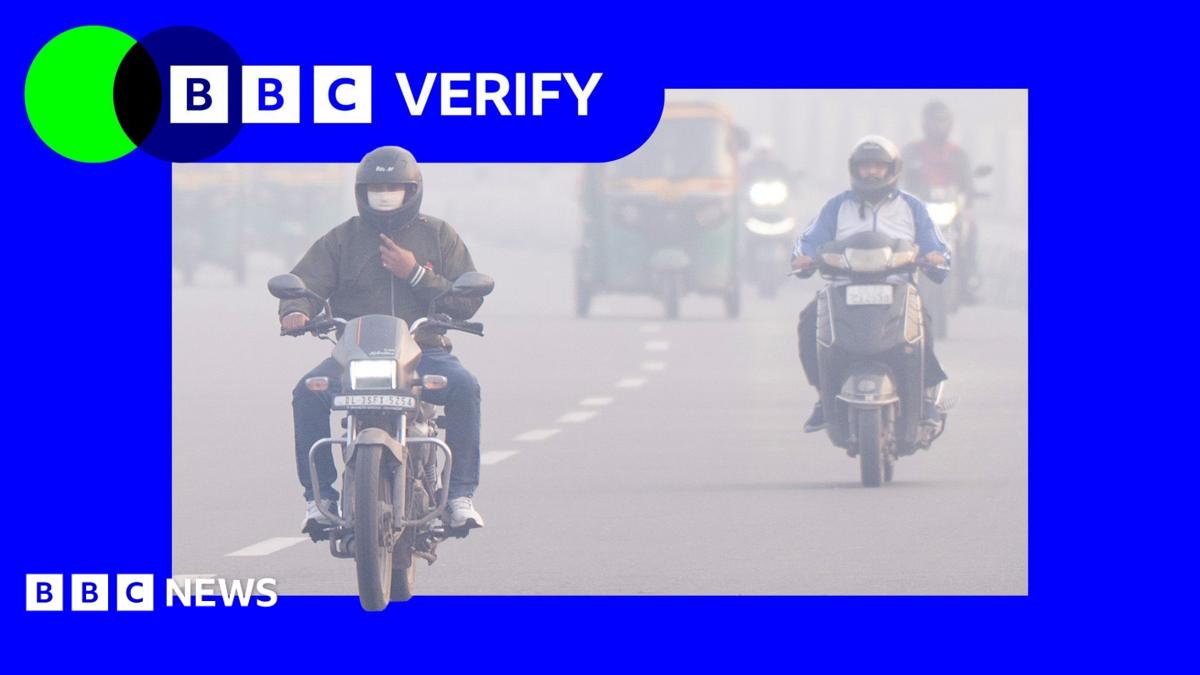
Image source, Anadolu via Getty ImagesByShruti Menon and Barbara MetzlerBBC VerifyPublished56 minutes agoBBC Verify has found significant discrepancies between two Indian government datasets showing Delhi's air pollution during Diwali, indicating official figures may not have captured the full extent of the problem.
As fireworks lit up Delhi's skies on 8 November to mark one of India's biggest festivals, some monitoring stations recorded very high levels of PM2.5, a fine particulate matter which can damage people's lungs and cause other serious health problems.
But every hourly PM2.5 reading above 1,000 micrograms per cubic metre was missing from the widely cited air quality index (AQI) published by the Central Pollution Control Board (CPCB), when compared to data from the Delhi Pollution Control Commission (DPCC).
Delhi is one of the most polluted cities in the world and often has dangerously poor air quality, so it is vital people living in India's capital can trust the official data. Firecrackers are not the only cause of pollution, which is also attributed to a mix of reasons including vehicle emissions, construction dust, farm fires and atmospheric factors. But they can worsen air quality, especially in winter.
Image source, ReutersThe CPCB, whose figures are generally cited by Indian media, has issued a statement which said readings above 1,000 micrograms are treated as "outside" the range for detection its equipment has been calibrated for and are excluded from calculations.
"During extreme episodes which are occasional like Diwali firecracker bursting, this may appear as a data gap at the particular station concerned, and those hours do not contribute to the 24-hour average of relevant pollutant for concerned station," the statement added.
Dr Manoj Kumar, a researcher at Centre for Research on Energy and Clean Air (CREA), told BBC Verify that excluding high readings risks misrepresenting actual pollution levels and could cause people to lose trust in official figures.
Our analysis found that, across the same 30 stations over 24 hours covering Diwali night, available CPCB readings averaged 240 micrograms per cubic metre - less than half the average of 551 in DPCC's data.
On the night of Diwali from Sunday into Monday, Delhi's already high pollution levels rose sharply as the celebrations peaked.
Three different pollution monitoring stations recorded PM2.5 hourly concentrations above 3,000 micrograms, DPCC data examined by BBC Verify shows.
Dr Kumar said that even a short-term exposure to extreme levels of particulate matter can have adverse health impacts.
The World Health Organization's air quality guidelines state that annual average concentrations should not exceed five micrograms per cubic metre.
Between 21:00 local time (15:30 GMT) on 8 November and 07:00 on 9 November, during the peak of Diwali celebrations, 217 hourly PM2.5 observations were missing across 59 CPCB monitoring stations in Delhi. Only 16 stations reported complete data during this period, while 43 had at least one missing observation.
None of the 116 readings above 1,000 micrograms from the 30 DPCC-managed stations appeared in the CPCB's published records they feed data into.
This matters because stations need at least 16 hours of valid PM2.5 measurements to calculate a daily average, according to CPCB's methodology. So a station with too many missing or invalid readings will not contribute to official pollution calculations.
One example of a station with several hours of missing data was at RK Puram in south Delhi, where pollution peaked at nearly 2,500 micrograms.
Using hourly PM2.5 readings from this station, BBC Verify calculated an average concentration of about 945 micrograms over the 24-hour period after 17:00 on 8 November.
But similar averages of CPCB's published data for 14 of those 24 hours produced a much lower figure of 299 micrograms. The missing 10 hours also meant this data was not included in daily average calculations.
The missing data across the city means that, despite a sharp overnight rise in pollution at some monitoring stations, CPCB reported Delhi's AQI at 344 at 16:00 on 9 November, down from 376 at the same time the day before.
Dr Sierra Clark, an environmental epidemiologist from City St George's, University in London, warned classifying high pollution readings as missing could leave out days which "contribute the most to short-term health events, such as asthma attacks and heart attacks".
She told BBC Verify "for transparency", Delhi's pollution reporting could show two scenarios including and excluding extreme pollution episodes.
"The latter would give a sense of typical pollution levels that are more representative of people's day-to-day experience. But it is also important to show the impact of those few days and what they contribute," Dr Clark added.
Pollution in Delhi is not limited to PM2.5 and satellite imagery shows a thick haze over the city on 8 and 9 November.
Satellite measurements of other pollutants like nitrogen dioxide (NO2), carbon monoxide (CO) and fire activity in the atmosphere, rather than at ground level, showed increases on 8 November.
But their overall average for Diwali week was not very high compared with 2024 and 2025.