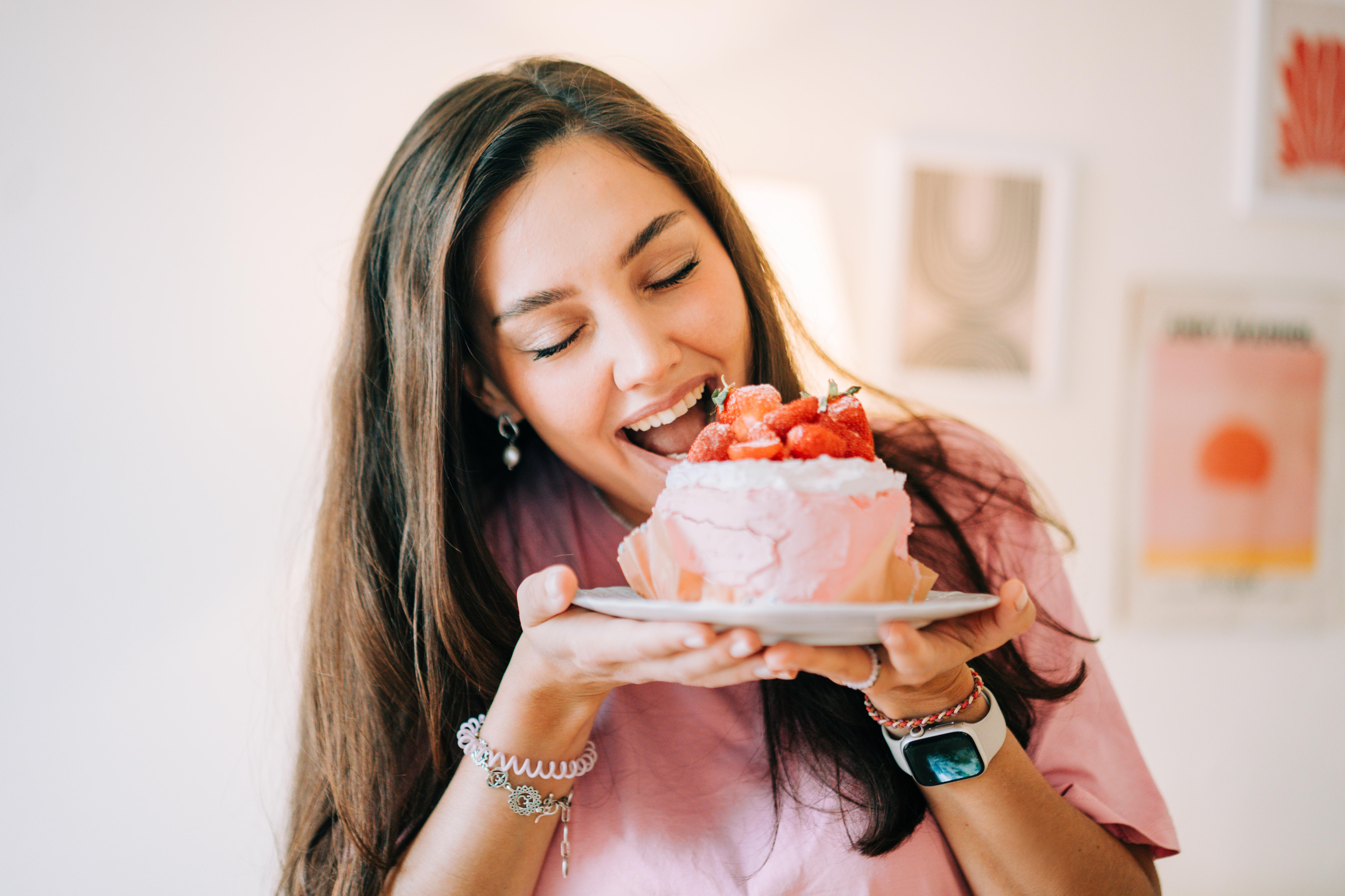
Do you have a terrible sweet tooth? Researchers have figured out a better way to satisfy it.
It’ll keep your favorite dessert on the menu while lowering the fat and sugar — and boosting whole-food nutrients and fiber. No artificial sugar, cream or butter substitutes required.
It’s not a bad proposition. But to sweeten the deal, consider this: After actually eating it, people actually prefer the healthier version to the traditional one, according to new research. Authors are calling the change a “dessert flip.”
The “dessert flip” trick flips the traditional proportions of cake to fresh fruit and nuts. Getty Images Here’s how it works: Rather than a slice of cake with a berry or two on top as decoration, swap for a small slice with a heaping portion of fresh fruit and nuts. The same concept works for ice cream, waffles, parfaits and more.
“I’m a huge dessert lover,” author Amalie Kurzer told the Washington Post. “But you can make a delicious dessert that has a lot of fruit, and it will be better for you.”
And according to a study, most people don’t feel like they’re missing out. Yes, really.
Researchers gave participants three desserts. Some got a traditional cake with a small side of berries and nuts (about 80% cake, 20% berries and nuts).
Another group got cake stuffed with peach puree — this was a kind of “stealth” dessert Kurzer compared to hiding the veggies in your kid’s meatballs.
The last group got the flipped dessert, which had 80% fruits and nuts with just a little (20%) cake.
Participants liked the first two options about the same. But the “flipped” dessert was rated much higher than the other options, meaning the participants liked it more.
Kurzer says that people don’t even really want the bigger slice of cake — they ended up tossing leftovers.
“As humans, we crave variety in our diets. So, a big piece of cake gets boring fast, especially if it’s a cake that you know is not necessarily good for you,” she said. “People would just get tired of their cake. They would eat a little and then be like, ‘Yeah, I’m done.’”
Instead of an 80/20 proportion of cake to fruit, flip the order for a number of health benefits. Getty Images Why it matters It’s no surprise that a sweet tooth is not good for our health. But there’s a biological reason sweet treats are so irresistible: We’re hardwired to seek out high-calorie foods for evolutionary survival.
The dessert flip makes making better choices — that go against some of these instincts — a little easier, without sacrifices.
Not only does flipping lower the sugar, fat, and possibly processed elements of your cake or ice cream, but it also introduces all the benefits of nuts and berries.
Berries are rich in antioxidants, vitamins and minerals. Blueberries, for example, offer anthocyanins which fight inflammation and could improve brain, eye, heart health and even reduce cancer risk. Raspberries have polyphenols, which could also protect against cell damage and cancer.
Meanwhile, nuts are high in protein, healthy fat that lowers cholesterol, and offer vitamin E, folic acid, niacin, magnesium, plus heart-healthy phytochemicals and L-arginine.
Fruits overall and nuts are also packed with fiber, which traditional desserts made of white flour, sugar, butter and eggs have little to none. Meat, eggs and dairy don’t have any fiber, while refined grains have little to no fiber.
The best way to get it is through fruits, vegetables, whole grains, and legumes, nuts and seeds.
That’s why 95% of Americans aren’t getting enough fiber, contributing to a number of public health issues, including colorectal cancer — a disease that’s skyrocketing among young people.
Kurzer notes that you can get creative with dessert flipping at home, and while you’re at it, try flipping your dinner too. Consider adding more vegetables to your plate and cut the meat and processed grains — think dinner rolls, white rice, and pasta.