NVDA +2.90% CRWV +25.57% TSLA +3.04% ORCL +8.86% PLTR +1.94% Explore stocks on Coinbase Trading disclosure Trading disclosure The above button links to Coinbase. Yahoo Finance is not a broker-dealer or investment adviser and does not offer securities or cryptocurrencies for sale or facilitate trading. Coinbase pays us for certain activity generated through this link. Prices displayed are informational.
Artificial intelligence (AI) has become the biggest story, the central story, perhaps the only story that matters to the stock market right now. But many investors are getting anxious.
The past few months have been bad for AI stocks. The tech-heavy Nasdaq-100 officially entered a correction (a 10% or more decline), dropping 11.3% since Oct. 6 before gaining today. That's more than halfway to a bear market (a 20% or more decline).
Missed AI's "Act 1"? Act 2 Could Be 16x Bigger. Most investors think they missed the AI boat because they didn't buy Nvidia in 2005. But according to our analysts, we're only at the end of "Act 1"—the R&D phase. "Act 2" is the global rollout. Continue »
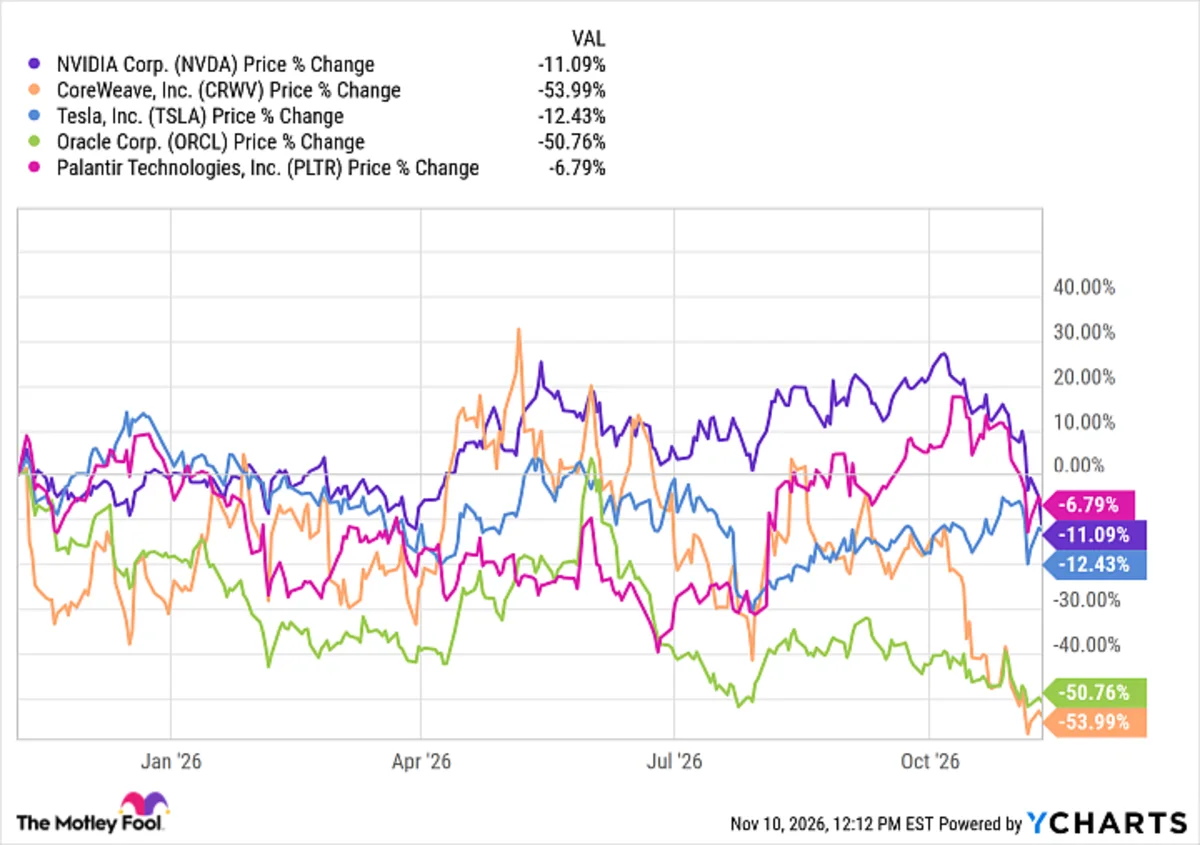
Some major tech names that have been driving the AI trade, such as Nvidia, CoreWeave, Tesla, Oracle, and Palantir, have seen significant share price declines over the past year.
Does this mean that AI stocks are "over" and it's time to move your money to bonds or cash? Not necessarily. There are a few possible future paths for what might happen next with AI stocks and the broader stock market.
AI executives have made some incredibly lofty predictions about what their technology might do in the future. We've heard bold claims that AI will boost U.S. GDP by 50% in just four years, but also that it will replace most entry-level white-collar jobs, or even be responsible for the extinction of mankind. I'm skeptical about these most extreme scenarios. At the other extreme, some AI skeptics believe the technology is overrated, overpriced, and unlikely to deliver meaningful gains in productivity or economic growth. I feel like this is unlikely to be true for too long. Companies across industries are experimenting with AI to improve their processes, save time, and reduce costs. Are we really supposed to believe that all that effort will amount to nothing, that AI is just going to "go away"? I doubt that. Instead, I think it's more likely that we find a happier middle ground on the future of AI.
Let's take a big-picture look at the future of AI stocks -- with optimistic (bull case), pessimistic (bear case), and middle-ground (base case) scenarios. And let's see how you could position your investments based on which outcome you think is most likely.
AI doesn't destroy human civilization or take all the jobs. Instead, it delivers game-changing productivity growth. Good news comes out about a highly popular, profitable new AI product that's a game changer, like Google search was in 1999 or the iPhone in 2007. Or AI gets cheaper to build. (Or both.)
The hyperscalers' massive investments in AI data center build-outs look more sustainable and are starting to pay off. The Nasdaq-100 skyrockets.
If you believe that today's tech majors are likely to be the biggest winners of AI's future, buy the Invesco Nasdaq-100 ETF (NASDAQ: QQQM) or other tech-heavy ETFs. If this bull case scenario comes true, owning a Nasdaq-100 ETF is likely going to put some of the biggest tech winners in your portfolio, no matter which companies come out on top of the AI race.
Despite years of investor enthusiasm, hundreds of billions of dollars in capital expenditures, and billions of curious users worldwide, AI fails to deliver. It turns out that advanced AI models cost too much to produce and are too expensive to build a profitable business model.
A major AI frontier lab fails to raise funding and is forced to scale back or go out of business. (For example, Big Short investor Steve Eisman recently said that he believes OpenAI has become so important to the AI-driven economy that if it were to hypothetically go bankrupt, America would go into a recession.)
AI hyperscalers announce that they are cutting back on AI capex and focusing on their core businesses. The Nasdaq-100 drops by 50% in a year, while the S&P 500 loses 30%, worse than 2022.
If you believe that AI is overhyped, AI stocks are overpriced, and this whole thing is going to end in disaster, you might want to put your money into value stocks and dividend stocks. This can diversify your portfolio into different parts of the economy away from the AI trade. The Schwab U.S. Dividend Equity ETF (NYSEMKT: SCHD) could be a good choice for this strategy.
What if AI doesn't destroy everyone's jobs or lead to a stock market crash? There is a third way forward for AI stocks, and it could be good news for everyone. Vanguard research forecasts that AI could be "as transformative as electricity was a century ago," but the biggest gains for AI will ultimately go to companies that adopt AI to improve their businesses, not necessarily the megacap tech companies building AI today.
As part of this broader trend toward AI delivering widely shared gains across the economy, Vanguard projects that over the next 10 and 30 years, U.S. value stocks will outperform U.S. growth stocks, and U.S. small caps will outperform U.S. large caps.
If you believe that in the long run, AI might work out for the best, and companies will figure out a way to use it in ways that drive growth and profits (but without replacing all humans), you might want to buy small-cap stocks like the iShares Russell 2000 ETF (NYSEMKT: IWM), or value stocks like the Vanguard Value Factor ETF (NYSEMKT: VFVA).
None of these possible futures are guaranteed to happen. None of the stocks and ETFs mentioned here are guaranteed to go up, or to outperform the S&P 500.
But hopefully this thought experiment shows that there's more than one way for the AI story to end -- and it doesn't have to end badly. Even if some AI stocks fail to deliver or some AI companies go out of business, in the long run, the rest of us might be fine. The future could be brighter than today's skeptics expect.
Before you buy stock in iShares Trust - iShares Russell 2000 ETF, consider this:
The Motley Fool Stock Advisor analyst team just identified what they believe are the 10 best stocks for investors to buy now… and iShares Trust - iShares Russell 2000 ETF wasn't one of them. The 10 stocks that made the cut could produce monster returns in the coming years.
Consider when Netflix made this list on December 17, 2004... if you invested $1,000 at the time of our recommendation, you'd have $341,157!* Or when Nvidia made this list on April 15, 2005... if you invested $1,000 at the time of our recommendation, you'd have $1,037,753!*
Now, it's worth noting Stock Advisor's total average return is 834% — a market-crushing outperformance compared to 207% for the S&P 500. Don't miss the latest top 10 list, available with Stock Advisor, and join an investing community built by individual investors for individual investors.
*Stock Advisor returns as of November 11, 2026.
Ben Gran has no position in any of the stocks mentioned. The Motley Fool has positions in and recommends Nvidia, Oracle, Palantir Technologies, and Tesla. The Motley Fool has a disclosure policy.
3 Possible Paths Forward for AI Stocks (Bull Case, Bear Case, Base Case) -- and How to Invest for Each was originally published by The Motley Fool