Leo Sun, The Motley Fool Wed, November 11, 2026 at 2:15 PM EST 5 min read NVDA +3.98% Trade NVIDIA on Coinbase Trading disclosure Trading disclosure The above button links to Coinbase. Yahoo Finance is not a broker-dealer or investment adviser and does not offer securities or cryptocurrencies for sale or facilitate trading. Coinbase pays us for certain activity generated through this link. Prices displayed are informational.
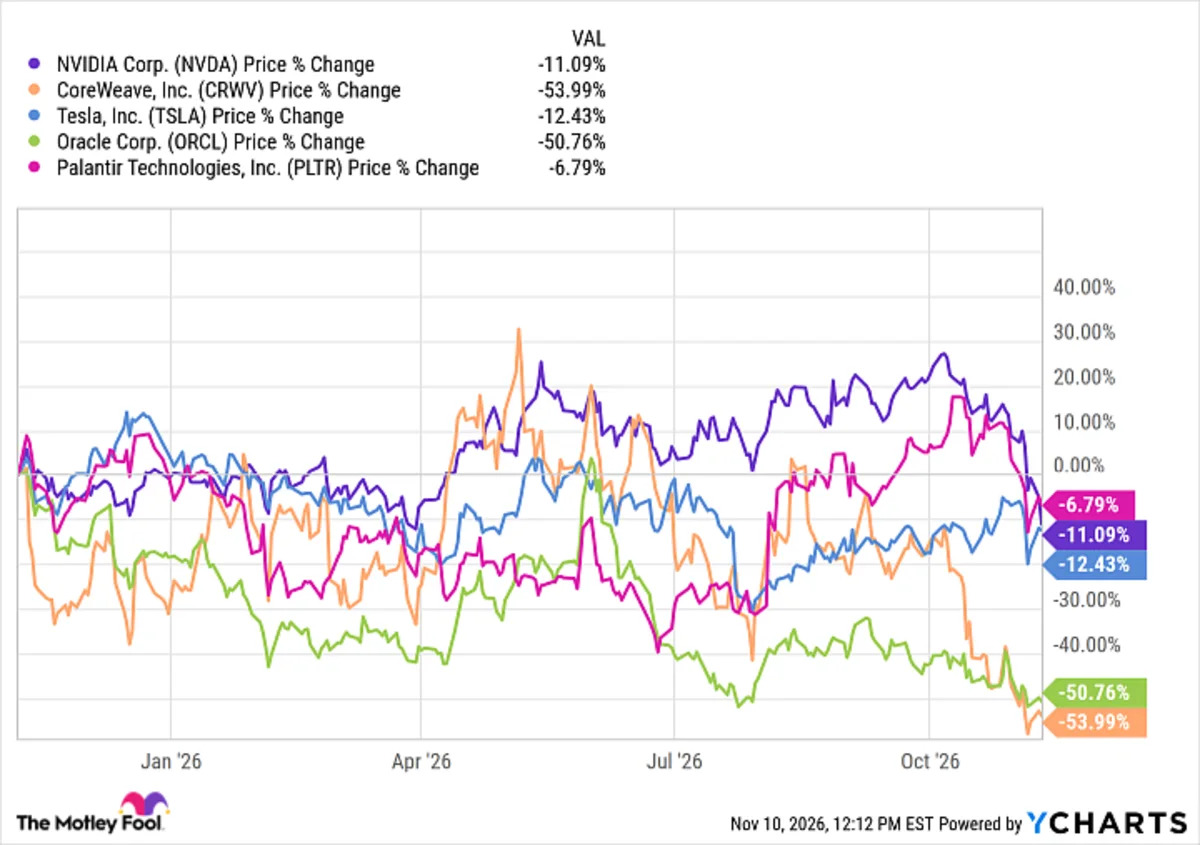
Nvidia's stock (NASDAQ: NVDA) closed at a record high of $239.24 per share on Oct. 6. But today, the AI chipmaker's stock trades at about $175. Let's see what caused that 27% decline -- and where Nvidia's stock might be trading by the end of next year.
Nvidia is the world's largest producer of discrete GPUs. It originally sold most of those chips to PC gamers, but it now generates most of its revenue from the data center market.
Missed Nvidia in 2009? This Rare Signal Is Flashing Again. In 2009, a "Double Down" signal flashed for a little-known chipmaker called Nvidia. For the first time in years, that same "Total Conviction" signal is flashing for a company 1/100th the size of Nvidia. Continue »
Unlike CPUs, which are optimized for fast sequential processing, GPUs are designed to execute thousands of calculations simultaneously through massive parallelism. That key difference makes GPUs better suited for training AI models than stand-alone CPUs.
Nvidia's early mover's advantage enabled it to dominate the AI data center market with its chips, and it locks in those customers with its proprietary software and services. Today, most of the world's top AI companies -- including Anthropic and OpenAI -- use Nvidia's GPUs.
From fiscal 2021 to fiscal 2026 (which ended this January), Nvidia's revenue grew from $16.7 billion to $215.9 billion, while its net income jumped from $4.3 billion to $120.1 billion. Even after its latest decline, its stock is still up roughly 1,210% over the past six years.
Nvidia's market dominance and breakneck growth made it one of the easiest ways to profit from the AI boom. But with 93% of its revenue coming from the data center market in its latest quarter, it could only maintain its momentum if AI companies kept buying more chips.
Over the past year, the Iran war, inflation, and the Fed's interest rate hike in September drove more investors to question that bullish thesis. As the costs of building new data centers outpaced the monetization of new AI services, it became harder to justify those expenses.
The Democratic sweep of the midterm elections on Nov. 3 exacerbated that pressure. Several newly elected officials -- including Texas governor-elect Gina Hinojosa -- have called for moratoriums on new data centers until tighter regulations are rolled out.
On Nov. 8, Nvidia co-founder and CEO Jensen Huang admitted that he had an extramarital affair in a public company memo. Huang didn't name anyone, but the major media outlets pointed at Alice Huang, an executive at Megaspeed. This Singapore-based cloud computing firm that spent at least $4.8 billion on Nvidia's data center chips over the past three years.
On its own, this partnership didn't violate any laws. However, Megaspeed allegedly sold those AI chips to Chinese tech companies and violated the export curbs against China. Several reports also called Alice Huang a Chinese spy, an allegation that China denies.
Those accusations are troubling because another one of Nvidia's major customers, California-based Supermicro (NASDAQ: SMCI), was recently hit with similar allegations. Supermicro's co-founder, Yih-Shyan Liaw, and two others were recently indicted for conspiring to smuggle $2.5 billion in Nvidia-equipped servers to China through Asian shell companies.
It's unclear whether Nvidia turned a blind eye to these activities or simply failed to track them, but the allegations have prompted the company's board to open an internal investigation. It also faces new government probes and a massive class action lawsuit from its shareholders.
Nvidia is still growing rapidly, and the market's demand for its chips is still outstripping its supply. From fiscal 2026 to fiscal 2029, analysts expect its revenue and EPS to both grow at a 61% CAGR. That's an incredible growth rate for a stock trading at 17 times this year's earnings.
However, Nvidia's stock could continue to trade at that discount if it doesn't resolve its most pressing issues. In a worst-case scenario, in which Nvidia's board fires Jensen Huang, Nvidia's stock could sink much lower before it's considered a bargain.
But even in a best-case scenario, in which Huang weathers the internal and government probes, Nvidia's valuations could remain depressed as it struggles with the macro headwinds. I don't think Nvidia's board will actually oust Huang, since that would crush its own stock, but I also don't see the company recovering from this scandal by the end of next year. Therefore, I expect it to trade sideways -- or recover slightly -- by the end of 2027 instead of rallying again.
The Motley Fool Stock Advisor analyst team just identified what they believe are the 10 best stocks for investors to buy now… and Nvidia wasn't one of them. The 10 stocks that made the cut could produce monster returns in the coming years.
Consider when Netflix made this list on December 17, 2004... if you invested $1,000 at the time of our recommendation, you'd have $341,157!* Or when Nvidia made this list on April 15, 2005... if you invested $1,000 at the time of our recommendation, you'd have $1,037,753!*
Now, it's worth noting Stock Advisor's total average return is 834% — a market-crushing outperformance compared to 207% for the S&P 500. Don't miss the latest top 10 list, available with Stock Advisor, and join an investing community built by individual investors for individual investors.
*Stock Advisor returns as of November 11, 2026.
Leo Sun has no position in any of the stocks mentioned. The Motley Fool has positions in and recommends Nvidia. The Motley Fool has a disclosure policy.
Prediction: Nvidia Stock Will Be Worth This Much by Year-End 2027 was originally published by The Motley Fool