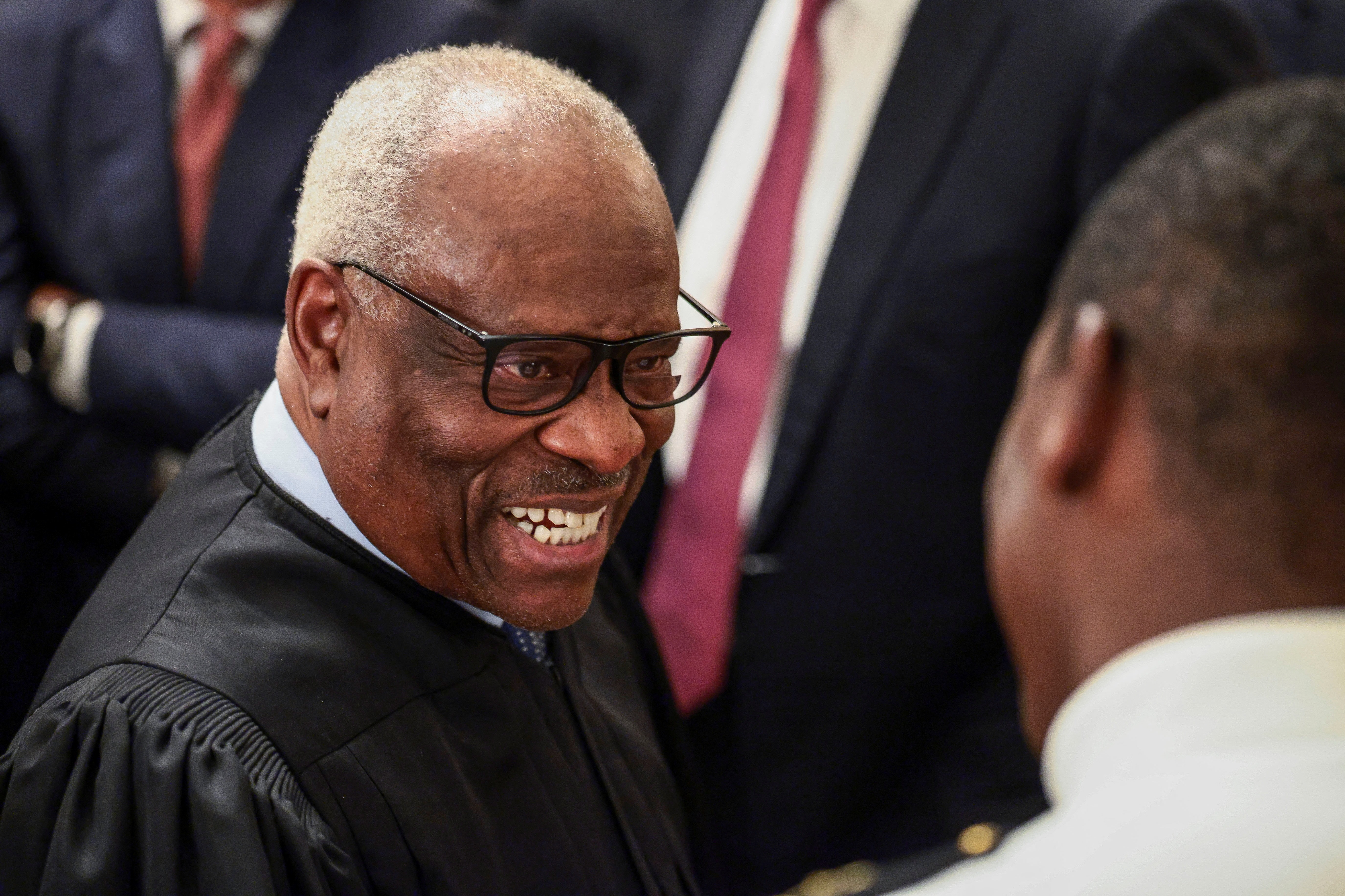
U.S. Supreme Court Justice Clarence Thomas attends a swearing-in ceremony for a new Federal Reserve Chair Kevin Warsh at the White House in Washington, D.C., U.S., May 22, 2026. REUTERS See more of our coverage in your search results.
Add The New York Post on Google This month, Clarence Thomas became the second-longest-serving justice in Supreme Court history.
For Thomas, it marks something more: the vindication of a constitutional vision that, for decades, was caricatured as eccentric, angry or unserious — until the court, and the country, began catching up.
The occasion comes just as Thomas has again demonstrated why his tenure matters.
In this session’s Louisiana v. Callais, the court held that Louisiana’s race-driven congressional map could not be justified by a misconstrued Voting Rights Act.
As my colleague Dan Morenoff has explained, Justice Samuel Alito’s majority opinion was correct in tightening Section 2 doctrine so that it no longer forces states into racial sorting.
But Thomas, joined by Justice Neil Gorsuch, concurred to say what he’s said for over 30 years: Section 2 doesn’t regulate districting at all.
That’s Thomas in full — he joins the court when it moves toward the Constitution, but doesn’t trim his sails merely because a plurality of colleagues has stopped short of first principles.
In Callais, he praised the court for ending a “disastrous misadventure” in voting-rights jurisprudence, but added that the statutory text — “voting qualification,” “prerequisite to voting,” or “standard, practice, or procedure” — doesn’t naturally encompass a state’s choice of district lines.
In other words, Thomas follows the Constitution wherever it leads — even when that takes him beyond Alito, and even beyond the late, great Justice Antonin Scalia.
Thomas has been the most radical originalist in the best sense: willing to reconsider not only Warren Court inventions but also Progressive Era assumptions, New Deal compromises and conservative half-measures.
That explains his landmark Second Amendment opinion in New York State Rifle and Pistol Association v. Bruen (2022), which defined the standard by which courts are to evaluate state laws with reference to the nation’s historical tradition of firearm regulation.
His approach has been much maligned — especially by those who prefer judicial balancing tests that always seem to weigh in favor of government power — but it has the virtue of treating a constitutional right as a right.
The same instinct animated Thomas’ concurrence in McDonald v. City of Chicago (2010), in which the court, again writing through Alito’s pen, “incorporated” the Second Amendment against the states through the Due Process Clause, as modern doctrine dictated.
Thomas agreed with that result but rejected the route, casting the decisive fifth vote in his own way.
The Fourteenth Amendment, he argued, didn’t need the judicial contrivance of “substantive due process” to protect fundamental rights: Its Privileges or Immunities Clause was written for that work.
That position remains lonely — Gorsuch again being the only one to join Thomas’ constitutional crusade.
Thomas’ critics often miss his nuance because they insist on psychologizing him.
They can’t believe that a black man from Pin Point, Ga., could read the Constitution differently from the faculty-lounge consensus — unless he were acting from resentment, ideology or false consciousness.
But Thomas’ remarkable American story points in the opposite direction.
As he wrote in his extraordinary memoir “My Grandfather’s Son,” he was born into desperate poverty in the Jim Crow South, raised by his grandfather, made his way through Catholic schools, Holy Cross, Yale Law and state and federal governments, and emerged as a force to be reckoned with.
Even then, the key to understanding him was not bitterness but intellectual consistency.
That consistency was on display again last month in Austin, Tex., where Thomas spoke at the University of Texas about the Declaration of Independence and the Constitution.
The Constitution, he said, is “the means of government,” while the Declaration announces its ends.
Rights don’t come from the administrative state, enlightened experts or the latest opinion survey, Thomas maintains.
Government exists to secure pre-political rights; constitutional structure exists to restrain those who would convert power into benevolence and benevolence into command.
For nearly 35 years he has written separately, dissented alone, returned to text and history, and refused to let bad precedent acquire moral authority merely by aging.
The justice once dismissed as Scalia’s shadow has proven to be the court’s most consistent constitutionalist.
William O. Douglas holds the record for Supreme Court service, and his jurisprudence is head-scratching even to those (progressives) who largely agree with its results.
But Thomas’ longevity matters because it has given originalism time to mature from slogan to method and from method to law.
It would thus be fitting if Thomas remains on the bench through May 20, 2028, when he would surpass Douglas as the longest-serving justice in American history.
It wouldn’t be so because records matter in themselves, but because this one would belong to a justice who has done more than almost anyone to restore the court to its proper role: not philosopher-king, not super-legislature, not engine of elite sentiment, but guardian of the Constitution we actually have.
Ilya Shapiro is director of constitutional studies at the Manhattan Institute and author of the Shapiro’s Gavel newsletter. From City Journal.