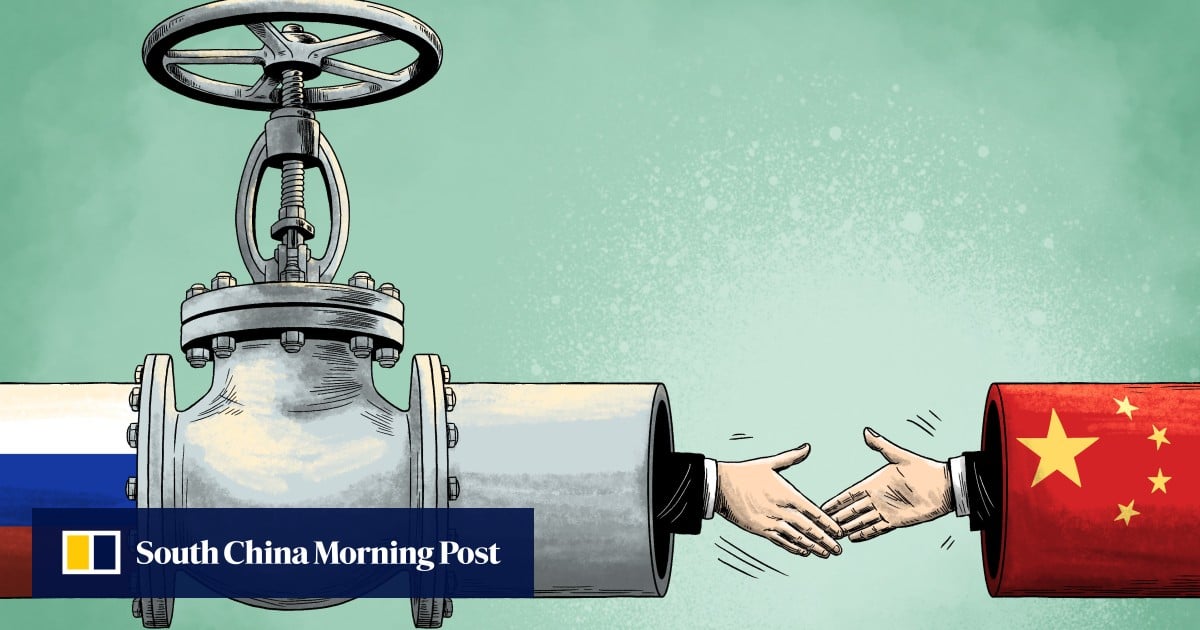
Though this week’s China-Russia summit featured many agreements, none progressed the long-delayed Power of Siberia 2 natural gas pipeline
5-MIN READ5-MINAlice Li,Sylvia MaandKandy WongPublished: 6:00am, 23 May 2026Updated: 6:11am, 23 May 2026In an era when technology seems to defy all limits, one age-old barrier has managed to endure: geography.
As geopolitical turbulence continues to disrupt traffic through the Strait of Hormuz – a vital shipping artery, especially for energy – the search for other fuel sources, and other means of transport, has shifted from a strategic luxury to an existential necessity. This need has become particularly acute for China, a major consumer of fossil fuels.
Middle Eastern imports remain a significant component of China’s energy mix, with Qatar and the United Arab Emirates supplying about 30 per cent of its liquefied natural gas (LNG) imports last year, according to S&P Global Energy.
While uncertainties mount over the long-term stability of maritime energy transport, Russia – with its vast energy reserves and sizeable land border with China – presents a viable alternative for Beijing, and a trade opportunity for Moscow.
As Russian President Vladimir Putin landed in Beijing this week for his 25th state visit, attention shifted to the long-delayed Power of Siberia 2 pipeline. Upon completion, the project would deliver an estimated 50 billion cubic metres (1.77 trillion cubic feet) of natural gas to China annually via a 2,600-km (1,616-mile) route passing through Russia and Mongolia, at a previously projected construction cost of US$13.6 billion.
Although Russian Deputy Prime Minister Alexander Novak reportedly said that some contracts for the pipeline are approaching “final agreement” following the summit, China has remained relatively quiet.