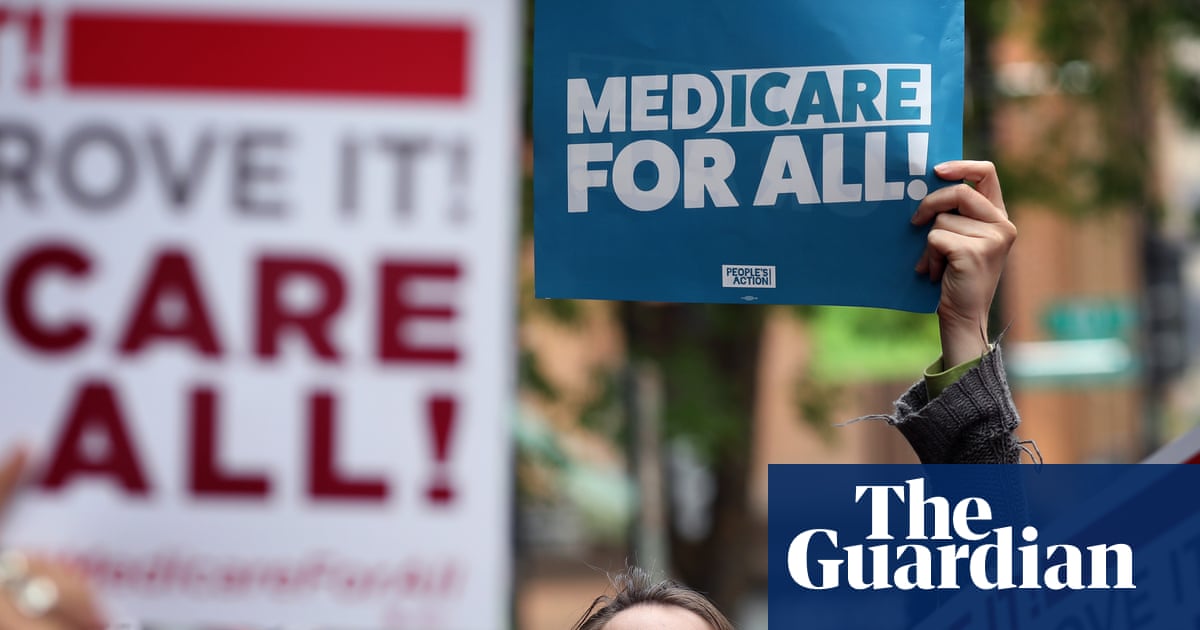
Protesters supporting ‘Medicare for All’ hold a rally outside PhRMA headquarters on 29 April 2019 in Washington DC. Photograph: Win McNamee/Getty ImagesView image in fullscreenProtesters supporting ‘Medicare for All’ hold a rally outside PhRMA headquarters on 29 April 2019 in Washington DC. Photograph: Win McNamee/Getty ImagesAnalysisDemocrats’ US election sweep brings the price of their promised social contract into focusEduardo Porter‘The post-election wish list is about to run into harsh fiscal reality: there is no money’
Is this an opportunity for a new America? As the Reagan revolution four decades ago launched US society down the path to low taxes and meager solidarity, perhaps the Republican bloodbath last week could turn US politics toward building a new social contract anchored on an aspiration to equitable prosperity.
One can sense the ambition of the bumper new crop of Democrats ushered to power last week, calling for support for programs for children and their parents; emphatically endorsing the long-held dream of Medicare for All. The project includes rolling back Donald Trump’s cuts to Medicaid and food stamps, and restoring subsidies for health insurance under the Affordable Care Act that Republicans allowed to expire. And that’s just the start.
Early odds suggest a Democrat may win the presidential election in two years, a fitting coda to last week’s broad rejection of the Maga brand of politics. It’s not beyond hope to expect a Democratic trifecta that will spend less time on settling grievances and more on fixing a threadbare social safety net that allows for the deepest poverty in the affluent world.
And yet, the post-election wish list is about to run into harsh fiscal reality: there is no money. The federal deficit is now running at about 6.2% of GDP. The federal debt hit $40tn, more than 120% of the nation’s gross domestic product. Paying interest on that debt costs some 3.2% of GDP. That’s about $1tn, more than is spent on national defense. The Congressional Budget Office projects that debt and interest payments will continue to grow faster than the economy over the coming decades. In October alone, the first month of the 2027 fiscal year, the fiscal deficit ballooned to $409bn.
The Center on Budget and Policy Priorities estimates that restoring the subsidies to health insurance plans under Obamacare from 2030 to 2039 would cost $460bn. Undoing the budget cuts to the Snap food stamp program and Medicaid that Trump used to partly fund the tax cuts in his One Big Beautiful Bill Act (OBBA) would cost $2.2tn over that decade. “Reversing the harms is going to be very expensive,” said CBPP’s senior director for Federal budget policy, Brendan Duke.
And that’s the easy part. The trust fund that pays for social security benefits is scheduled to run out of money in less than six years, when the new crop of Democratic senators are still in their first term. By law, that would lead to an automatic 22% cut in benefits. Fixing that will require more money. Artificial intelligence may further complicate the picture, burdening the safety net with potentially millions of workers displaced by the new technological revolution.
Historian Bruce Bartlett, who back in the day advised Ronald Reagan on budget policy, argues that this state of affairs is the outcome of a Republican strategy honed over the years since Gipper’s day: cut taxes to strangle the budget and tie the hands of whatever Democratic administration comes next.
Trump’s OBBBA will add somewhere between $4.1tn and $5.5tn to the federal debt over 10 years, depending on whether temporary tax cuts in the bill are made permanent by a future Congress, something that has usually happened in the past. This, Bartlett once told me, will “make sure the next Democratic president is a complete and total failure”.
The new taxes that would be needed just to fill the holes Trump and his Republican enablers bored into the budget, let alone patch up the safety net they gleefully eviscerated, seem beyond anything achieved in recent memory.
Consider this: The last time that a government with any Republican in power delivered a tax increase was in the 1990s, when George HW Bush was president and Congress was blue. Bush paid for his sin, though, losing reelection to Democrat Bill Clinton. And that was the end of that.
Democrats have raised money when they held the presidency and Congress. But the trend suggests the opportunities are fading. Bill Clinton’s 1993 tax increases are estimated to yield the equivalent of $3.3tn over the 2030-2039 decade, adjusting for inflation. But the feat, which helped produce the nation’s first budget surplus since the 1960s, was ultimately spent on a tax cut by Clinton’s successor, George W. Bush.
The next shot at raising taxes was more modest. Barack Obama’s Affordable Care Act raised the equivalent of $1.1tn over 2030-2039, in inflation-adjusted dollars. But Obama also made permanent some of George W Bush’s tax cuts. Joe Biden tried to go bigger: his original Build Back Better Act, passed in the House, would have raised the equivalent of $2.3tn over that window. But the Senate nixed that, authorizing only about $700bn in the Inflation Reduction Act.
How much more tax revenue does the US need? It depends on what Democrats want to achieve. Total tax revenue in the US amounts to less than 26% of its gross domestic product. That is 9 percentage points less than Britain’s total tax take, as a share of its economy, 9.5 points less than Canada’s, 12.5 points less than Germany’s and 16 percentage points less than Sweden’s.
Perhaps matching other rich countries is an impossibly high bar. Still, Democrats must prove that they understand the new America they hope to build comes with a price tag they are willing to fight for.
Some tax cuts in Trump’s OBBBA are set to expire in the next couple of years: exemptions on income from tips and overtime, a new deduction for seniors and an increase in the deduction for state and local taxes. The CBPP observed that these cuts offer next to nothing to Americans on the bottom rungs of the income distribution. Extending them would cost about $1.2tn over the 10-year window.
Will Democrats have the guts to end them? That will be the test of whether America is ready for a new social contract or not.