Geoffrey Seiler, The Motley Fool Wed, November 11, 2026 at 3:03 AM EST 5 min read NVDA 0.00% Trade NVIDIA on Coinbase Trading disclosure Trading disclosure The above button links to Coinbase. Yahoo Finance is not a broker-dealer or investment adviser and does not offer securities or cryptocurrencies for sale or facilitate trading. Coinbase pays us for certain activity generated through this link. Prices displayed are informational.
Nvidia (NASDAQ:NVDA) shares have slumped by more than 20% since news broke that CEO Jensen Huang was having an affair with someone who is now accused of being a spy for the Chinese government. Huang has since admitted to the relationship. Nvidia's board and independent counsel will run an investigation into the matter, but believe that neither Nvidia's secrets nor national security were compromised. With that likely to prove the case, the stock looks like a buy on this dip.
One of the biggest reasons for Nvidia's success over the years has been the leadership of Huang, so this matter certainly does add some risk to the investment thesis. He co-founded Nvidia back in 1993 and has been its only CEO since its inception. His true brilliance in guiding the company has come from his rare ability to see where tech markets are headed before most others.
Missed Nvidia in 2009? This Rare Signal Is Flashing Again. In 2009, a "Double Down" signal flashed for a little-known chipmaker called Nvidia. For the first time in years, that same "Total Conviction" signal is flashing for a company 1/100th the size of Nvidia. Continue »
His foresight could be seen all the way back in 2007, when Nvidia debuted its CUDA software platform. The chipmaker originally developed its graphics processing units (GPUs) to speed up graphics rendering in video games, but Huang saw potential for these chips in other areas, including in the then-emerging field of artificial intelligence (AI). CUDA allowed developers to easily program its chips for whatever parallel-processing tasks they required, and Huang smartly seeded the free software platform into institutions that were doing early work on AI. The result is that most original AI code was written on CUDA and optimized for Nvidia's chips, which gave its GPUs the wide moat they continue to have in AI model training today.
However, Jensen didn't stop there. Nvidia also developed its proprietary NVLink interconnect system that helps clusters of its GPUs act as one powerful unit, and the company also went out and acquired networking company Mellanox in 2020 for around $7 billion. Mellanox's technology was arguably well ahead of its time when Nvidia bought it, and it has since become the foundation of the company's networking portfolio and complete end-to-end AI systems. The deal proved to be a home run, with Nvidia's networking unit generating nearly $18 billion in revenue in fiscal Q2 alone.
More recently, Jensen has made other smart moves. One of the biggest was the decision for Nvidia to acquire Groq, which gave it language processing units (LPUs) designed specifically for inference. Demand for inference compute is growing more quickly than demand for training compute, and is projected to become the much larger of the two markets. By pairing LPUs, which can more quickly handle the decode phase of inference, with its GPUs, it offers a top solution with its end-to-end rack solutions. This, along with expanding its software stack, has helped Nvidia get an increasingly bigger piece of the AI data center pie. With these pieces in place, its revenue per gigawatt has gone from $18 billion with its Hopper platform, to $25 billion with Blackwell, to $40 billion with its new Vera Rubin platform.
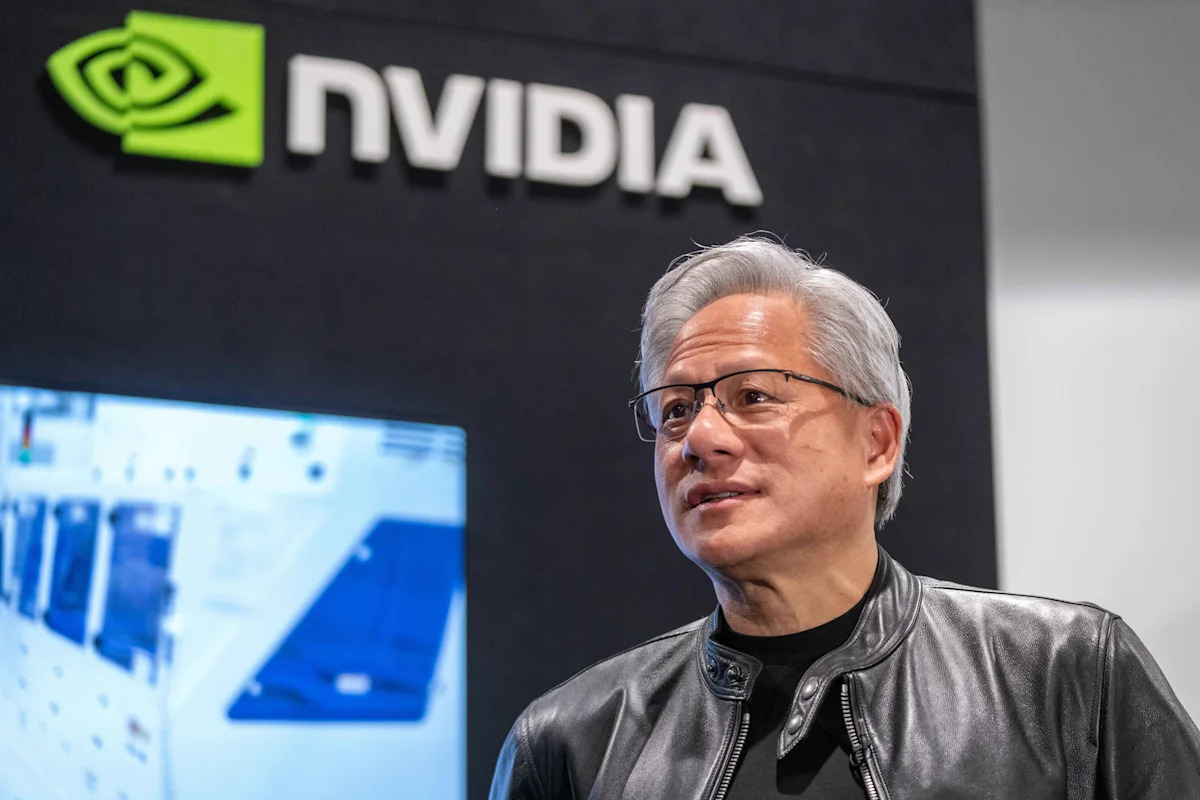
Nvidia CEO Jensen Huang. Image source: Getty Images.
While the removal of Huang from his leadership position would be a huge blow, that seems like an unlikely scenario. While he has always pushed to allow his company's chips to be exported to China, that is what nearly all CEOs would do given the size of the Chinese market. Meanwhile, it seems unlikely he would be sharing any technical details about the company's technology with his mistress.
Nvidia remains the AI infrastructure leader, and Huang's ability to move to where the market is going is second to none. The company is the main provider of compute capacity in the world, it's smartly locking up future high-bandwidth memory (HBM) supply from SK Hynix (NASDAQ:SKHY), and it has close ties with SpaceX (NASDAQ:SPCX), which has said it intends to exclusively use Nvidia's GPUs. All of those factors are likely to help keep it in the pole position for a long time.
With the stock now trading at a forward P/E of just 11 times estimates for its fiscal 2028 (which ends in January 2028), this is a top AI stock to buy.
The Motley Fool Stock Advisor analyst team just identified what they believe are the 10 best stocks for investors to buy now… and Nvidia wasn't one of them. The 10 stocks that made the cut could produce monster returns in the coming years.
Consider when Netflix made this list on December 17, 2004... if you invested $1,000 at the time of our recommendation, you'd have $344,878!* Or when Nvidia made this list on April 15, 2005... if you invested $1,000 at the time of our recommendation, you'd have $1,097,846!*
Now, it's worth noting Stock Advisor's total average return is 852% — a market-crushing outperformance compared to 208% for the S&P 500. Don't miss the latest top 10 list, available with Stock Advisor, and join an investing community built by individual investors for individual investors.
*Stock Advisor returns as of November 11, 2026.
Geoffrey Seiler has no position in any of the stocks mentioned. The Motley Fool has positions in and recommends Nvidia and Space Exploration Technologies. The Motley Fool has a disclosure policy.
Is Nvidia Stock a Buy on the Spy Allegation Sell-Off? was originally published by The Motley Fool