Add The New York Post on Google Call it a sea rex.
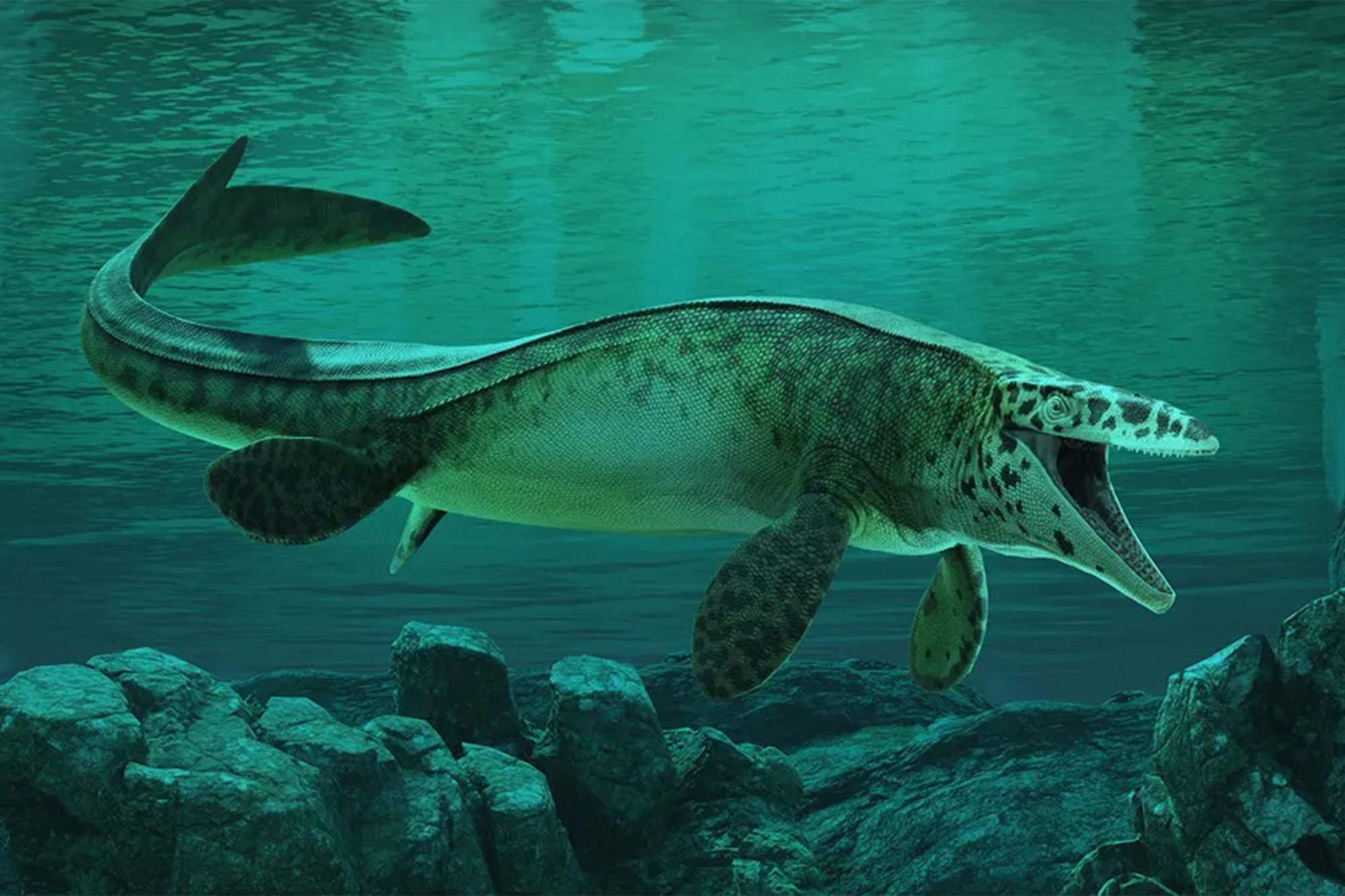
Just when you thought it was safe to go back in the water, scientists have discovered a giant, bus-size sea predator that was so monstrous that they’re calling it the T. rex of the sea, according to a study in the journal Bulletin of the American Museum of Natural History.
Dubbed Tylosaurus Rex — or “King of the Tylosaurs” — this aquatic nightmare is a type of mosasaur, a sea monster best known for dispatching the evil Indominus Rex in “Jurassic World.” The marine reptiles roamed the ocean during the Cretaceous Period, 66 million to 145 million years ago, roughly the same time the Tyrannosaurus Rex terrorized the land above.
But this particular beast, which was described from 80 million-year-old fossils found in Texas, was even more fearsome than the rest of its family.
It measured a whopping 43 feet long — twice the length of the largest great white sharks — and sported skull-crushing jaws and fossil evidence of fighting with its own kind.
“Everything is bigger in Texas, and that includes the mosasaurs, apparently,” the study’s head author, Amelia Zietlow of the American Museum of Natural History in New York City, quipped in a statement.
Despite its formidable proportions, this mammoth mosasaur had previously been misidentified. While working, Zietlow came across a fossil in their collection that had seemingly been mislabeled as Tylosaurus proriger — a 30-foot mosasaur species that was first described in 1869, according to Livescience.
She suspects that the fossil — discovered outside Dallas in 1979, along with dozens of others — belonged to a different species, based on several different traits.
Notably, all of them were found in northern Texas, sported serrated teeth uncharacteristic of other mosasaurs, and measured 13 feet longer than T. proriger.
In addition, they are about 4 million years younger than their brethren, whose remnants dated back to around 84 million years ago.
And the differences don’t stop there. T. rex was also a lot more violent than the rest of the family, according to study author Ron Tyloski, a curator of the Perot Museum in Dallas.
One of the specimens at the institution is reportedly missing the tip of its nose and has a broken jaw — presumed war wounds from a fight with a rival, National Geographic reported.
“The only thing that could have done this was another Tylosaur of the same size,” said Tyloski. Coincidentally, the animal’s so-called terrestrial namesake, the Tyrannosaurus rex, was known for engaging in intraspecies grudge matches as well.
Coincidentally, this team isn’t the first to identify T. rex as its own species.
In fact, the name is a tribute to Texas paleontologist John Thurmond, who, in the 1960s, first recognized that the large Tylosaurs from Northern Texas might be an entirely new species. He named them “Tylosaurus thalassotyrannus,” or “sea tyrant” — a name he acknowledged was a tad cliché.
Along with changing the name, the findings shed light on a longstanding issue with mosasaur research: the dataset used to study the species’ evolutionary tree has paradoxically remained largely unchanged for almost 30 years. Thankfully, the team updated the information and proposed a new evolutionary tree, as most scholarship relied on the “dinosaur” dataset.
Zietlow said that the discovery demonstrates the “need to revisit long-standing assumptions about mosasaur evolution and to modernize the tools we use to study these iconic marine reptiles.”
Despite its ferocious nature, this T. rex might not have been the baddest beast in the sea.
That honor arguably goes to a 62-foot “kraken”-like octopus that prowled the sea at the same time as the Tylosaur.
In fact, the supersize cephalopod may have even preyed on them.