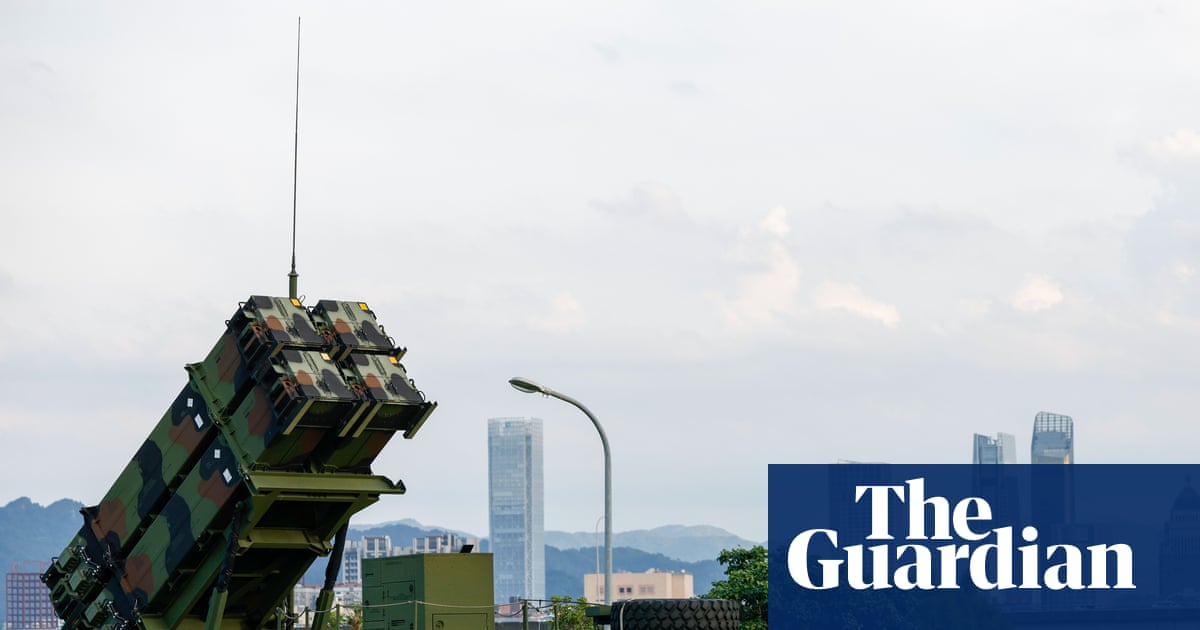
A US-made Patriot air defence system deployed at a park during military exercises in Taipei in July 2025. Photograph: Ritchie B Tongo/EPAView image in fullscreenA US-made Patriot air defence system deployed at a park during military exercises in Taipei in July 2025. Photograph: Ritchie B Tongo/EPAUS arms sales to Taiwan on ‘pause’ due to Iran war, says acting navy chiefHung Cao’s comments are latest blow to Taipei after Donald Trump recently cast doubt over US’s enduring support
US arms sales to Taiwan have been put on “pause” to ensure its military has enough munitions for its Iran operations, according to Washington’s acting navy secretary, in the latest blow to Taipei after a series of comments by Donald Trump.
When asked at a congressional hearing on Thursday about a $14bn (£10.4bn) weapons package, which has been awaiting Trump’s signoff for months, Hung Cao said: “Right now we’re doing a pause in order to make sure we have the munitions we need for Epic Fury [the Iran war] – which we have plenty.”
Cao added: “We’re just making sure we have everything, then the foreign military sales will continue when the administration deems necessary.”
When asked by the US senator Mitch McConnell whether he expected the arms sales to Taiwan to be approved eventually, Cao said the secretary of state, Marco Rubio, and Pete Hegseth, the Pentagon chief, would make that decision. “Yeah, that’s what’s really distressing,” said McConnell.
Concern is growing over reports that the US has burned through a significant chunk of its missile stockpiles since launching its increasingly intractable war against Iran on 28 February, which has since settled into a fragile ceasefire.
View image in fullscreen‘The foreign military sales will continue when the administration deems necessary,’ said Hung Cao (pictured on Tuesday). Photograph: Elizabeth Frantz/ReutersResponding to Cao’s statement, Taiwan’s presidential office spokesperson, Karen Kuo, said on Friday that Taipei had received “no information indicating that the US intends to make any adjustments to this arms sale”.
But the announcement will be unwelcome news for Taipei, coming a week after Trump met his Chinese counterpart, Xi Jinping, in Beijing for a summit in which Washington’s multibillion-dollar weapons packages to Taiwan were high on the agenda.
Beijing has repeatedly said it “resolutely opposes” Washington’s arms sales to the island democracy, which it regards as a breakaway province, despite never having ruled it, and has not renounced the use of force to take.
During Trump’s visit, Xi issued a stark statement asserting that the US and China “will collide or even conflict” if the Taiwan issue “is not handled well”.
Read moreWashington maintains an ambiguous stance on whether it would defend Taiwan in an invasion scenario. But under the decades-old Taiwan Relations Act, it is required to provide Taipei with sufficient military equipment to defend itself.
While Trump said he made no commitments about Taiwan during his meeting with Xi, he has made several statements in the week since that have cast doubt over the future of Washington’s enduring support for Taipei.
In an interview with Fox News while still in Beijing, the US leader described the weapons packages as a “very good negotiating chip”, suggesting he was prepared to break with Washington’s policy that it would not consult China on the matter.
Trump also told reporters onboard Air Force One when returning from the Chinese capital that he discussed Taiwan in “great detail” with Xi and would soon “make a determination” on pending weapons packages.
The US leader, however, has also said he plans to speak with Taiwan’s president, Lai Ching-te – a bold move that Taipei has said it is open to, but which would surely provoke a robust response from Beijing.
No sitting US president has spoken to Taiwan’s leader since 1979, when Washington shifted diplomatic recognition from Taipei to Beijing. Trump did, however, speak to the then Taiwan president, Tsai Ing-wen, when he was US president-elect in late 2016.