Microsoft (MSFT) Is Getting Paid for AI Agents. That’s Why I’m Bullish TipRanks Tue, November 10, 2026 at 3:56 PM EST 6 min read MSFT -2.00% MSF 4338 Trade MSFT on Coinbase Trading disclosure Trading disclosure The above button links to Coinbase. Yahoo Finance is not a broker-dealer or investment adviser and does not offer securities or cryptocurrencies for sale or facilitate trading. Coinbase pays us for certain activity generated through this link. Prices displayed are informational.
Microsoft (MSFT) is getting paid for artificial intelligence (AI) agents, software that can finish tasks on its own. The maker of Windows and Microsoft 365 now charges more and more customers for how much work these agents do. This makes me bullish on Microsoft. Its AI push is starting to pay for itself, and the company keeps very high margins even while it spends heavily on data centers.
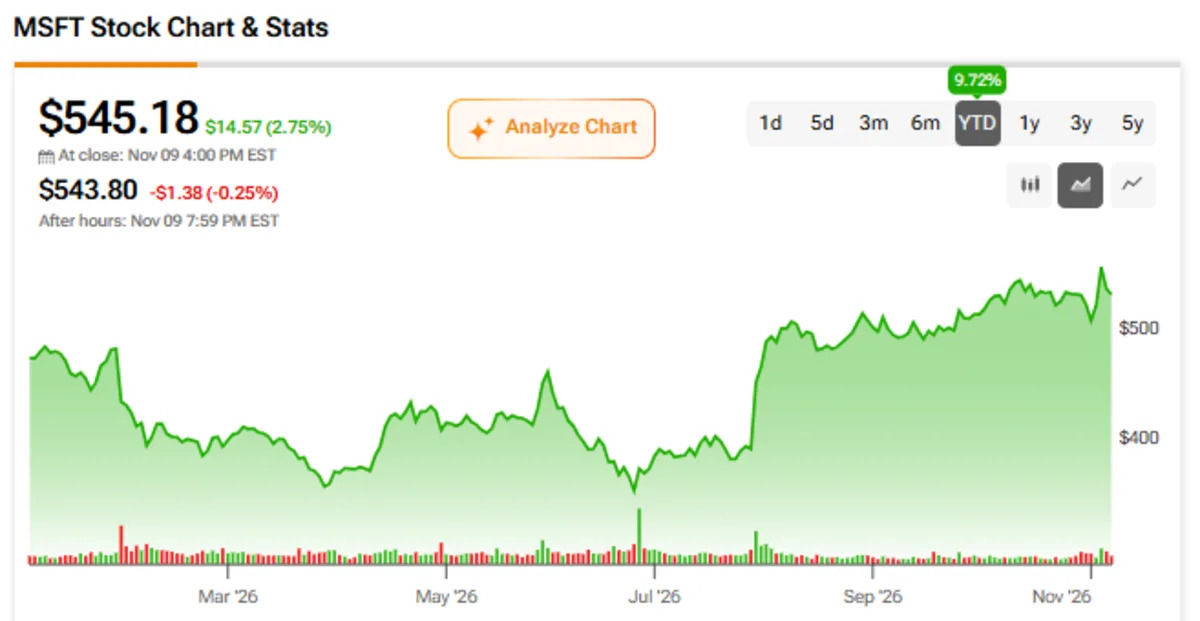
The latest quarter backs that up. Revenue from Azure, Microsoft's cloud platform, grew 48%. The operating margin, the share of sales left after operating costs, reached about 50%. The stock is up 9.7% this year. It is no longer cheap after its rally since June, and AI spending keeps climbing. However, I believe agents give Microsoft a clear way to earn that money back.
Microsoft gets paid for AI agents mostly through usage. Copilot, its AI assistant, has mainly been sold as a monthly per-user license, but customers can now also buy credits and pay for the work their agents do. Copilot customers using these credits grew more than 75% in a single quarter, while paid Microsoft 365 commercial seats rose just 5% year-over-year.
Get 75% Off TipRanks Premium and unlock powerful investing tools to make smarter, more confident investment decisions
The two figures measure different things, but the difference in pace stands out. License sales follow a customer's headcount, while credit sales follow the work agents take on, which can grow much faster.
Agent 365, Microsoft's registry for managing a company's agents, now holds more than 50 million agents, up over 30% in one quarter. Foundry, where companies build their own AI apps and agents, passed 120,000 customers, and its revenue more than tripled year-over-year.
I think Copilot is a big part of Microsoft's future, because usage keeps climbing. Daily users grew more than fivefold year-over-year, and user satisfaction is at an all-time high.
Big companies are buying in, too. The number of customers with more than 50,000 Copilot seats grew more than eightfold in a year, and Volkswagen (VWAGY) has rolled out Copilot to more than 330,000 employees. For Microsoft, more usage now means more revenue.
Azure keeps speeding up, and agents are part of the reason, since they need a lot of computing power. Its revenue grew 48% in the September quarter, ahead of what Wall Street expected, helped by Foundry. Management expects 49% to 50% growth in the December quarter, excluding currency effects.
Microsoft is also getting more out of its hardware. Copilot workload throughput, meaning how much AI work its systems can process, rose more than 50% in one quarter, which should make each AI task cheaper to run.
Microsoft's AI spending is high, but I think it is manageable. The company spent $135.9 billion on capex over the past four quarters, mostly on data centers and chips, and that number is still rising. The risk of overinvesting will always be there.
That is why return on invested capital (ROIC) is the number I watch most closely. It shows how much profit a company makes on the money put into its business. Adding up the last four quarters gives Microsoft an ROIC of about 22%, so it earns roughly 22 cents on every dollar invested. That is slightly lower than a year earlier, but returns have improved in each of the last two quarters, so I don't see a red flag during such a big build-out.
Microsoft is also careful with cash. Over the past 12 months, it still had about $60 billion of free cash flow, the money left after capex. I usually prefer companies that spend more aggressively, but I understand why Microsoft doesn't want to make its shareholders nervous. In late October, it raised $25 billion in its first major U.S. bond sale since 2017, which gives it more room to keep building data centers without draining its own cash.
Management expects free cash flow to stay positive in Fiscal 2027 and says it is confident these investments will pay off over the long run. That convinces me, because agents are already turning part of this spending into revenue.
Microsoft stock isn't too expensive, in my view, although it is no longer cheap. Its trailing-12-month (TTM) price-to-earnings (P/E) ratio is around 27.7x, based on reported profit, so investors pay about $27.7 for each dollar Microsoft earns in a year.
That is higher than the 20.72x it traded at when Fiscal 2026 ended in June, after a sharp sell-off in the first half of the year. Still, it is well below the levels of the three fiscal years before that, when the P/E ended each year above 35x.
Looking at the next 12 months, the forward P/E is about 26x, based on analysts' estimates of adjusted earnings, which leave out the impact of Microsoft's investment in OpenAI. I think 26x is a fair price for a company that keeps about half of its sales as operating profit.
The main risk is margins. Microsoft's cloud gross margin, the share of cloud revenue left after the direct cost of running it, is already shrinking as lower-margin Azure makes up a bigger part of cloud sales. Management also expects operating margin to dip slightly from a year earlier in the December quarter. If that continues, the stock will start to look expensive.
Wall Street sees Microsoft very positively, with a Strong Buy consensus rating based on 35 Buys, four Holds, and zero Sells assigned in the last three months. At $632.48, the average Microsoft price target implies 16.01% upside potential.
Bernstein analyst Mark Moerdler, one of the top analysts on TipRanks, raised his price target to $722 from $662 after the September-quarter report and reiterated his Outperform (Buy) rating on November 6, implying about 32% upside. He believes lower-than-expected capex and capacity delays created some unwarranted noise around solid results, and I fully agree.
I'm bullish on Microsoft. It is spending a lot on AI, and I can already see how that money comes back through agents that customers pay for as they use them. The next test is keeping returns this high while the build-out continues. So far, Microsoft is passing it.