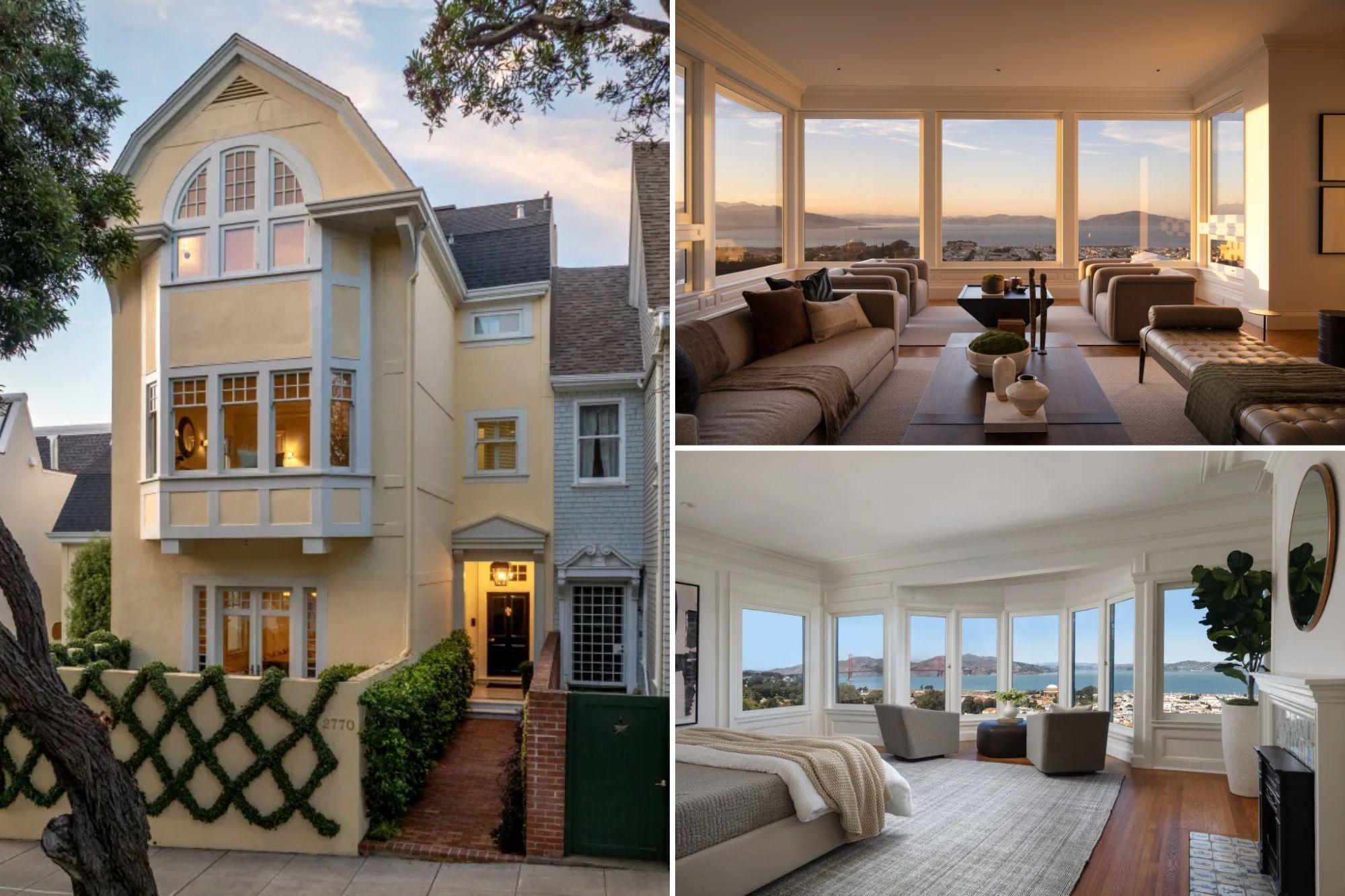
For no fewer than 37 years, nobody could buy 2770 Broadway. Now, finally for sale, it’s the most expensive home for sale on San Francisco’s Multiple Listings Service this year.
The Gilded Age mansion on the city’s Gold Coast landed on the market this week for a cool $34.95 million, nearly nine times the $3.95 million the late David Chamberlain paid when he bought it in 1989. It hadn’t been listed since.
Chamberlain, who led both the San Francisco Opera and the city’s Chamber of Commerce, held onto the house for the rest of his life. His children are now selling, with Compass agent Neal Ward handling the listing.
Buyers who left the city during the pandemic are piling back in, and locals are scrambling to lock down homes before a fresh wave of AI fortunes hits.
“The fear of competition in the future is making these people pay over asking right now so they don’t have to compete with crazy amounts of liquid cash that’s about to hit the market,” Roh Habibi, a star of “Million Dollar Listing San Francisco,” told The Post.
Habibi said the frenzy isn’t being fueled by AI paydays — yet. Those, he said, are still on the way, likely within the next six to 18 months. For now, he said, much of the buying comes from executives and founders who borrow against their stock and from returnees who fled to Texas, Tahoe and beyond, and quickly regretted it.
2770 Broadway is exactly the kind of home that sets off a stampede. Architects Reid & Reid, the firm behind the Fairmont Hotel, designed it in 1894, decades before the Golden Gate Bridge it now overlooks was built.
The four-story manor spans more than 9,000 square feet on a rare 50-foot-wide lot, with an elevator, a private sport court and a bookcase concealing a secret door. A 2007 overhaul by architect Jim Jennings added a seismic retrofit.
Habibi said most of today’s supply comes from families who have held their homes for decades and are finally cashing out. On blocks like this one, he said, buyers know the chance may never come again.
“It’s like that’s a one of one. It’s not going to sell again,” he said. “So [buyers say] ‘I have one opportunity and one chance to buy this thing now or forever hold my peace’ type thing.”
The house has notable company. Down the street, Nvidia CEO Jensen Huang paid $38 million in 2017 for a limestone mansion that set a city record at the time. Next door to that stretch, Larry Ellison bought his own Broadway home for $3.9 million in 1990, a year after Chamberlain closed on his. Ellison sold it for $45 million late last year, the city’s biggest deal of 2025.
The crunch reaches well below the trophy tier. Active listings in San Francisco fell about 20% year-over-year as of January, and the median home sale in the city now fetches $2.2 million.
“The bull run in San Francisco is here for the foreseeable future,” Carter Waite, a Compass San Francisco agent and founder of Readdress, told The Post. “Citywide, single-family homes have less than one month’s supply and condos have less than two months.”
Waite said 20-plus offers on top properties is now routine. “The best locations and homes are routinely trading 40 to 50% and a million-plus over asking,” he said.
Arman Javaherian, CEO and co-founder of home-buying platform Homa, said city homes sold for a median of 26.5% over asking in October and expects the bidding wars to rage for another two to three years at minimum.
“We’re at the beginning of another major wealth cycle in San Francisco, and this one could last for years,” he said.
Everyone is watching the AI listings, and not the real estate kind.
“An Anthropic IPO could pour gasoline on an already overheated housing market,” Javaherian said, adding that he expects the hardest hit to come in the $2 million to $5 million range.
Nicole Brown, a Bay Area agent with eXp Realty, agreed.
“I do expect to see prices continue to grow with an Anthropic IPO,” she said, though she cautioned that plenty of smaller AI outfits won’t survive long enough to go public.
It’s a dramatic turnaround for a city many had written off. In early 2024, roughly one in five San Francisco homes was selling at a loss, and said he was “shocked” at the transformation.
“I never count San Francisco out,” Brown said. “It has that dog in it and the real estate market always rebounds and pulls ahead of the nation.”
“The irony is that a few years ago, people wondered whether anyone would want to live in San Francisco again. Now the question is whether anyone outside the AI industry will be able to afford it,” Javaherian added.