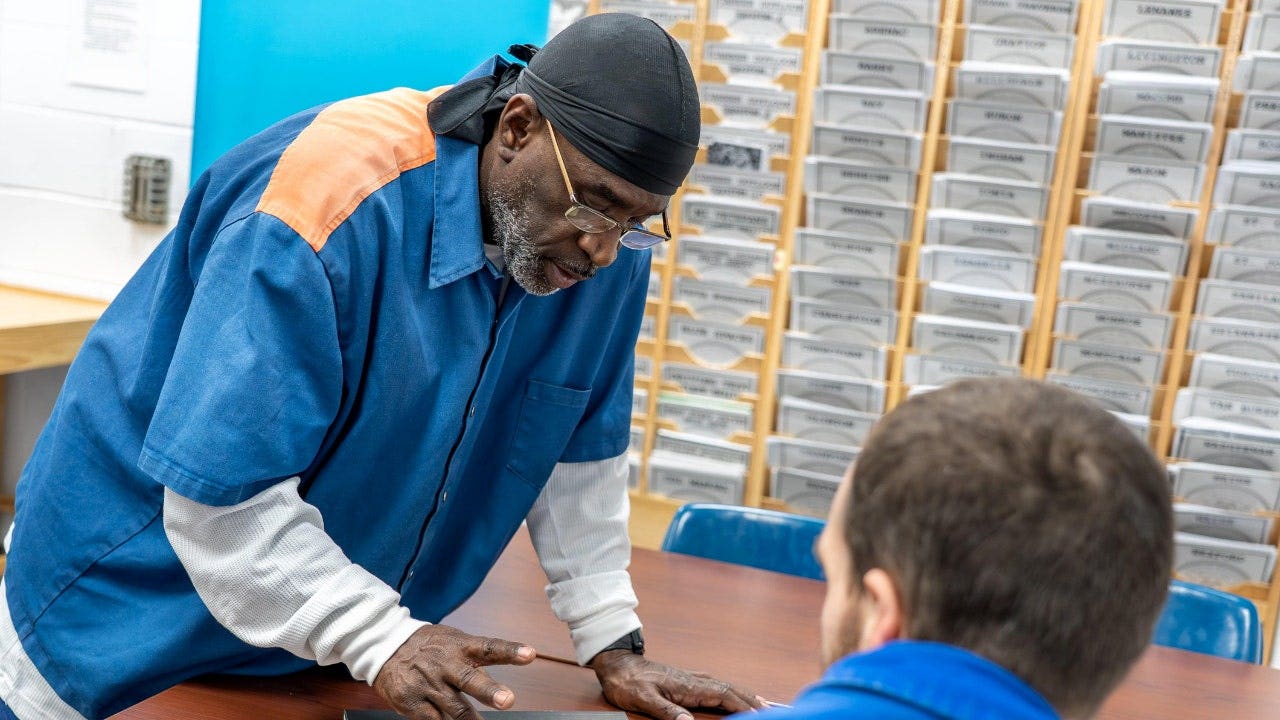
Incarcerated men participate in employment counseling at a Michigan prison, where security classifications can affect access to job training and educational opportunities. (Michigan Department of Corrections)
What if a computer-generated score could influence whether someone lives in a low-security prison dorm or a tightly controlled cell? Michigan is preparing to test new technology that could affect exactly that. State officials say the system could improve predictions of future prison violence by approximately 30%. That's a big claim, especially when the safety of correctional officers and incarcerated people could depend on getting those assessments right.
But there's something important missing from early reports about Michigan prison AI. Despite headlines suggesting artificial intelligence will determine how dangerous someone might be, the nonprofit developing the software says AI plays no role in calculating security scores. Instead, the technology follows predetermined rules, and corrections staff make the final decisions. So, how does the system work? And can Michigan really predict prison violence more accurately without putting too much trust in a computer-generated score?
FEDERAL INMATES MAY SOON GET TABLETS WITH MESSAGING CAPABILITIES AS BUREAU OF PRISONS MAKES MODERNIZATION PUSH
Missed CyberGuy LIVE? Watch the replay and discover 5 ways to travel smarter and save money.
Our free CyberGuy LIVE class, 5 Ways to Travel Smarter and Save Money, has ended, but you can still watch the full replay. Kurt "CyberGuy" Knutsson walks you through five practical ways to protect your phone and personal information, avoid common travel scams, find better deals, save money on bookings and use technology to make your travels easier and less stressful. No technical experience is needed.
Watch the free replay + downloadable checklist now at CyberGuyLive.com.
The Michigan Department of Corrections oversees approximately 32,000 incarcerated people statewide. Currently, corrections employees use a manual scoring process to determine the appropriate security level for each person. Those classifications influence where someone lives and how closely they're supervised. They can also affect access to educational programs and job training opportunities. For someone serving a lengthy sentence, a change in security level can make a significant difference in daily life.
Michigan has four general population security levels: I, II, IV and V. Level I generally allows greater freedom of movement, while Level V involves much tighter supervision. People at lower security levels may have access to more vocational training and higher education opportunities. However, Michigan says programs such as Violence Prevention Programming remain available at every general population security level. There is no general population Level III. Now, the state wants a better way to determine which security level fits each person's current behavior and needs.
The Michigan Department of Corrections plans to begin testing the new system on Dec. 1 at selected men's prisons. If the pilot performs well, officials could eventually expand the technology to additional facilities. One significant change involves how often corrections staff can reassess someone's security level. Instead of relying on information collected at scheduled intervals, the new system will allow ongoing reviews using updated prison records. That could help staff recognize changes in behavior sooner.
The software comes from Recidiviz, a nonprofit technology organization that supports criminal justice agencies in 19 states. Its team analyzed 10 years of Michigan prison classification data to help redesign the state's scoring process. Here's how it works. The software examines information already in prison records and calculates a score using factors selected by Michigan corrections experts. Recent disciplinary incidents may carry more weight than incidents from years ago. Meanwhile, someone who maintains good behavior over time may have an opportunity to qualify for a lower security level.
Completing certain rehabilitation programs can also help someone qualify for a less restrictive classification. Additionally, the software can flag a person's record when new information warrants another review. Michigan Department of Corrections Director Heidi E. Washington believes the changes could help improve safety. "Classifying prisoners at the security level that fits their current behaviors and needs keeps everyone safer," Washington said in the state's announcement. She also expressed optimism that the combination of historical information and research-based scoring could strengthen security throughout Michigan's prison system. The idea sounds promising. But how much confidence should officials place in those computer-generated scores?
GRANDMOTHER SUES AFTER ALLEGED AI FACIAL RECOGNITION ERROR LED TO MONTHS IN JAIL, EXPERTS SOUND ALARM
Michigan uses four general population security levels, from Level I with the fewest restrictions to Level V with the tightest supervision. (Getty Images/iStockphoto)
This is where the story takes an unexpected turn. On Nov. 2, Recidiviz published an explanation titled Why We Don't Use AI to Classify People in Prisons. The nonprofit confirmed that Michigan's new classification system does not use artificial intelligence to calculate security scores. The system relies on a points-based formula that corrections employees can examine.
You may hear this type of formula called an algorithm. That's simply a set of instructions a computer follows to complete a task. Think of it like a digital scorecard. The computer reviews specific information and adds up the points according to established rules. Give it the same information, and it produces the same score. Recidiviz says Michigan corrections experts helped determine which factors belong in the scoring process. Staff can review the calculations and override a score when circumstances require it. For example, someone might have medical needs or personal safety concerns that call for a different housing assignment. Corrections employees can consider that information before making the final decision.
Now, Recidiviz does use AI in other parts of its technology platform. Some tools help corrections employees prepare case notes and organize information from meetings. However, the organization says AI does not determine someone's security level or release. And here's what I find interesting. We're hearing about AI being used in nearly every industry. Yet this particular system relies on a more traditional approach to computer software. That clarification is important because people deserve to understand how technology influences decisions affecting someone's daily life. Still, using a rules-based system doesn't guarantee perfect results. Even straightforward software can produce questionable scores when the information behind its calculations contains errors.
This is the number that really caught my attention. In its Oct. 28 announcement, the Michigan Department of Corrections said the redesigned system is expected to improve its ability to predict future violence by approximately 30%. That's a substantial improvement if the technology delivers it. However, the announcement doesn't explain how officials calculated that figure or provide the underlying performance results.
For example, will the system identify more people who might become violent? Could it also incorrectly classify someone as dangerous? And how will officials know whether it's performing better than the current process? Those questions deserve answers because someone's security classification can affect their daily life throughout their sentence. There's another issue worth considering. The software depends on prison records. If a disciplinary report contains inaccurate information, that mistake could influence someone's score. Even when the information is correct, a risk assessment cannot predict with certainty what someone will do in the future.
NORTHEASTERN CITY VOTES TO END SHOTSPOTTER CONTRACT FOR GUNFIRE-DETECTION TECH DESIGNED TO FIGHT CRIME
An incarcerated man uses a resource center inside a Michigan correctional facility, where educational and employment materials can help people prepare for life after prison. (Michigan Department of Corrections)
Even if Michigan's new software delivers more accurate security scores, officials still face a challenge that technology cannot solve on its own. What happens when someone needs higher-security housing but there's no appropriate bed available? Byron Osborn, president of the union representing Michigan corrections officers, raised that concern in recent reporting.
According to Osborn, the department faces a shortage of higher-security beds. He argues that the bigger problem involves a lack of appropriate housing for people already classified as higher risk. Consider what happens if the software identifies someone who needs tighter supervision. Corrections staff agree with the assessment, but the prison lacks space in the appropriate security unit.
Now what? The computer may have helped identify a potential safety concern. However, officials still need somewhere appropriate to house that person. Michigan has announced plans to add 870 high-security beds as part of its Safe Prisons Initiative. Some facility conversions are already underway, while larger construction projects will take longer to complete.
More than 400 of those beds will come from two new high-security units at Oaks Correctional Facility and St. Louis Correctional Facility. The state expects those construction projects to take approximately two and a half years. Osborn has warned that corrections officers and incarcerated people need solutions sooner.
Meanwhile, the state has experienced serious violence inside its prisons, including several recent incidents in which incarcerated people were suspected of killing their cellmates. Better classification could help officials recognize potentially dangerous situations sooner. But the department still needs sufficient staffing and appropriate housing to respond. And that raises another question. How much safer can a prison become if officials identify a problem but lack the resources to address it?
I can see why Michigan wants to try something new. Nobody wants to see more violence inside prisons, and if technology can help prevent it, I'm all for giving it a chance. But I was surprised to learn that despite all the talk about AI, this new system actually uses a fairly straightforward scoring process. Corrections staff still make the final decisions, which I think is important when you're dealing with people's safety.
Now, that 30% improvement Michigan is talking about sounds impressive. But I'd really like to know how they arrived at that number. And what happens when the computer gets someone's risk level wrong? Maybe a person has turned their life around, but an old disciplinary record still works against them. That's the kind of situation I'd want someone to take a closer look at before making a decision.
There's also the bigger issue of whether Michigan has enough high-security beds and corrections officers to act on these assessments. You can have the best scoring system in the world, but what good does it do if there's nowhere appropriate to house someone who needs closer supervision? I'll be interested to see what happens when the pilot begins Dec. 1. If it leads to safer prisons and gives people a fairer way to demonstrate they've changed, that would be something worth talking about. But Michigan needs to show us the results.
Would you trust a computer-generated score to help determine how dangerous someone might be, or should decisions affecting someone's safety remain entirely in human hands? Let us know by writing to us at CyberGuy.com.
Sign up for my FREE CyberGuy Newsletter
CLICK HERE TO DOWNLOAD THE FOX NEWS APP
Kurt "CyberGuy" Knutsson is an award-winning tech journalist who has a deep love of technology, gear and gadgets that make life better with his contributions for Fox News & FOX Business beginning mornings on "FOX & Friends." Got a tech question? Get Kurt’s free CyberGuy Newsletter, share your voice, a story idea or comment at CyberGuy.com.