Video Iran expert breaks down what Trump’s new ‘Iron Gate’ can actually do Farzin Nadimi explains how the U.S. could target Iran’s remaining land routes — and why sealing them off will be a "mid- to long-term project."
President Donald Trump isn't backing off his pressure campaign against Iran despite claims the conflict contributed to sweeping Republican losses in last week's midterm elections.
In fact, Trump is doubling down by expanding U.S. efforts to choke off the trade routes Tehran increasingly relies on as it tries to rebuild its military in the midst of war.
The new effort, dubbed Task Force Iron Gate, takes aim at a vulnerability that has persisted despite the U.S. naval blockade: the land and Caspian Sea routes Iran can use to bring in goods, dual-use technology and military supplies beyond the reach of American warships.
That approach, one expert claims, fits into a broader administration strategy of tightening the squeeze on Tehran while stopping short of restarting full-scale military operations. Meanwhile, others caution that it could produce escalation rather than an immediate diplomatic breakthrough.
IRAN VOWS ‘ASTONISHING’ STRIKES AND LIFTS MISSILE-RANGE LIMIT AS US TARGETS LAND ROUTES
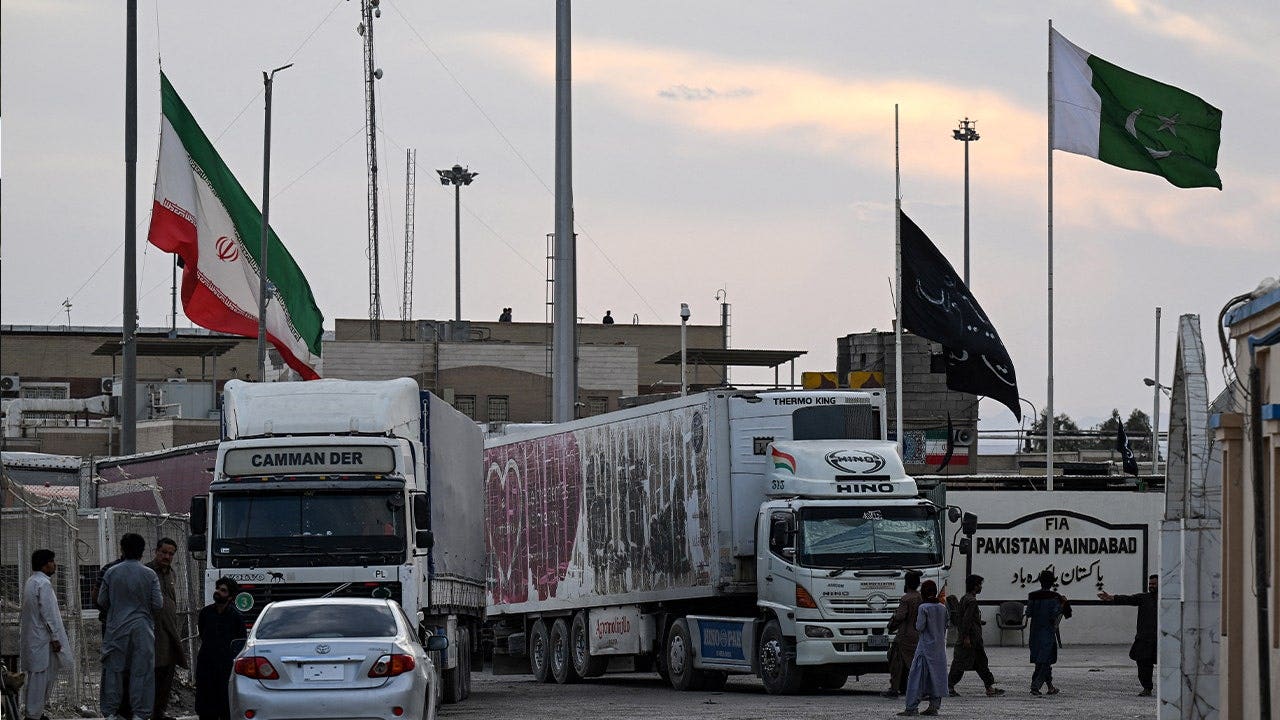
An Iranian cargo truck crosses into the Pakistan-Iran border as an Iranian national flag (L) flies at half-mast at Taftan, Balochistan province on March 1, 2026 after the death of Iran's supreme leader Ayatollah Ali Khamenei amid US-Israel strikes. (Banaras KHAN / AFP via Getty Images)
"We have Operation Iron Gate that just went into effect. That means nothing comes in by land," Trump said Sunday.
But the roughly 20-person task force established at U.S. Central Command headquarters in Tampa is taking a quieter approach than Trump’s sweeping description might suggest.
"This is not a deployable special operation task force," Farzin Nadimi, a senior fellow at the Washington Institute for Near East Policy, told Fox News Digital, describing Iron Gate instead as a "fusion cell" coordinating military, civilian and intelligence efforts.
US ECONOMIC CHOKEHOLD ON IRAN REACHES PEAK LEVERAGE AS COLLAPSE RISKS EMERGE
Nadimi said its immediate role is likely to center on gathering intelligence about activity along Iran’s borders and building cooperation in the region that could support sanctions and other efforts to disrupt the flow of goods.
Secretary of State Marco Rubio, who heads the department responsible for spearheading the administration's diplomatic foreign agenda, supports taking action that could decrease military escalation.
"We don't need to conduct military strikes if we're achieving the same objective through economic means and economic pressure," Rubio told reporters on Tuesday.
He rejected the suggestion that the U.S. and Iran were at a stalemate, arguing that sanctions, the naval blockade and other measures were steadily weakening Tehran.
"They’re bleeding. They’re bleeding economically," Rubio said. "It is an increased pressure on Iran that continues to grow every day."
The push comes a week after an election in which the war proved a political liability for Republicans.
The Iran war was a crucial factor in the House vote for 34% of voters, according to the Fox News Voter Poll, while about six in 10 said the U.S. had made the wrong decision to take military action against Iran.
An Iranian oil tanker is seen floating on the Caspian Sea, as Iranian President Mohammad Khatami attends the opening ceremony of the Neka oil terminal on the Caspian Sea, 340 kms northwest of Tehran in Mazandaran province. (HENGHAMEH FAHIMI/AFP via Getty Images)
A separate Fox News/NORC survey conducted around Election Day found 68% said avoiding a prolonged military conflict in Iran was very important. When forced to choose, 61% said ending U.S. military involvement to lower gas prices was more important than restarting military action to stop Iran from developing nuclear weapons, while 35% chose restarting military action.
Yet four days after the election, CENTCOM announced Iron Gate, extending the administration’s pressure campaign to the land routes Tehran could use to blunt the effects of the naval blockade.
CENTCOM said the task force would coordinate efforts to disrupt advanced weapons, dual-use technologies, sanctioned materials and illicit revenue moving across Iran’s land borders and the Caspian Sea.
"We will not allow the Iranian regime to rebuild its weapons factories or replenish its arsenal with materials smuggled across its borders," CENTCOM commander Adm. Brad Cooper said in announcing the task force.
CENTCOM declined to provide additional details about how Iron Gate would operate beyond its announcement.
The challenge is the sheer scale of the territory involved.
Iran shares land borders with Afghanistan, Armenia, Azerbaijan, Iraq, Pakistan, Turkey and Turkmenistan, spanning roughly 6,000 kilometers, according to Nadimi. While it has dozens of official border crossings, goods can also be smuggled through mountainous and desert terrain.
"It will be extremely difficult to know where and how things get in or out of Iran," Nadimi said.
Much of Iron Gate’s effectiveness will also depend on governments outside Iran.
Nadimi said the task force could build relationships with military and intelligence services in neighboring countries to identify and disrupt suspicious shipments. Turkey and Pakistan have already placed some limits on goods moving across their borders with Iran, he said, contributing to long truck lines and higher shipping costs.
But even if neighboring governments cooperate, Iran and the Islamic Revolutionary Guard Corps are likely to look for ways around the restrictions.
Behnam Ben Taleblu, senior director of the Iran program at the Foundation for Defense of Democracies, said the effort should not be judged by whether Washington can completely eliminate Iran’s overland trade.
"That is not going to mean zeroing out this trade overnight," Taleblu told Fox News Digital. Instead, he said the goal is to increase the cost of moving goods, pressure the foreign companies and individuals facilitating Iranian trade and give Washington more leverage over Tehran.
"This is literally akin to boxing in the Islamic Republic," he said.
The routes have taken on added importance as Iran’s other avenues to the outside world have narrowed.
Taleblu said Iran’s missile program remains dependent on foreign inputs including fuel precursors and high-strength steel. China and Russia are important to those flows, he said, but Iraq, Turkey and Pakistan also represent important regional routes.
The U.S. military has been enforcing a naval blockade in the Strait of Hormuz, even during the ceasefire. (U.S. Central Command)
Nadimi described effectively restricting Iran’s land trade as a "mid- to long-term project" and predicted Tehran would initially "become more aggressive" as the pressure mounts.
CLICK HERE TO DOWNLOAD THE FOX NEWS APP
"It is entirely plausible that you squeeze them hard enough that they feel like the only way to throw off the strangulation is to throw a punch," he said.
That leaves the administration trying to increase its leverage over Iran without reigniting the full-scale fighting voters strongly signaled they wanted to avoid — while Trump has publicly described the objective in much starker terms.