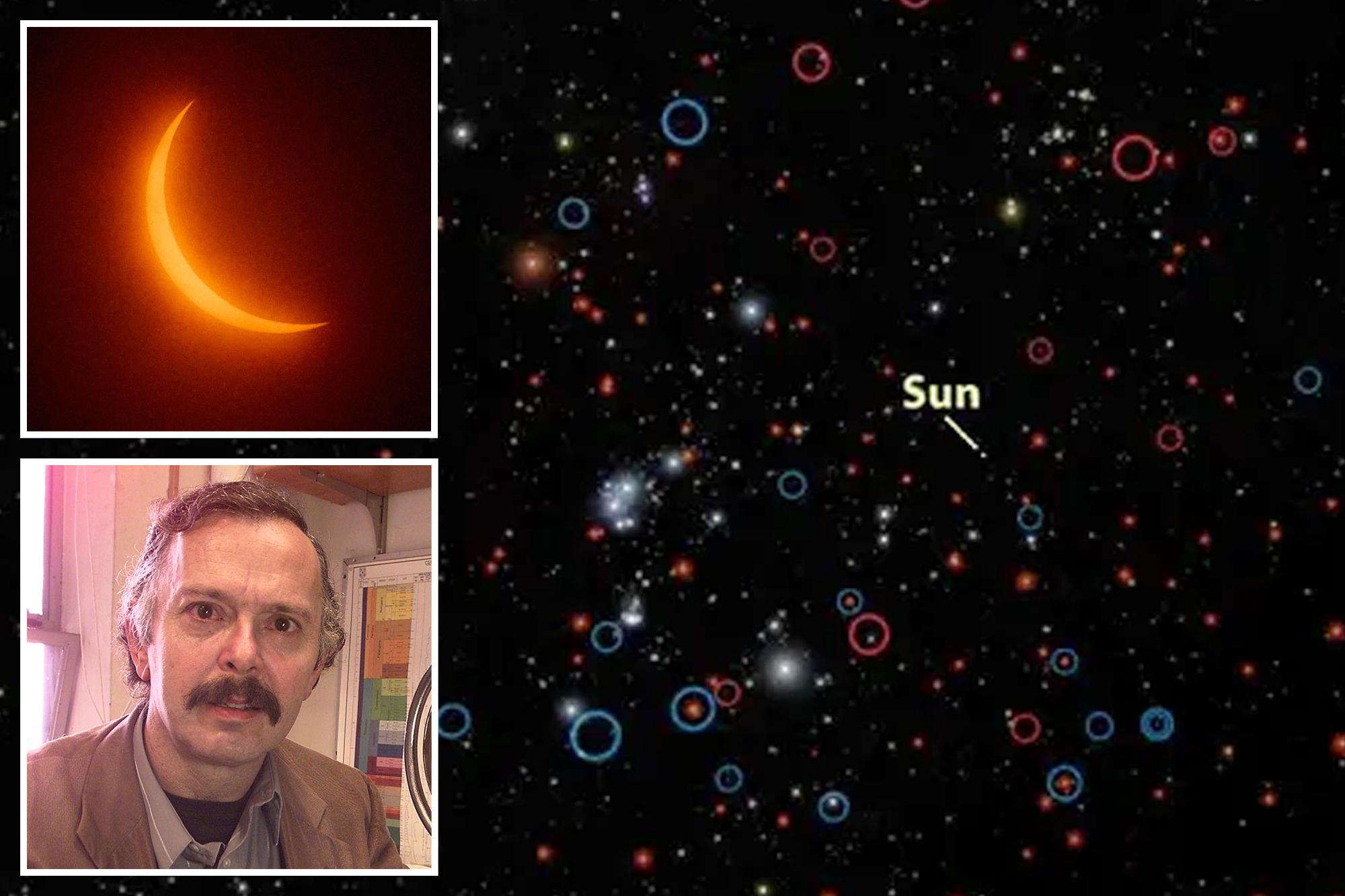
Make New York Post a Preferred Source The sun’s hidden twin is hurling killer comets at Earth every 26 million years — and the bad bro may have wiped out the dinosaurs, according to a new theory.
And tape up the windows — UC Berkeley physicist Richard Muller estimates the next barrage from the theoretical twin nicknamed “Nemesis” is a mere 12 million years away.
Muller, a professor emeritus of physics at Berkeley, theorizes that the red dwarf is floating quality on the outskirts of the solar system and flinging large, icy comets toward us.
Nemesis, according to Muller, mirrors the sun as the two orbit a shared center of gravity in lockstep, almost as if they were tethered, which he explains is exactly why no one has spotted the strange star before, according to Universe Today.
Astronomers usually spot nearby stars by how they creep across the sky, but what makes the long-hypothesized Nemesis unique is that the star barely budges, according to theories.
It’s also got the perfect hiding spot, Muller claimed, as the star sits near the plane of the solar system where it is far and too dim to see with the naked eye and buried among countless other stars.
But Muller theorized that every 26 million years, Nemesis makes its closest pass through the Oort Cloud, a giant shell of trillions of icy objects at the edge of the solar system.
According to Muller, that sets off a comet shower that can last a million years.
The theory goes back to a 1982 study that found marine extinctions spiking on an eerily steady 26-million-year cycle. One spike theoretically came 66 million years ago, when a space rock — said to be an asteroid — slammed into what is now Mexico and triggered a global catastrophe that wiped out the dinosaurs.
But Walter Alvarez, the Berkeley geologist behind the impact theory, said scientists were unable to tell the difference between whether what hit into the earth and killed the dinos was a comet or an asteroid, the outlet reported.
However, not everyone agrees, and a 2014 Penn State study of NASA’s WISE infrared telescope data found no sign of the star.
“The outer solar system probably does not contain a large gas-giant planet, or a small companion star,” astronomer Kevin Luhman, the associate professor of astronomy and astrophysics at Penn State, said at the time.
But Muller insists there’s no clear evidence against the theory, as the star is hidden.