Fed’s Goolsbee Says AI Data Centers Look Like ‘Old-Fashioned Overheating’ Omor Ibne Ehsan Tue, November 10, 2026 at 10:38 AM EST 6 min read MSFT -0.39% NVDA -6.34% SHY -0.36% SPY -0.77% Explore stocks on Coinbase Trading disclosure Trading disclosure The above button links to Coinbase. Yahoo Finance is not a broker-dealer or investment adviser and does not offer securities or cryptocurrencies for sale or facilitate trading. Coinbase pays us for certain activity generated through this link. Prices displayed are informational.
Stocks rallied while short-term bonds slipped, with SPY up 2% and SHY down slightly, as futures put December hike odds at 84%.
NVIDIA and Microsoft make up about 8% and 5% of SPY, so the fund's direction hinges on investor views of AI spending.
Goolsbee says inflation is showing up in services beyond oil and tariffs, and overheated demand is harder to reverse than a supply shock.
Building a portfolio and living off one are two completely different skills, and almost nobody teaches the second. This problem is what The Definitive Guide to Retirement Income helps, and it is free today. Read more here. (Sponsor)
Chicago Fed President Austan Goolsbee told a Leadership Greater Chicago audience on November 9, 2026, that the AI data center build-out is starting to look like "old-fashioned overheating." The Fed has not released a transcript of the moderated Q&A, so the phrase comes from reports of what he said.
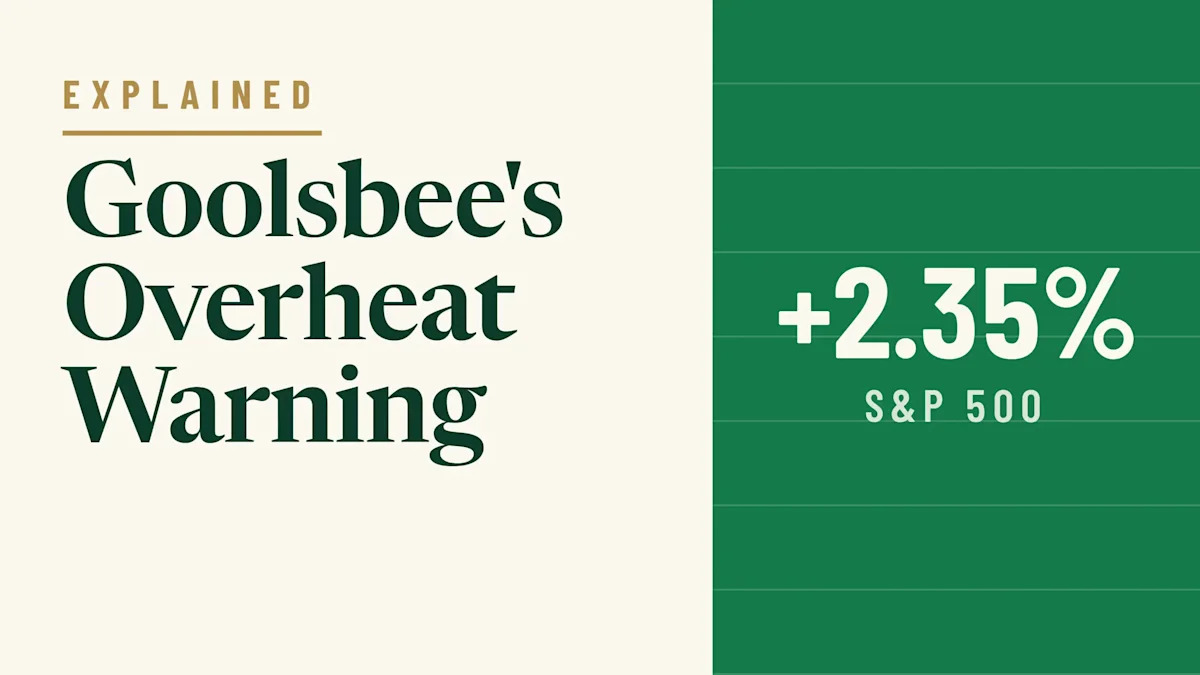
Stocks rallied the same day. The S&P 500 rose 2.35% to 7,549.94, and the SPDR S&P 500 ETF Trust (NYSEARCA:SPY) gained 2.36% to $752.69.
Short-term bonds moved the other way. The iShares 1-3 Year Treasury Bond ETF (NASDAQ:SHY) slipped 0.05% to $81.59. The two-year Treasury yield ended at 4.56%, and futures put the odds of a quarter-point December hike at 84% by the close.
If you hold SPY near retirement, this split is significant. The AI spending that raises chip stocks is the same spending a Fed official now links to inflation, and the usual fix for inflation driven by too much demand is higher rates, which tend to lower stock valuations.
All of that AI spending has to be powered and cooled by somebody, and the suppliers doing that work are the subject of a free report we put together on seven companies behind the data center expansion: here.
Many successful investors eventually reach the same moment. The saving is done, the portfolio is built, and the question quietly changes from how much can I grow this to how much can I take out? Get that second question wrong and decades of good investing can come apart in a handful of years.
That is exactly what The Definitive Guide to Retirement Income helps answer. It covers what your retirement could actually cost, which income sources are worth using, and the withdrawal math that decides whether the money lasts. It is free today from Fisher Investments. Read More Here ›
Goolsbee called employment and growth fairly stable and said inflation is the Fed's big problem. He said officials have to face up to their failure. He argued inflation was supposed to be gone by now, yet it is showing up in services beyond areas tied to oil and tariffs.
That distinction matters because a tariff or oil shock tends to fade on its own. Demand overheating, meaning spending that exceeds what the economy can supply, keeps going until the Fed cools it with higher rates.
He made the same case on October 13, 2026. He said the AI investment boom was pushing prices up beyond data center components and closely related industries, and that overheated demand is harder to reverse than a supply shock.
He did not say which way he leans on a December hike, although he said current conditions could call for action. He has no vote on rates in 2026 but gets one in 2027, so the way he frames the problem will shape the debate over next year's rate path.
SPY depends heavily on the AI trade. NVIDIA (NASDAQ:NVDA) made up 7.58% of the fund and Microsoft (NASDAQ:MSFT) 4.91% on its March 17, 2026 fact sheet.
The semiconductor index jumped 6.9% on November 9 after falling more than 12% the week before, and NVIDIA was its only decliner. Swings that large show how much of SPY's direction now depends on investor views of AI spending.
SHY acts differently. Its price barely moves, but a higher policy rate pushes its yield up, and the Fed already raised the upper bound of its target range to 4.00% from 3.75% in September.
Richmond Fed President Tom Barkin said in prepared remarks in South Carolina that the risks lie on the inflation side and that firms are trying to pass on higher costs. He also called for officials to move carefully, and he did not blame data centers.
September CPI (the consumer price index) rose 0.6% on the month, and core CPI, which leaves out food and energy, rose 0.3%. Those readings support Goolsbee's concern, but he gave no estimate of how much AI spending adds to inflation, so his diagnosis is still a judgment call.
The bond market's signal deserves more weight than the stock rally. On November 9, stocks priced in relief while short-term bonds priced in tighter policy, and the bond market's read matches what two Fed presidents said. SHY makes short-term rates that would stay high if the economy keeps overheating, and it carries little price risk if a December hike arrives.
October CPI comes out November 10 at 8:30 a.m. ET. Forecasters expect a 0.3% monthly rise in headline prices and 0.2% in core. The government will not publish a year-over-year rate for October, but one major bank estimates 3.8% for headline and 2.7% for core.
This view is wrong if core CPI prints at or below 0.2% and December hike odds drop below about 80% before Goolsbee speaks again on November 12 at 11:15 a.m. ET. If neither happens, expect a hike at the December 8-9 meeting.
(Sponsor) Most people spend their entire working lives focusing on one thing: growing a pile of money. Then they retire and discover the skill they actually need is close to the opposite. Turning that pile into steady income, year after year, through good markets and bad, without ever running out.
It may be the least discussed and most consequential transition in personal finance, and plenty of otherwise careful investors walk into it with no real plan. That is exactly what The Definitive Guide to Retirement Income helps answer. It is a free guide from Fisher Investments covering what your retirement will really cost, where the cash flow should come from, and how much you can safely withdraw each year. Learn more here. Learn More Here ›
Contact editorial@247wallst.com for any questions or corrections.